
Category
Kingdom Jurisprudence
Reading Time
Approximately 22–25 minutes
Supports Learning Path
Kingdom Jurisprudence
Featured Course
Kingdom Jurisprudence (Coming Soon)
Key Topics
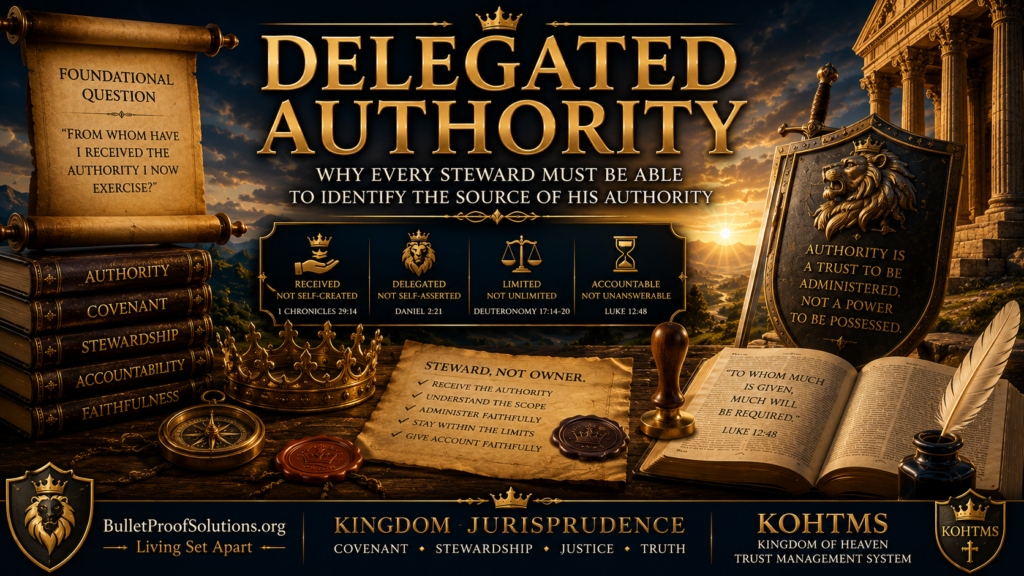
From whom have I received the authority I now exercise?
The lawful right and corresponding responsibility to administer according to the governing covenant.
Authority entrusted by one possessing rightful authority to another for a defined purpose, within established limits, and subject to accountability.
One entrusted to faithfully administer property, responsibilities, relationships, or authority belonging to another.
The obligation to give an account to the one from whom authority has been been received.
The faithful management and execution of responsibilities according to the governing covenant.
One of the greatest misunderstandings concerning authority is the belief that authority originates within the person exercising it.
Kingdom Jurisprudence rejects this proposition.
Authority is never self-created.
It is received.
Entrusted.
Delegated.
Every steward exercises authority because another has first entrusted that authority to him.
This single principle explains why faithful administration always requires humility.
The steward remembers that authority is not personal property.
Authority is a trust.
It is received for a purpose.
It is exercised within limits.
It remains accountable to its source.
To forget these truths is to misunderstand stewardship itself.
The faithful steward never creates authority. He receives it through covenant, administers it within its lawful limits, and faithfully gives an account to the One who entrusted it.
Delegated authority is one of the most consistent patterns found throughout Scripture.
Nothing entrusted is self-originating.
Parents receive responsibility for children.
Judges receive causes to hear.
Kings receive kingdoms.
Prophets receive messages.
Priests receive ministry.
Trustees receive trusts.
Stewards receive property to administer.
Messengers receive instructions to deliver.
Every office points beyond itself.
The office never becomes the source.
The office reveals the source.
Every delegation contains boundaries.
The one who delegates authority determines:
Its purpose.
Its duration.
Its limits.
Its responsibilities.
Its accountability.
The steward therefore cannot expand his authority merely because he possesses it.
Faithful administration requires remaining within the scope of what has actually been entrusted.
Whenever delegated authority exceeds its purpose, faithful stewardship begins to fail.
The Kingdom consistently presents authority as a responsibility rather than a privilege.
The steward receives authority to preserve.
To protect.
To administer.
To provide.
To teach.
To reconcile.
To restore.
Authority therefore exists for the benefit of those entrusted to the steward’s care.
It is never an end in itself.
The faithful steward measures success not by how much authority he possesses but by how faithfully he serves.
Delegated authority is representative authority.
The steward acts on behalf of another.
The ambassador represents the king.
The trustee represents the trust.
The messenger represents the sender.
The servant represents the master.
The representative does not replace the one represented.
He reflects him.
This principle preserves humility.
The steward never forgets that he serves another’s purpose rather than his own.
Every delegation carries with it an accounting.
The steward will answer for the manner in which authority has been exercised.
The greater the authority entrusted…
The greater the responsibility to administer faithfully.
Without accountability…
Authority quickly becomes self-serving.
With accountability…
Authority remains connected to its purpose.
Kingdom Jurisprudence therefore joins authority and accountability together as inseparable principles.
One of the first responsibilities of every faithful steward is identifying the source of the authority he intends to exercise.
Before administering…
Before directing…
Before judging…
Before correcting…
Before acting…
The steward asks:
Who entrusted this authority?
What covenant governs it?
What responsibilities accompany it?
What limits define it?
To whom must I ultimately give account?
These questions protect both the steward and those affected by his administration.
Order does not arise from force.
It arises from faithful administration.
When each steward understands:
His authority.
His responsibility.
His accountability.
His purpose.
Harmony becomes possible.
Families flourish.
Communities strengthen.
Trusts endure.
Inheritance is preserved.
Delegated authority is therefore one of the Creator’s instruments for establishing order without abandoning personal responsibility.
Throughout Scripture, delegated authority consistently follows the same pattern.
The King delegates.
The steward receives.
The steward administers faithfully.
The steward gives an account.
The King judges faithfulness.
This pattern appears in the Garden.
It appears in the patriarchs.
It appears under Moses.
It appears among the judges.
It appears under the kings.
It appears throughout the teachings of Messiah.
It appears within the assemblies.
It appears in every faithful stewardship.
Kingdom Jurisprudence recognizes this pattern as foundational.
Many misunderstand authority because they separate it from stewardship.
Some pursue authority.
Others resist authority.
The faithful steward does neither.
He receives authority with humility.
Exercises it with wisdom.
Limits it according to covenant.
Administers it faithfully.
Returns glory to the One who entrusted it.
Authority becomes sacred because it belongs to another.
The steward merely administers it.
Delegated authority is one of the defining principles of Kingdom Jurisprudence.
No faithful steward creates authority.
Every faithful steward receives authority through covenant.
The source establishes the purpose.
The purpose defines the limits.
The limits preserve justice.
Justice protects stewardship.
Stewardship preserves inheritance.
The faithful steward therefore continually remembers:
Authority is never mine.
It has been entrusted to me.
I must administer it faithfully.
And one day…
I must give an account.
Kingdom Jurisprudence is not merely studied—it is practiced through faithful stewardship.
Consider every area in which you currently exercise authority.
Ask yourself:
Prepare a Delegated Authority Inventory.
For every position of stewardship you hold, identify:
Review this inventory regularly as a reminder that authority is a sacred trust to be administered faithfully rather than a possession to be exercised for personal benefit.
Kingdom Jurisprudence (Coming Soon)
Develop a comprehensive understanding of covenant, authority, stewardship, administration, justice, inheritance, and faithful governance from Genesis through Revelation.
The Source of Authority and Faithful Stewardship (Coming Soon)
Explore the foundational principles of delegated authority, representative capacity, covenant, and stewardship in an in-depth teaching designed to equip Kingdom stewards for faithful administration.
Next Article
The Trust Res: Why Every Administration Begins With an Entrusted Subject Matter
I acknowledge that all authority belongs to the King.
I accept that every stewardship entrusted to me carries both responsibility and accountability.
I will seek wisdom before exercising authority.
I will faithfully administer what has been entrusted to my care.
I will exercise authority with humility, justice, mercy, and truth.
I will remember that every stewardship requires an accounting before the One who entrusted it.
May every decision honor the King and advance His Kingdom.
“Well done, good and faithful servant.”