
Category
Kingdom Jurisprudence
Reading Time
Approximately 22–25 minutes
Supports Learning Path
Kingdom Jurisprudence → Trust Estate Foundations
Featured Course
Establishing Your Trust Estate
Related Course
From Public to Private – Mastering Trust Estate Administration
Key Topics
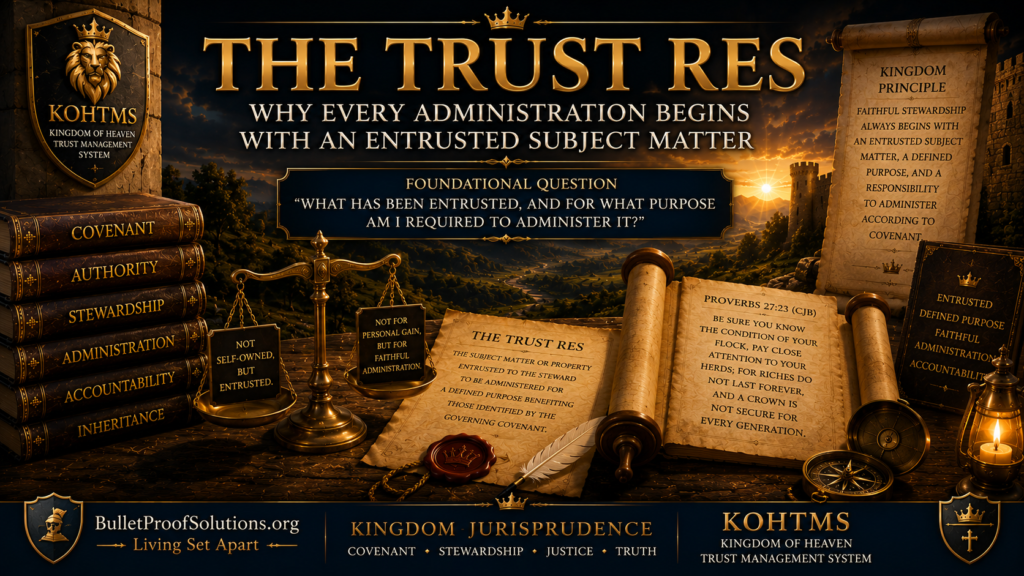
What has been entrusted, and for what purpose am I required to administer it?
A fiduciary relationship in which one party holds and administers identified property or responsibilities for the benefit of another according to the governing terms established by the creator of the trust.
The property, rights, responsibilities, relationships, interests, or subject matter that have been entrusted to the administration of the trustee.
The identifiable thing over which administration is exercised.
The steward entrusted with the faithful administration of the trust res according to the governing covenant or trust instrument.
The faithful management, preservation, protection, and distribution of the trust res according to its governing purpose.
Every administration begins with something entrusted.
There can be no stewardship without something to steward.
There can be no trusteeship without something to administer.
There can be no inheritance without something capable of being inherited.
This simple principle is often overlooked.
Many discussions concerning trusts focus immediately upon trustees, beneficiaries, documentation, or legal instruments.
Kingdom Jurisprudence begins earlier.
It first asks:
“What has been entrusted?”
Until that question is answered, faithful administration cannot begin.
The trust res is the heart of every trust.
It gives purpose to administration.
It defines the steward’s responsibilities.
It identifies what must be preserved for those entitled to benefit from faithful stewardship.
Faithful stewardship always begins with an entrusted subject matter. The steward does not administer ideas in the abstract, but that which has been specifically entrusted to his care according to the governing covenant.
Every trust exists for a purpose.
That purpose cannot be fulfilled without an identifiable res.
The res may consist of land.
Livestock.
Businesses.
Tools.
Gold and silver.
Intellectual property.
Contract rights.
Family records.
Knowledge.
Responsibilities.
Relationships.
Future inheritances.
The form may differ.
The principle does not.
The trustee administers what has actually been entrusted.
Without an identifiable res…
Administration becomes impossible.
The steward’s responsibilities are determined by what has been entrusted.
A shepherd administers a flock.
A vineyard keeper administers a vineyard.
A trustee administers trust property.
Parents administer the care of children entrusted to them.
Kings administer kingdoms.
Every stewardship is defined by its res.
The subject matter determines the nature of faithful administration.
The steward therefore begins by carefully identifying what has actually been entrusted.
Throughout Scripture, the Creator continually entrusts identifiable responsibilities.
Adam received the Garden.
Noah received the Ark.
Israel received the Land.
The Levites received service within the Tabernacle.
The disciples received the proclamation of the Kingdom.
Each stewardship involved an identifiable subject matter.
Each required faithful administration.
Each carried accountability.
The pattern never changes.
Entrustment precedes administration.
Many people think only of physical assets.
Kingdom stewardship is broader.
A trust may include:
Property.
Businesses.
Family enterprises.
Knowledge.
Skills.
Records.
Covenant responsibilities.
Ministry.
Community resources.
Future inheritances.
Reputation.
Goodwill.
Relationships requiring faithful care.
The faithful steward recognizes that not everything of value can be measured financially.
Some of the greatest inheritances are preserved through wisdom, instruction, and faithful example.
One of the trustee’s first responsibilities is preservation.
What has been entrusted should not be wasted through neglect.
Consumed through selfishness.
Or abandoned through indifference.
The steward preserves.
Improves where appropriate.
Protects.
Maintains.
Documents.
Accounts.
Only then can faithful distribution occur according to the governing purpose.
Because the res belongs to another, every steward will eventually give an account concerning its administration.
Questions naturally arise.
Was it preserved?
Was it protected?
Was it increased where appropriate?
Was it faithfully administered according to its purpose?
Was it transferred to the proper beneficiaries?
The existence of the res creates accountability.
Without something entrusted…
No accounting could ever be required.
The Kingdom consistently follows the same sequence.
The King possesses.
The King entrusts.
The steward receives.
The steward administers.
The steward gives account.
The inheritance continues.
Everything begins with something entrusted.
The trust res therefore becomes one of the foundational principles of Kingdom Jurisprudence.
Many people immediately ask:
“Who is the trustee?”
Kingdom Jurisprudence first asks:
“What has been entrusted?”
Because without an entrusted subject matter…
There can be no trustee.
No administration.
No accounting.
No inheritance.
Understanding the res transforms the way the faithful steward views every responsibility.
Life itself becomes a stewardship.
Time becomes a stewardship.
Family becomes a stewardship.
Knowledge becomes a stewardship.
Resources become a stewardship.
Everything entrusted becomes part of the steward’s account before the King.
Every faithful administration begins with an entrusted subject matter.
The trust res gives purpose to the trust.
It defines the steward’s duties.
It establishes accountability.
It preserves inheritance.
It connects administration to covenant.
The faithful steward therefore begins every administration by carefully identifying what has been entrusted.
Only then can that stewardship be faithfully preserved for the benefit of present and future generations.
Kingdom stewardship begins by knowing exactly what has been entrusted to your care.
Ask yourself:
Prepare a Trust Res Inventory.
List every asset, responsibility, relationship, and inheritance entrusted to your administration.
Include:
For each item, ask:
A faithful inventory is often the first step toward faithful administration.
Establishing Your Trust Estate
Learn how to identify, inventory, and structure the trust res as the foundation of faithful stewardship and long-term preservation.
From Public to Private – Mastering Trust Estate Administration
Explore practical methods for administering trust property, maintaining records, fulfilling fiduciary responsibilities, and preserving the trust estate for future generations.
Building a Trust Estate That Lasts
Discover practical strategies for identifying, documenting, and preserving the trust res through faithful stewardship.
Next Article
Ownership Versus Stewardship: Why Nothing Truly Belongs to Man
I acknowledge that everything belongs to the Father.
I accept that I am a steward and not an owner.
I will carefully identify what has been entrusted to my care.
I will preserve, protect, and faithfully administer the trust res according to its purpose.
I will remember that every stewardship requires an accounting.
May my administration strengthen the inheritance of future generations and honor the King who entrusted it to me.
“Well done, good and faithful servant.”