
Category
Kingdom Jurisprudence
Reading Time
Approximately 22–25 minutes
Supports Learning Path
Kingdom Jurisprudence → Trust Estate Foundations → Kingdom Economics
Featured Course
Establishing Your Trust Estate
Related Courses
Key Topics
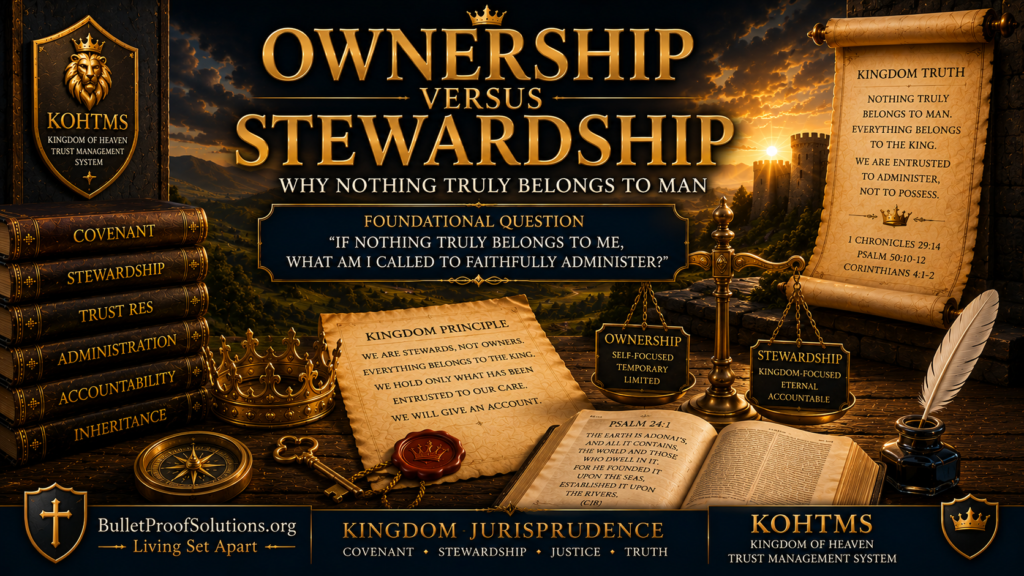
If nothing truly belongs to me, what has the King entrusted me to faithfully administer?
One possessing the ultimate and complete right to possess, control, use, transfer, or dispose of property without answering to a higher earthly owner.
One entrusted to administer property, authority, responsibilities, or relationships belonging to another according to the purposes established by the one who entrusted them.
Delegated authority to exercise faithful oversight and administration according to the will of the One who delegated that authority.
That which is entrusted to future generations for continued faithful stewardship.
The obligation of every steward to render an account concerning what has been entrusted.
One of the greatest questions in all jurisprudence is not:
“What do I own?”
It is:
“What has been entrusted to me?”
These questions appear similar.
They are not.
One begins with possession.
The other begins with responsibility.
One asks what may be claimed.
The other asks what must be faithfully administered.
Kingdom Jurisprudence consistently teaches that faithful stewardship begins when the steward understands that everything under his administration has first been entrusted by another.
The steward’s responsibility is therefore not merely to possess.
It is to preserve.
To cultivate.
To protect.
To administer faithfully according to the purposes of the King.
The Kingdom does not begin with ownership. It begins with stewardship. Everything belongs to the King. Every steward administers only that which has been entrusted to his care and will one day give an account for its administration.
The opening chapters of Scripture establish one of the most important principles in Kingdom Jurisprudence.
The heavens.
The earth.
The seas.
The creatures.
The Garden.
All existed before mankind was created.
The Creator possessed before man received.
Only after creation was complete did mankind receive the responsibility to exercise dominion.
Notice what was not transferred.
Ownership.
What was entrusted was administration.
This distinction changes the entire understanding of stewardship.
The steward governs.
The King owns.
Possession alone proves little.
A steward may possess keys to a house.
That does not make him the owner.
A trustee administers trust property.
That does not make the trustee the beneficial owner.
Parents care for children.
Children are not property.
Judges administer justice.
Justice is not their personal possession.
The faithful steward therefore never mistakes administration for ownership.
He recognizes that authority has been entrusted for service rather than personal dominion.
The command to exercise dominion is often misunderstood.
Dominion does not authorize exploitation.
It does not grant arbitrary control.
It does not remove accountability.
Dominion is delegated stewardship.
It requires cultivation.
Protection.
Preservation.
Faithful administration.
Everything entrusted must ultimately reflect the wisdom and character of the One who entrusted it.
These two mindsets produce entirely different lives.
The owner asks:
“What belongs to me?”
The steward asks:
“What has been entrusted to my care?”
The owner seeks personal advantage.
The steward seeks faithful administration.
The owner measures success by accumulation.
The steward measures success by faithfulness.
The owner eventually leaves everything behind.
The faithful steward leaves behind an inheritance strengthened through faithful administration.
Once the steward understands this principle, every area of life changes.
Time becomes a trust.
Marriage becomes a trust.
Children become a trust.
Knowledge becomes a trust.
Businesses become a trust.
Communities become a trust.
Resources become a trust.
Influence becomes a trust.
Authority becomes a trust.
Even life itself becomes a sacred stewardship entrusted by the King.
Nothing is viewed merely as possession.
Everything becomes administration.
Owners often think in terms of personal enjoyment.
Stewards think in terms of future generations.
The faithful steward continually asks:
How will this decision affect those who follow after me?
Will this stewardship leave the inheritance stronger?
Have I preserved what was entrusted?
Have I prepared successors?
Stewardship naturally produces continuity because the steward understands he himself is temporary.
The King’s purposes continue beyond any single generation.
The condition of the trust res often reflects the character of the steward.
Neglected property.
Broken relationships.
Disorganized records.
Unresolved responsibilities.
Waste.
Confusion.
These often reveal failures of administration rather than failures of resources.
Likewise, well-maintained property.
Faithful records.
Prepared successors.
Peaceful relationships.
Healthy communities.
Orderly administration.
These testify to faithful stewardship.
Administration reveals character.
Throughout Scripture the pattern remains remarkably consistent.
The King owns.
The King entrusts.
The steward receives.
The steward administers.
The steward gives account.
The inheritance continues.
Nothing in this pattern suggests that faithful stewardship ends with personal possession.
Everything points toward faithful administration on behalf of the King.
Much confusion concerning law, commerce, trusts, inheritance, and government disappears when ownership is distinguished from stewardship.
The steward ceases asking,
“What can I claim?”
He begins asking,
“What must I faithfully preserve?”
This shift transforms every area of administration.
Family.
Business.
Trusts.
Community.
Inheritance.
Leadership.
Justice.
All become expressions of faithful stewardship rather than exercises of personal control.
Kingdom Jurisprudence teaches that stewardship is greater than ownership because stewardship reflects the character of the King.
The faithful steward recognizes that everything under his care has first been entrusted.
Nothing is administered for selfish gain.
Everything is administered for faithful preservation.
The steward therefore lives with humility.
Exercises authority with wisdom.
Protects what has been entrusted.
Prepares future generations.
And remembers that every stewardship will one day require an accounting before the King who entrusted it.
Stewardship begins by recognizing that every blessing carries responsibility.
Take time this week to consider the areas of your life that you commonly think of as “mine.”
Ask yourself:
Prepare a Kingdom Stewardship Inventory.
Create categories for:
For each category answer:
Allow this inventory to become an annual review of your stewardship before the King.
Establishing Your Trust Estate
Discover how to structure, inventory, preserve, and faithfully administer the stewardships entrusted to your care.
Becoming a High-Caliber Trustee
Develop the character, discipline, and administrative habits required of faithful trustees.
Private Commerce & Kingdom Stewardship (Coming Soon)
Learn how Kingdom principles of stewardship shape commerce, exchange, and long-term generational provision.
The Stewardship Mindset: Building an Inheritance That Lasts
Explore the practical transition from an ownership mentality to faithful Kingdom stewardship.
Next Article
Representative Capacity: Acting on Behalf of Another
I acknowledge that everything belongs to the King.
I accept every blessing as a stewardship rather than a possession.
I will faithfully preserve what has been entrusted to my care.
I will administer with humility, wisdom, justice, and love.
I will prepare future generations to continue faithful stewardship.
I will remember that I am a steward who will one day give an account before the King.
May every decision strengthen the inheritance and honor the One from whom every good gift comes.
“Well done, good and faithful servant.”