
Category: Kingdom Jurisprudence
Reading Time: 18–22 Minutes
Learning Path: Kingdom Jurisprudence Foundations
Featured Course: Kingdom Jurisprudence I – Authority, Covenant & Stewardship (Coming Soon)
Key Topics
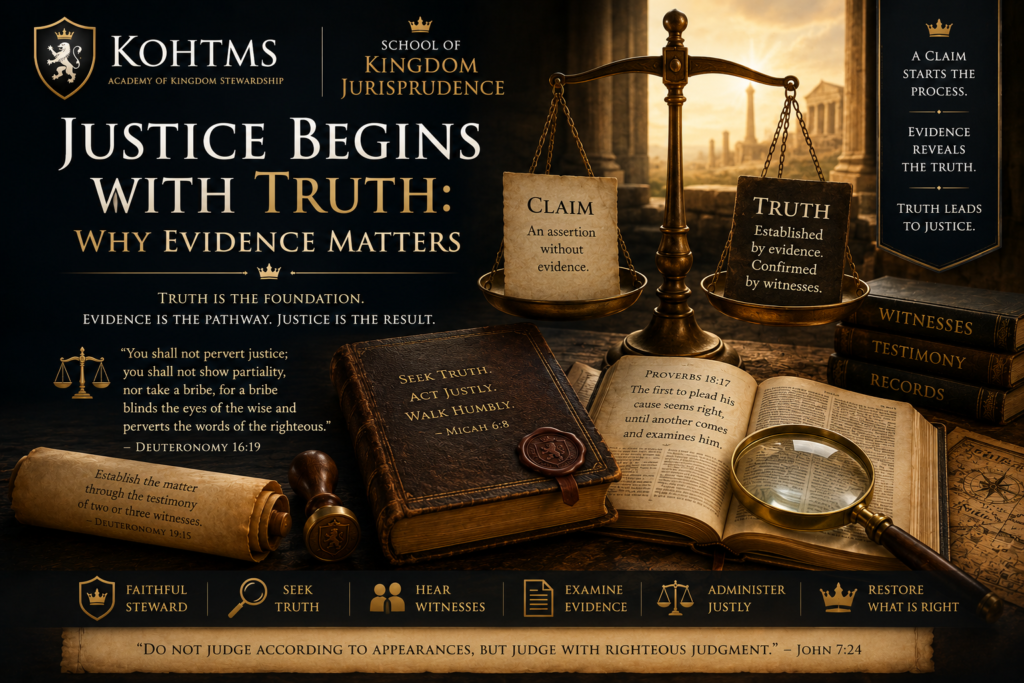
Every administration begins with a claim.
Yet a claim alone cannot establish truth.
Claims may be true.
Claims may be mistaken.
Claims may be incomplete.
Claims may even conflict with one another.
For this reason, faithful administration cannot rest upon assertions alone.
Justice requires something more.
It requires truth.
Truth is not established by the number of voices that repeat a claim.
Nor is truth determined by position, influence, or authority alone.
Faithful administration seeks that which corresponds to reality.
Therefore, every steward must learn to distinguish between what is merely asserted and what has been established.
Justice begins with truth.
Throughout Scripture, justice is never separated from truth.
Where truth is ignored, justice becomes partial.
Where truth is distorted, judgment becomes corrupt.
Where truth is hidden, faithful administration becomes impossible.
A steward cannot administer what he has not first understood.
Therefore, truth is not merely desirable.
It is indispensable.
Justice without truth is not justice at all.
Every claim presents a question.
The steward must not confuse the making of a claim with the establishment of its truth.
Instead, faithful administration asks:
Questions are not obstacles to justice.
They are the pathway to it.
Evidence is that which assists the faithful steward in discerning the truth concerning a matter.
Evidence may consist of:
Not all evidence carries equal weight.
Nor does every piece of evidence answer every question.
Faithful stewardship requires the careful consideration of the whole matter rather than isolated fragments.
Scripture repeatedly demonstrates that numbers alone do not establish truth.
Many voices may agree and still be mistaken.
One faithful witness may stand against a multitude.
The steward therefore resists the temptation to substitute popularity for truth.
Truth remains truth regardless of how many affirm or deny it.
Faithful administration seeks what is true rather than what is merely accepted.
A faithful steward does not begin by deciding who should prevail.
Neither favoritism nor prejudice belongs within faithful administration.
Instead, the steward approaches every matter with humility.
Listening before speaking.
Learning before concluding.
Examining before deciding.
Impartiality protects both the integrity of the steward and the confidence of those entrusted to his administration.
Immediate conclusions frequently become lasting errors.
Scripture repeatedly demonstrates that wisdom is patient.
Questions may require time.
Evidence may require gathering.
Witnesses may require hearing.
Records may require examination.
Faithful stewardship is rarely hurried.
The steward who values truth learns the discipline of patience.
Evidence is not gathered merely to support one’s preferred conclusion.
Its purpose is to reveal reality.
The faithful steward therefore remains willing to adjust his understanding whenever the evidence demonstrates that his earlier assumptions were incomplete.
Humility and truth walk together.
Pride and partiality often walk together as well.
Faithful administration chooses humility.
Truth protects the claimant.
Truth protects the one responding to the claim.
Truth protects the steward.
Truth protects the community.
When faithful administration pursues truth above preference, confidence grows.
Relationships are strengthened.
Justice becomes trustworthy.
For this reason, truth serves every party involved in the administration.
The purpose of discovering truth is not merely to assign blame.
Truth reveals reality so that faithful stewardship may pursue what is right.
Where restoration is possible, truth points the way.
Where correction is necessary, truth identifies it.
Where responsibility exists, truth reveals it.
Thus, truth serves restoration rather than mere accusation.
Claims begin administration.
Truth guides administration.
Justice depends upon administration that faithfully seeks truth before reaching conclusions.
The steward who pursues truth with patience, humility, and impartiality becomes a trustworthy administrator of the matters entrusted to his care.
Justice begins with truth because faithful stewardship begins with understanding reality.
Before reaching a conclusion concerning any matter entrusted to your care, ask yourself:
Choose a recent disagreement or administrative decision.
Without deciding who should prevail, create two separate lists:
Claims Made
Evidence Available
Notice how often these become confused.
Practice separating assertions from established facts before reaching conclusions.
This discipline develops wisdom and strengthens faithful administration.
Kingdom Jurisprudence I: Authority, Covenant & Stewardship (Coming Soon)
The Foundations of Kingdom Jurisprudence (Coming Soon)
The Burden of Establishing a Claim: Responsibility Before Judgment