
Category: Kingdom Jurisprudence
Reading Time: 18–22 Minutes
Learning Path: Kingdom Jurisprudence Foundations
Featured Course: Kingdom Jurisprudence I – Authority, Covenant & Stewardship (Coming Soon)
Every administration begins with a claim.
Every claim invites examination.
Every examination seeks truth.
Truth is established through faithful consideration of what has been presented.
Among the greatest gifts God has provided for faithful administration is the witness.
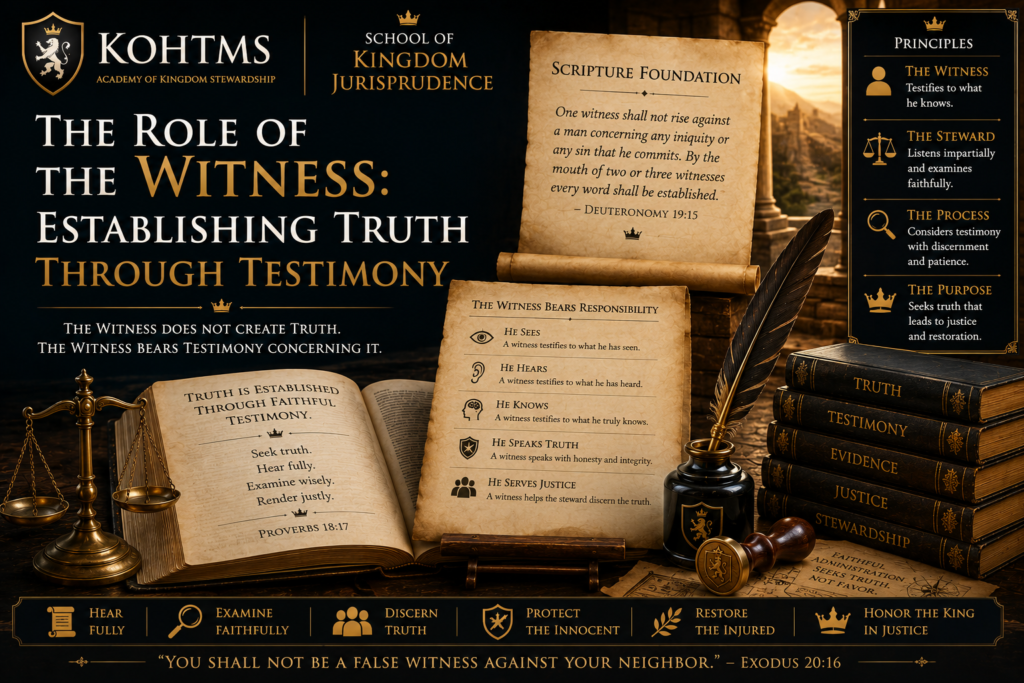
A witness does not create truth.
A witness bears testimony concerning what he has seen, heard, or faithfully knows.
The steward therefore does not ask merely,
“Who is speaking?”
He asks,
“To what does the witness bear testimony?”
Kingdom Jurisprudence recognizes that testimony is one of the principal means by which truth becomes known within faithful administration.
A witness is one who bears testimony concerning a matter.
A witness is not called to speculation.
Neither is he called to advocate for one side or another.
His calling is much simpler.
To testify faithfully.
A witness speaks concerning what he knows.
Not what he imagines.
Not what he assumes.
Not what he desires.
Faithful testimony serves truth rather than preference.
The purpose of testimony is not to win an argument.
Nor is it to strengthen personalities.
Its purpose is to assist faithful administration in discerning reality.
For this reason testimony belongs to justice.
The steward receives testimony with careful attention because every truthful witness contributes toward understanding the matter entrusted to him.
Truth remains the objective.
Never merely agreement.
Throughout Scripture, important matters are repeatedly established through witnesses.
This principle reflects God’s concern that important decisions not rest upon mere accusation or unsupported assertion.
Faithful administration values corroboration.
It seeks confirmation where confirmation is appropriate.
This protects both the innocent and the injured.
Order protects justice.
Just as the claimant bears responsibility for the claim…
The witness bears responsibility for his testimony.
To testify falsely is to corrupt administration.
To exaggerate is to distort understanding.
To conceal truth is to hinder justice.
The faithful witness therefore recognizes that testimony itself is a stewardship.
Words possess consequence.
Receiving testimony does not eliminate discernment.
The steward still asks:
Faithful stewardship requires thoughtful examination.
Not suspicion.
Not naïveté.
But discernment.
Although truth ultimately stands upon reality rather than personality, the steward also recognizes that credibility matters.
A witness known for honesty strengthens confidence.
A witness known for inconsistency invites careful examination.
Character does not replace evidence.
Neither is it irrelevant.
Faithful administration considers the whole matter.
Sometimes a single witness provides clarity.
Sometimes several witnesses together reveal a fuller picture.
Each witness may observe different aspects of the same matter.
Together they help the steward understand what no single perspective could fully reveal.
This is why faithful administration welcomes careful examination from more than one perspective when appropriate.
The purpose is not multiplication of opinions.
It is fuller understanding.
False testimony does not merely injure another person.
It damages justice itself.
It burdens the steward.
It misleads the community.
It hinders restoration.
For this reason Scripture consistently treats truthful testimony as a sacred responsibility.
Faithful administration cannot flourish where testimony cannot be trusted.
Listening is itself a discipline.
Many hear words.
Few truly listen.
The faithful steward listens carefully.
Patiently.
Without interruption.
Without prejudice.
Without predetermined conclusions.
Only after listening well can testimony be weighed wisely.
Listening is one of the steward’s greatest responsibilities.
The goal of testimony is not condemnation.
It is faithful understanding.
When truth is established, restoration becomes possible.
Responsibilities become clearer.
Relationships may be repaired.
Wrongdoing may be corrected.
Faithful stewardship therefore values testimony because it serves restoration through truth.
The witness serves neither accusation nor defense.
The witness serves truth.
Faithful testimony strengthens faithful administration.
Faithful administration strengthens justice.
Justice strengthens peace within the community.
The steward who learns to receive testimony wisely becomes better prepared to administer faithfully according to truth rather than assumption.
Consider the conversations and decisions entrusted to your care.
Ask yourself:
Think of a recent disagreement or administrative matter.
Write down:
This exercise develops the habit of discerning testimony rather than merely collecting opinions.
Kingdom Jurisprudence I: Authority, Covenant & Stewardship (Coming Soon)
The Foundations of Kingdom Jurisprudence (Coming Soon)
Law, Equity, and Covenant: Three Ways of Understanding Justice