
Category: Kingdom Jurisprudence
Reading Time: 22–28 Minutes
Learning Path: Kingdom Jurisprudence Foundations
Featured Course: Kingdom Jurisprudence I – Authority, Covenant & Stewardship (Coming Soon)
The purpose of Kingdom Jurisprudence has never been merely to study law.
Nor has it been simply to understand authority.
Neither has it been merely to learn principles of justice.
Every lesson has pointed toward a single calling.
Faithful administration.
The King governs His Kingdom.
The steward administers what has been entrusted to his care.
This distinction is the foundation of every faithful administration.
The steward does not invent truth.
He administers it.
He does not establish righteousness.
He walks in it.
He does not own the Kingdom.
He serves the King.
Kingdom Jurisprudence therefore reaches its highest expression not in knowledge alone, but in faithful stewardship.
Our journey began with authority.
We discovered that authority originates with the King.
No steward creates authority.
None possesses authority independently.
Every stewardship begins with delegation.
Every responsibility begins with trust.
Everything entrusted remains the King’s.
This truth humbles every faithful steward.
Nothing entrusted remains without responsibility.
Time.
Property.
Knowledge.
Relationships.
Families.
Communities.
Resources.
Influence.
Every stewardship carries administration with it.
The steward is never merely a possessor.
He is always an administrator.
Scripture consistently measures stewards by faithfulness.
Not brilliance.
Not influence.
Not popularity.
Not position.
The question asked by the King is never,
“How important were you?”
The question is,
“Were you faithful with what I entrusted to you?”
Faithfulness transforms ordinary stewardship into Kingdom administration.
Faithful administration is not merely organizational.
It is worship.
Every decision becomes an opportunity to honor the King.
Every judgment reflects His character.
Every act of mercy displays His compassion.
Every faithful account acknowledges His ownership.
Administration therefore becomes one expression of covenant faithfulness.
The steward serves through the manner in which he administers.
Throughout this learning path we have seen that faithful administration depends upon truth.
Claims must be understood.
Evidence must be examined.
Witnesses must be heard.
Responsibilities must be identified.
Justice must be administered.
Truth governs every step.
Without truth, stewardship becomes preference.
Without truth, justice becomes partiality.
Without truth, administration loses its foundation.
Truth alone does not complete faithful administration.
The steward must also possess wisdom.
Wisdom knows:
When to speak.
When to listen.
When to correct.
When to restore.
When to wait.
When to act.
Law provides standards.
Equity provides discernment.
Covenant preserves faithfulness.
Wisdom brings them together.
Stewardship always includes accountability.
The steward answers for what has been entrusted.
Not merely for the outcome.
But for the faithfulness of the administration itself.
This accountability is not intended to create fear.
It creates diligence.
The steward remembers continually:
Nothing entrusted belongs ultimately to me.
Everything belongs to the King.
Kingdom administration does not exist merely to punish wrongdoing.
Its greater purpose is restoration.
To restore truth.
To restore justice.
To restore faithfulness.
To restore relationships whenever righteousness permits.
Justice without restoration remains incomplete whenever restoration is possible.
The faithful steward continually seeks the King’s redemptive purposes.
The steward’s administration becomes a visible testimony.
Others learn about the King through the steward’s conduct.
When administration is truthful…
The King’s righteousness becomes visible.
When administration is impartial…
The King’s justice becomes visible.
When administration is merciful…
The King’s compassion becomes visible.
When administration is faithful…
The King’s Kingdom becomes visible.
Stewardship therefore becomes a witness.
This learning path began with one question.
By what authority do you act?
It concludes with another.
How faithfully have you administered what has been entrusted to you?
These two questions define Kingdom Jurisprudence.
Authority without faithful administration becomes tyranny.
Administration without authority becomes presumption.
Faithful stewardship unites both.
Kingdom Jurisprudence is ultimately the study of faithful administration under the authority of the King.
Every principle we have examined—
Authority.
Delegated Authority.
The Trust Res.
Representative Capacity.
Quo Warranto.
Claims.
Evidence.
Witnesses.
Law.
Equity.
Covenant.
Responsibility.
Justice.
All converge upon one calling.
To become a faithful steward.
The steward who understands these principles yet fails to administer faithfully has missed their purpose.
The steward who faithfully administers what the King has entrusted reflects the government of Heaven in every sphere of responsibility.
This is the highest duty of every Kingdom steward.
Take inventory of every area currently entrusted to your care.
For each one, ask:
Create a personal Stewardship Covenant.
List the responsibilities entrusted to you and write a commitment for each one describing how you intend to administer it faithfully according to the King’s standards.
Review this covenant regularly as a reminder that stewardship is an ongoing calling rather than a one-time achievement.
Kingdom Jurisprudence I: Authority, Covenant & Stewardship (Coming Soon)
The Foundations of Kingdom Jurisprudence (Coming Soon)
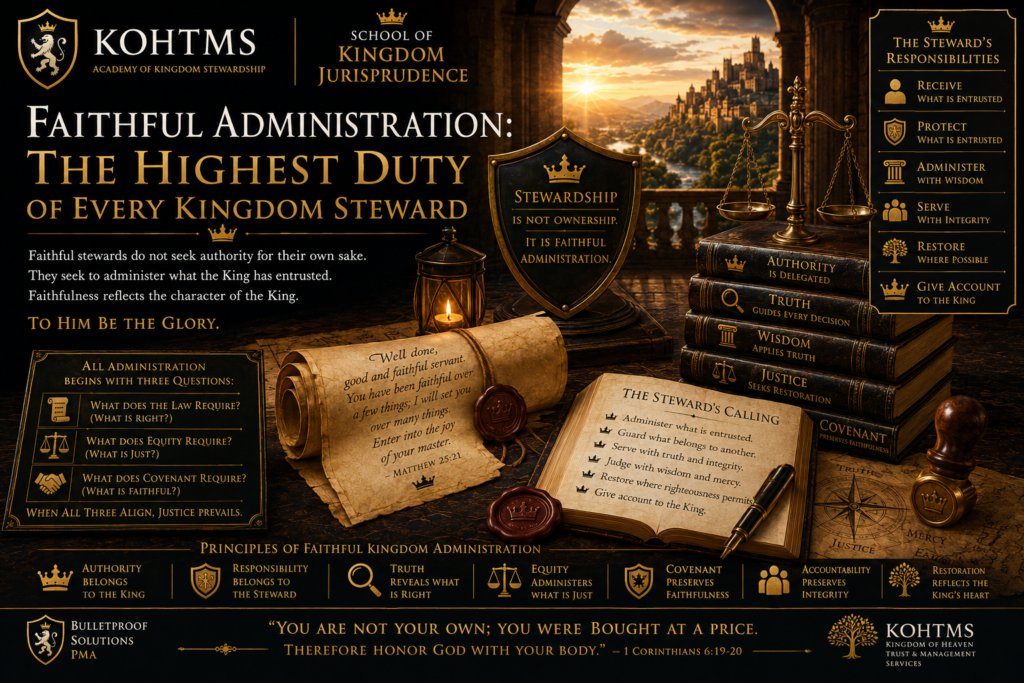
The faithful steward does not seek authority for its own sake.
He seeks to administer faithfully what the King has entrusted to him.
For in the Kingdom, greatness is not measured by dominion over others, but by faithfulness to the One who entrusted all things into our care.