
Category: Trust Estate Foundations
Reading Time: 20–25 Minutes
Learning Path: Trust Estate Foundations
Featured Course: Mastering Trust Estate Administration (Coming Soon)
Faithful stewardship requires more than creating trusts.
It requires understanding how property, responsibilities, agreements, and beneficial interests move through the trust estate from the moment they are received until they reach their proper place of administration.
Many people think of a pass-through trust as merely another trust within a larger structure.
Its purpose is much greater.
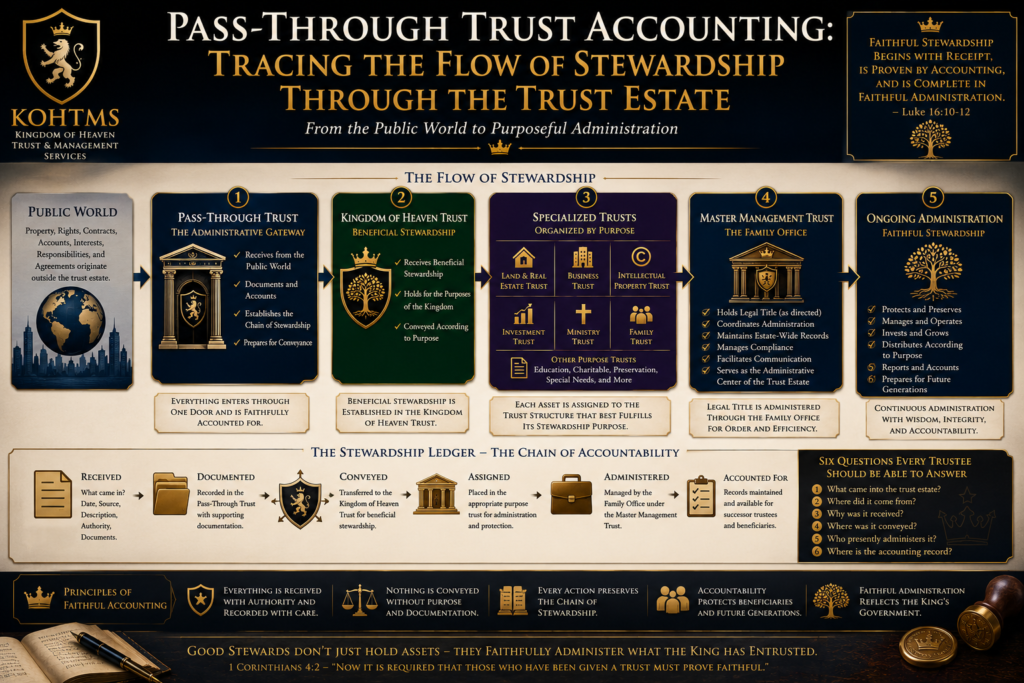
The Pass-Through Trust serves as the administrative gateway into the trust estate.
It receives.
It documents.
It accounts.
It conveys.
It creates the chain of stewardship that allows every subsequent administration to be traced with clarity and integrity.
Faithful accounting is therefore not merely recording numbers.
It is preserving the history of faithful administration.
The Pass-Through Trust is not intended to become the permanent home of every asset.
Its primary responsibility is administrative.
It receives property, rights, agreements, responsibilities, and other interests that originate outside the trust estate.
Once received, the trustee determines the proper destination according to the purpose for which each item will be administered.
The Pass-Through Trust functions much like the receiving department of a well-organized estate.
Nothing enters unnoticed.
Nothing enters undocumented.
Nothing proceeds further until it has been faithfully accounted for.
Order begins with consistency.
Rather than conveying assets directly into numerous trusts, faithful administration benefits from receiving everything through a single administrative gateway.
Whether the trust estate receives:
each first enters the Pass-Through Trust.
This creates one continuous accounting record from the moment stewardship begins.
Whenever something enters the trust estate, the trustee should establish an administrative record.
That record should answer fundamental questions:
These questions establish the beginning of the chain of stewardship.
After receipt and documentation, administration continues.
The Pass-Through Trust does not ordinarily retain beneficial stewardship.
Instead, the property is conveyed into the Kingdom of Heaven Trust.
Within the trust estate architecture, the Kingdom of Heaven Trust serves as the central trust through which beneficial stewardship is recognized and administered.
Rather than functioning as a destination for daily administration, it serves as the foundational trust from which stewardship throughout the estate proceeds.
The Pass-Through Trust records both the receipt and the conveyance, creating a complete administrative history.
Not every asset should remain under identical administration.
Faithful stewardship recognizes that different purposes often require different trust structures.
Once conveyed into the Kingdom of Heaven Trust, property may be assigned to trusts organized according to their intended purpose.
Examples include:
Each structure exists because it fulfills a particular stewardship purpose within the larger estate.
The goal is not complexity.
The goal is faithful administration.
As the trust estate grows, administration itself requires organization.
Rather than each trust independently maintaining every aspect of legal administration, many trust estates centralize those administrative responsibilities through a Master Management Trust functioning as the Family Office.
Within this model, the Master Management Trust serves as the administrative center of the trust estate.
It coordinates:
This allows the specialized trusts to remain focused upon their individual stewardship purposes while administration remains organized and consistent.
Every movement through the trust estate should be traceable.
Faithful administration establishes a continuous chain.
Received.
Documented.
Conveyed.
Assigned.
Administered.
Accounted For.
Nothing should disappear into uncertainty.
Years later, a successor trustee should be able to reconstruct the complete administrative history from the records alone.
This continuity protects both the trust estate and every steward who serves it.
Many people hear the word “accounting” and immediately think of financial statements.
Trust accounting is broader.
It records the life of administration itself.
A faithful accounting demonstrates:
This creates confidence, continuity, and accountability throughout the trust estate.
A faithful trustee should always be able to answer six simple questions regarding every item administered through the trust estate.
If these questions can be answered clearly, the chain of stewardship has been preserved.
The Pass-Through Trust is more than an administrative convenience.
It establishes order.
It creates accountability.
It preserves continuity.
It documents stewardship.
From the moment something enters the trust estate until it reaches its proper place of administration, the Pass-Through Trust provides the accounting that allows every subsequent steward to understand the history of faithful administration.
When properly maintained, the accounting records tell the complete story of the trust estate—not merely its assets, but the stewardship through which those assets have been faithfully administered.
Review the current administration of your trust estate.
Ask yourself:
Create a Trust Estate Flow Register.
For each item entering the trust estate, record:
This register becomes the living history of the trust estate and preserves the chain of stewardship for future generations.
Mastering Trust Estate Administration (Coming Soon)
Trust Estate Architecture: Designing a Stewardship System That Lasts for Generations