
Category: Trust Estate Foundations • Kingdom Jurisprudence
Reading Time: 15–20 Minutes
Learning Path: Registration • Ownership • Authority • Stewardship
Featured Course: From Public to Private – Mastering Trust Estate Administration
Registration should be understood according to the legal relationship it creates, recognizes, or administers—not merely by the name given to the process.
Whenever property is registered, what relationship is being created, recognized, or administered?
Every day people register property without giving much thought to what the act of registration actually accomplishes.
Homes are deeded and recorded.
Motor vehicles are titled and registered.
Businesses are organized and filed.
Security interests are perfected.
Intellectual property is registered.
Professional licenses are issued.
Marriage licenses are recorded.
Births and deaths are entered into official records.
Most people see registration as little more than paperwork.
A necessary administrative task.
Something required to move forward.
Yet registration is far more than placing information into a database.
It establishes relationships.
It identifies parties.
It recognizes interests.
It creates records.
It assigns responsibilities.
It may establish priority between competing claims.
It may recognize ownership.
It may document delegated authority.
It may create ongoing duties for one or more parties.
The faithful steward therefore asks a different question than most people.
Rather than asking:
“How do I register this?”
The steward first asks:
“What relationship is created, recognized, or administered by this registration?”
Understanding that relationship is one of the most important responsibilities of anyone seeking to faithfully administer an estate.
Authority cannot be understood until the relationship creating that authority has been identified.
Every administrative relationship should be understood before property is entrusted to its care.
Registration is the formal recording or recognition of a person, property, transaction, status, or legal interest within an established administrative system.
Although registration often creates an official record, the legal consequences of registration are not identical in every circumstance.
Sometimes registration merely provides notice.
Sometimes it establishes priority.
Sometimes it documents ownership.
Sometimes it records delegated authority.
Sometimes it perfects a security interest.
Sometimes it establishes eligibility to exercise certain rights or privileges.
Sometimes it creates continuing administrative duties.
For this reason, registration should never be viewed as a single legal concept.
Instead, each registration should be examined according to the relationship created by the governing instrument and the law that applies to it.
Do not assume authority simply because a record exists.
Identify the source of the authority recognized by that record.
Do not assume administration simply because property has been registered.
Identify the offices, duties, and relationships established by the registration.
One of the most common mistakes is assuming that every registration accomplishes the same thing.
It does not.
Recording a deed differs from registering a motor vehicle.
Registering a copyright differs from perfecting a lien.
Creating a corporation differs from filing a financing statement.
Recording a marriage differs from registering a trademark.
Each transaction creates or recognizes a different legal relationship.
The wise steward therefore avoids broad assumptions.
Instead, each registration should be examined independently.
The questions remain the same, even though the answers may differ.
What was registered?
Who are the parties?
What rights were recognized?
What duties were created?
Who now administers the relationship?
Justice begins by identifying the true nature of the relationship before declaring the rights of the parties.
Every office within an administrative relationship should be identified before determining the duties owed by each party.
Whenever property becomes subject to registration, faithful stewards should ask questions before making assumptions.
Who supplied the property or interest?
Who presently possesses it?
Who maintains the official record?
Who has authority to modify that record?
Who recognizes transfers?
Who receives notice?
Who may impose conditions?
Who may restrict the use of the property?
Who may authorize services concerning it?
Who owes duties?
Who receives benefits?
Who must provide an accounting?
These questions do not presume wrongdoing.
They simply seek to identify the legal relationship that now exists.
Understanding begins with observation before conclusion.
Every claim of authority should answer the question:
“By what relationship does this authority arise?”
Every administrator should be able to identify the office occupied, the duties assumed, and the authority entrusted to that office.
This is one of the most important questions a steward can ask.
Not every registration creates a fiduciary relationship.
However, some registrations may involve fiduciary duties, administrative responsibilities, or trust-like characteristics depending upon the governing law, the instruments executed, and the nature of the transaction.
Rather than assuming either answer, the wise steward examines the relationship carefully.
If another party administers property for the benefit of another…
If duties of loyalty, care, preservation, or accounting exist…
If legal title and beneficial interests are separated…
If one party administers while another enjoys the benefit…
Then the steward should carefully determine whether fiduciary principles apply.
Labels alone do not answer these questions.
The substance of the relationship must always be examined.
Names and titles do not determine authority.
The substance of the relationship determines the duties that follow.
Whenever administration and beneficial interests are separated, the relationship deserves careful examination.
Rather than beginning with conclusions, faithful stewards begin with questions.
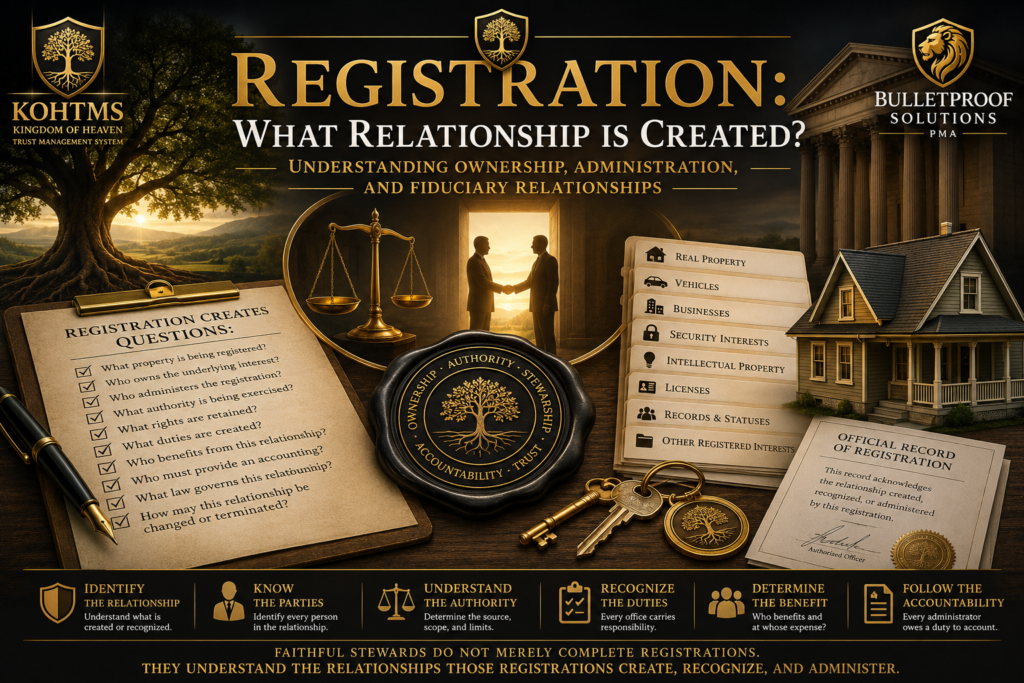
Whenever property is registered, ask:
These questions create a framework that can be applied to every registration, regardless of the subject matter.
Understanding begins by asking the right questions.
Faithful stewardship requires more than signing documents.
It requires understanding the relationships those documents create.
The wise steward studies every agreement before accepting it.
He seeks to understand every office before accepting its authority.
He identifies every duty before accepting its responsibility.
He distinguishes ownership from administration.
He distinguishes possession from beneficial interest.
He distinguishes power from authority.
Only then can he faithfully administer what has been entrusted to his care.
Select three registrations that relate to your estate, such as a vehicle title, real property deed, business filing, or another registered interest.
For each one, answer the following:
Understanding these relationships strengthens both stewardship and faithful administration.
Understanding the legal relationships created by registration is an essential step toward faithful estate administration. Continue your study in From Public to Private – Mastering Trust Estate Administration, where registration, ownership, stewardship, and fiduciary administration are explored in greater depth.
Faithful stewards do not merely complete registrations.
They understand the relationships those registrations create, recognize, and administer.