
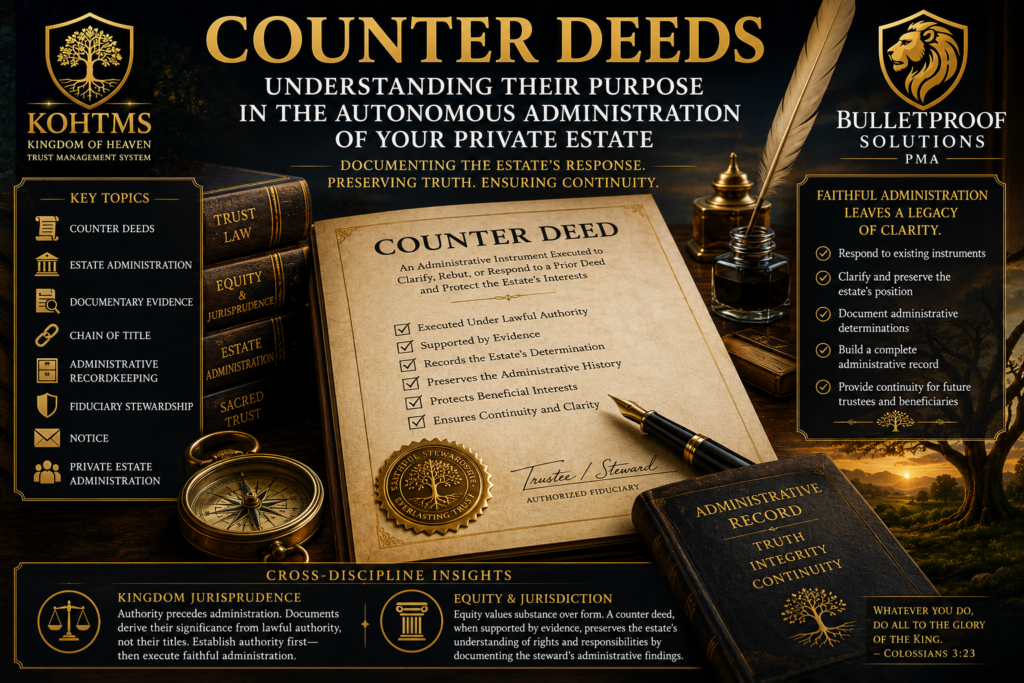
Category: Trust Estate Foundations
Cross-Discipline Connections: Kingdom Jurisprudence • Equity & Jurisdiction
Reading Time: 18–22 Minutes
Learning Path: Estate Administration → Documentary Evidence → Administrative Instruments
Featured Course: Trust Estate Administrator Mastery
Faithful administration is demonstrated not merely by decisions made, but by the complete and orderly record of those decisions.
How does a faithful steward document the estate’s response to an existing instrument affecting property or administration?
Every estate has a history.
Property is acquired.
Interests are conveyed.
Rights are transferred.
Obligations arise.
Trustees succeed one another.
Beneficiaries change.
Administrative decisions are continually made.
A faithfully administered estate preserves this history through its records.
Every significant administrative act should be capable of being traced, understood, and verified by those who later assume responsibility for the estate.
Among the documentary instruments utilized within private estate administration is the Counter Deed.
While not commonly defined within modern legal dictionaries, a counter deed has long been described within private trust administration as an administrative instrument executed to respond to an existing deed or recorded instrument affecting the estate.
Properly prepared, it becomes part of the permanent administrative history of the estate.
It records not merely an opinion, but the steward’s official administrative determination concerning an existing instrument, relationship, or property interest.
Its purpose is to preserve clarity, continuity, and accountability within the administration of the estate.
Within the Trust Estate Foundations curriculum, a Counter Deed is defined as:
A Counter Deed is an administrative instrument executed privately, often before a notary public or under private seal, for the purpose of modifying, clarifying, rebutting, revoking, or otherwise establishing the estate’s administrative position concerning a previously executed or recorded instrument. It may also document changes affecting administration, title, beneficial interests, obligations, or other legal relationships connected to the estate.
Unlike an original conveyancing deed, a counter deed generally responds to an existing instrument.
It does not exist independently.
It addresses something already affecting the estate.
It becomes part of the documentary history through which future trustees understand both the event and the estate’s response.
The title of the document alone gives it no significance.
Its value depends upon:
Administration is not static.
As an estate grows, circumstances change.
Errors may be discovered.
Relationships evolve.
Property interests are clarified.
New documentation becomes available.
Questions arise concerning prior instruments.
Rather than leaving these matters unresolved, the steward documents the estate’s official administrative determination.
A counter deed may therefore be used to:
The objective is not conflict.
The objective is faithful administration.
Autonomous administration requires trustees to actively manage—not merely possess—the records of the estate.
Every administrative decision should answer three fundamental questions:
What happened?
Why did it happen?
Where is it documented?
Counter deeds help answer those questions.
They create continuity between historical records and present administration.
Rather than allowing uncertainty to accumulate over time, the steward records the estate’s position as each significant matter is addressed.
Future trustees inherit not confusion, but understanding.
Although each estate establishes its own administrative standards, a properly prepared counter deed commonly includes:
Every statement should be capable of being verified through documentation maintained within the estate’s records.
No single document administers an estate.
Administration consists of an organized body of records working together.
A complete administrative file commonly includes:
Together these records establish the documentary history upon which future administration depends.
Documents should never exist merely to increase the volume of paperwork.
Every administrative instrument should communicate truthfully.
The steward should ask:
Is it accurate?
Is it supported?
Is it necessary?
Does it faithfully document the administration of the estate?
Substance always outweighs labels.
The quality of administration is measured by the integrity of its records.
Every trustee eventually leaves office.
Every steward eventually hands responsibility to another.
The greatest inheritance a trustee leaves is not merely property.
It is understanding.
A complete administrative history allows future fiduciaries to understand:
What occurred.
Why it occurred.
Who possessed authority.
What evidence existed.
How the estate reached its present condition.
Counter deeds become one chapter within that continuing administrative history.
Authority always precedes administration.
No documentary instrument acquires significance merely because it bears an impressive title. The legitimacy of any administrative act begins with the lawful authority of the person executing it. A faithful steward therefore asks first, “By what authority is this instrument executed?” Only after establishing authority does the steward consider the document’s purpose and effect. In Kingdom Jurisprudence, documents serve authority—they do not create it.
Equity values substance over form.
When questions arise concerning an estate, equity looks beyond labels to determine the true relationship, responsibilities, and intentions of the parties. A counter deed, when accurately prepared and supported by evidence, may assist in preserving the estate’s understanding of those relationships by documenting the steward’s administrative findings. Its value lies not in the name of the instrument but in the integrity of the administration it reflects.
Review the records of your own estate.
Identify one significant administrative event.
Ask yourself:
If not, your administrative history may be incomplete.
Counter deeds are only one instrument within a much broader system of trust estate administration. Continue building your understanding through the Trust Estate Foundations learning path:
A faithful steward does more than preserve property. He preserves the history, authority, and integrity of its administration so that every generation of trustees may faithfully continue the work entrusted to them.