
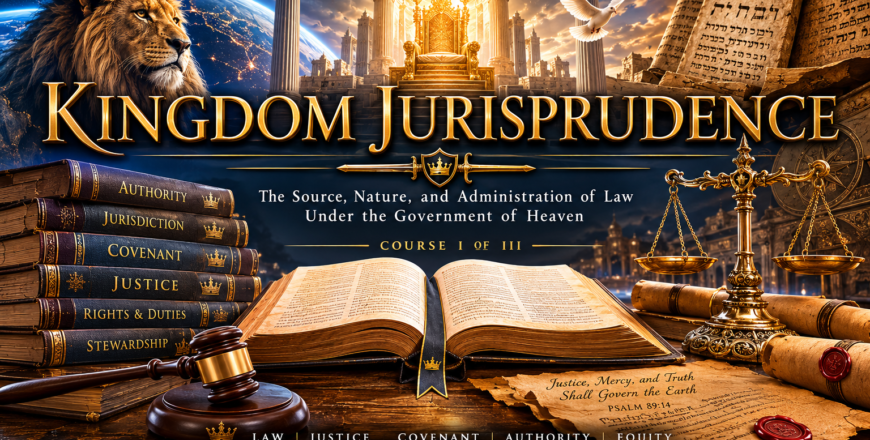


"How blessed are those who do not follow the advice of the wicked, who don't stand on the path of sinners or sit where scoffers sit! Their delight is in ADONAI's Torah; on His Torah they meditate day and night. They are like trees planted by streams—they bear their fruit in season, their leaves never wither; everything they do succeeds. Not so the wicked, who are like chaff driven by the wind. For this reason the wicked won't stand up to the judgment, nor will sinners at the gathering of the righteous. For ADONAI watches over the way of the righteous, but the way of the wicked is doomed."
Every legal system presupposes the existence of law, yet few begin by defining what law truly is. Courts administer it. Legislatures enact statutes. Judges render opinions. Scholars debate its meaning. Yet before one may understand commandments, judgments, equity, covenant, or jurisdiction, one must first answer the foundational question:
What is law?
Authority is the lawful right to govern within a defined jurisdiction. Jurisdiction is the lawful boundary within which authority may be exercised. Because all lawful authority originates with ADONAI, every delegated authority remains limited by the terms of its delegation and accountable to the One from whom it proceeds.
Sovereignty is the supreme, original, and indivisible authority by which ADONAI governs all creation according to His own nature, wisdom, and purpose. Because sovereignty originates in the Creator alone, it cannot be granted by the creature, transferred through consent, divided among competing authorities, or extinguished by rebellion. Every lawful government, covenant, judgment, stewardship, and jurisdiction derives its legitimacy from the Sovereign who established it.
Government did not originate with mankind, nor with the formation of nations, nor with the establishment of civil institutions. Government originates with ADONAI Himself, whose sovereign administration preceded creation and whose orderly rule was manifested in creation before any human office existed. Every lawful human government is therefore derivative, existing only as a delegated administration within the everlasting government of the Kingdom of Heaven.
Jurisdiction is the lawful sphere within which authority may be exercised according to the will of the Sovereign. The Kingdom of ADONAI is therefore not merely a people, a place, or an institution; it is the comprehensive jurisdiction of the everlasting King, within which all delegated authority is granted, exercised, limited, and judged. Every lawful office derives both its authority and its jurisdiction from participation in the Kingdom, while every exercise of authority outside that delegated jurisdiction constitutes usurpation.
Law exists to reveal and preserve the righteous order established by ADONAI, to govern faithful relationships within creation, to define the responsibilities of stewardship, to restrain injustice, to provide righteous judgment, and to restore covenantal order when it has been violated. The purpose of law is therefore neither domination nor mere punishment, but the faithful administration of justice according to the character and will of the everlasting King.
The Kingdom of ADONAI is established, governed, and perpetuated through covenant. Covenant is the constitutional relationship by which the Sovereign binds Himself according to His promises, defines the obligations of His people, establishes lawful inheritance, delegates stewardship, and orders every sphere of Kingdom life. Consequently, law is never independent of covenant, nor can covenant be understood apart from the righteous character of the everlasting King.
The Kingdom of ADONAI is administered through lawful offices rather than through personal privilege. Every office exists by delegation from the Sovereign, is limited by jurisdiction, governed by covenant, accountable to law, and exercised as a sacred stewardship. Accordingly, the office is distinct from the individual who temporarily occupies it, and faithful administration depends upon honoring the office according to the purposes established by the King.
Stewardship is the faithful administration of that which belongs to another according to the purpose for which it was entrusted. In the Kingdom of ADONAI, stewardship constitutes the first fiduciary principle, for all authority, property, offices, relationships, and responsibilities ultimately belong to the Sovereign. Every steward therefore administers what has been entrusted rather than exercising ownership over what has been received.
A trust is a constitutional fiduciary relationship in which one possessing lawful authority entrusts an identifiable res to another for administration according to a defined purpose, subject to fiduciary duties, accountability, and the continuing sovereignty of the one from whom the entrustment ultimately proceeds. Accordingly, trust is not first an instrument of law but a relationship of faithful administration arising from lawful entrustment.
Every fiduciary office imposes affirmative duties that define the lawful administration of entrusted authority. These duties do not arise from personal agreement or professional custom but from the constitutional nature of the fiduciary relationship itself. Among these duties, loyalty stands first, for without undivided loyalty the remaining obligations cannot be faithfully discharged. Prudence governs judgment, obedience preserves the governing purpose, good faith directs every exercise of authority, impartiality protects those for whose benefit the trust exists, and accountability secures faithful administration. Together these duties constitute the constitutional standard by which every fiduciary office shall be measured within the Kingdom of ADONAI.
Every fiduciary office exists for the administration of a trust res. Without a res there can be no trust, no trustee, no fiduciary duty, and no administration. The trust res is therefore the constitutional subject of fiduciary administration—the collection of property, rights, interests, responsibilities, and lawful obligations entrusted to the care of another for the accomplishment of a defined purpose. Kingdom Jurisprudence recognizes that the nature of the res may vary, but the constitutional principles governing its administration remain constant because they arise from the Sovereign's law rather than from the character or value of the thing entrusted.
Every trust exists for a lawful purpose that ultimately benefits one or more beneficiaries. While the trustee administers the trust res according to fiduciary duty, the beneficiary stands as the lawful object of that administration. Kingdom Jurisprudence recognizes that beneficial interests arise not from possession or personal entitlement, but from lawful relationship established through covenant, entrustment, and the governing purpose of the trust. Accordingly, beneficiaries possess both protected interests and corresponding responsibilities within the constitutional order of the Kingdom.
Power is never self-originating. Within Kingdom Jurisprudence, every lawful power proceeds from the Sovereign, is entrusted through lawful authority, is exercised within the limits established by covenant, and exists solely to accomplish the governing purpose of the trust. The trustee possesses no inherent authority over the trust res or the beneficiaries; rather, the trustee exercises only those powers lawfully entrusted for faithful administration.
How does a faithful fiduciary exercise judgment when the governing authority permits choice?
The Court holds that fiduciary discretion is neither arbitrary freedom nor personal preference. It is the disciplined exercise of judgment within the constitutional boundaries of lawful entrustment, governed by wisdom, faithfulness, prudence, and accountability before the Sovereign.
Kingdom Jurisprudence recognizes that delegation concerns the performance of duties, not the transfer of ultimate responsibility. The fiduciary may authorize another to assist in carrying out entrusted work, but the fiduciary cannot divest himself of the covenantal obligations that accompany the office. Authority may be exercised through lawful agents, servants, officers, or subordinate stewards, yet accountability remains with the one originally entrusted unless the Sovereign or the governing covenant lawfully appoints a successor.
Accordingly, delegation is neither an escape from duty nor a surrender of office. It is a constitutional mechanism by which faithful administration is extended without abandoning covenantal responsibility. Every lawful delegation must therefore preserve the governing purpose of the entrustment, remain within the limits established by the governing covenant, and be continually supervised by the fiduciary who bears ultimate accountability.
The Opening Thesis of Lesson 18 establishes the constitutional foundation for the entire law of fiduciary accountability. It introduces accountability not as a remedial doctrine arising after breach, but as an enduring constitutional obligation attached to fiduciary office from the moment of entrustment until final accounting. This distinction is essential, for the lessons that follow concerning breach, equitable remedies, removal, succession, and final judgment all presuppose the continuing obligation to render a faithful account. Lesson 18 therefore stands as the constitutional center of Book II, binding together every prior doctrine into a unified jurisprudence of faithful stewardship under the Law of the Sovereign.
Because fiduciary authority exists solely to serve the interests protected by the governing covenant, every exercise of fiduciary power remains subject to judicial review for faithfulness. Where the Court determines that the fiduciary has departed from the governing covenant through disloyalty, imprudence, neglect, self-interest, abuse of authority, failure of accountability, or other constitutional deficiency, the Court shall recognize a fiduciary breach and apply such equitable remedies as justice requires.
Thus, fiduciary breach is not merely the violation of a private obligation. It is a constitutional failure of stewardship that threatens the integrity of the fiduciary office, the protection of the beneficiaries, and the purposes of the Sovereign.
The Opening Thesis of Lesson 20 establishes the constitutional philosophy governing every equitable remedy examined throughout the remainder of Book II. Restitution, accounting, disgorgement, constructive trusts, injunctions, equitable liens, tracing, removal, and judicial supervision are not isolated legal devices; they are constitutional instruments through which the Kingdom Court restores faithful stewardship under the governing covenant. This foundational principle will unify every subsequent doctrine, Reporter decision, Rule of Decision, and practical exercise developed in the study of fiduciary remedies, ensuring that the administration of justice remains consistently aligned with the character and purposes of the Sovereign King.
The Kingdom Trust is not merely a legal arrangement or a mechanism for holding property. It is the constitutional relationship established by the Sovereign whereby authority is delegated to faithful stewards for the administration, preservation, increase, and lawful distribution of that which belongs to Him according to the purposes of His governing covenant.
From the opening chapters of Genesis through the consummation described in Revelation, Scripture consistently presents the Kingdom as operating through entrusted administration. Adam is entrusted with the garden. Noah with the preservation of life. Abraham with the covenant promises. Israel with the oracles of God. The priests with the sanctuary. The kings with the nation. The apostles with the proclamation of the Kingdom. In every instance, the pattern remains constant: ownership resides with the Sovereign, administration is entrusted to faithful stewards, beneficiaries receive according to the covenant, and accountability accompanies every delegation of authority.
From Genesis to Revelation, Scripture consistently reveals that the Sovereign never entrusts administration without first establishing the constitutional foundation upon which that administration rests. Adam is placed into an already-established Garden under clearly declared commands. Noah receives precise covenantal instructions before entering the ark. Abraham is called under a declared covenant with defined promises. Israel receives the Torah before assuming national administration. David's throne is established by covenant before royal authority is exercised. Messiah is publicly affirmed by the Father before His earthly ministry begins. The apostles are commissioned before undertaking their stewardship.
This recurring biblical pattern demonstrates that constitutional creation always precedes constitutional administration.
In Kingdom Jurisprudence, fiduciary duties are constitutional obligations arising directly from the Sovereign's delegation of authority. They do not originate from personal morality, institutional policy, or human custom. They arise because the fiduciary acts in a representative capacity on behalf of another. Every exercise of delegated authority carries with it corresponding obligations of loyalty, obedience, prudence, preservation, impartiality, truthfulness, diligence, and accountability.
Scripture consistently presents faithful administration as the defining characteristic of lawful fiduciary service. Adam was charged to cultivate and guard the Garden. Noah was commanded to build the ark according to every instruction given by ADONAI. Moses was repeatedly warned not to deviate from the pattern revealed on the mountain. The priests were required to distinguish between the holy and the common. The judges were forbidden to show partiality. David was called to shepherd Israel with integrity of heart. The apostles were described as trustees of God's mysteries, and Messiah Himself declared that He always did the will of the Father who sent Him.
Every legal system must answer a fundamental constitutional question:
What should a court do after it determines that a wrong has occurred?
The answer to that question reveals the true character of the legal order.
If the purpose of judgment is merely punishment, then remedies become instruments of retribution. If the purpose is merely compensation, justice is reduced to economic calculation. If the purpose is political control, judicial power becomes an extension of governmental authority.
Kingdom Jurisprudence begins from an entirely different constitutional premise.
The beneficiary is neither the owner of the Kingdom Trust nor merely a passive recipient of its administration.
Rather, the beneficiary is a constitutionally recognized participant in the covenantal order whose rights, protections, expectations, and responsibilities arise directly from the Governing Covenant itself.
The beneficiary's interest does not originate through personal entitlement.
It originates through the Sovereign's constitutional declaration.
Because the beneficiary derives every constitutional interest from the Governing Covenant, the beneficiary remains protected by the same constitutional principles that govern fiduciaries, judges, and every office of Kingdom administration.
The Kingdom Trust exists not merely for the faithful administration of the present generation but for the orderly transmission of the Governing Covenant, the Trust Estate, covenantal responsibilities, and constitutional offices to succeeding generations according to the will of the Sovereign.
Inheritance within Kingdom Jurisprudence is therefore fundamentally constitutional rather than merely proprietary.
It is the lawful succession of covenantal stewardship.
The Kingdom inheritance is not first concerned with the transfer of possessions.
It is concerned with the preservation of the Kingdom Trust.
Property, authority, responsibility, office, and blessing all derive their constitutional significance from the Governing Covenant.
Accordingly, inheritance is not measured by the value of assets received but by the continuity of faithful stewardship established across generations.
Throughout Scripture, the Sovereign governs His people by covenant. The relationship between the King and His people is not arbitrary, nor is it sustained by mere sentiment or force. It is established through covenantal commitments that define identity, authority, stewardship, obligation, blessing, correction, and restoration.
The Kingdom Trust therefore cannot be understood apart from covenant administration. The trust derives its purpose from the covenant, its offices from the covenant, its standards of conduct from the covenant, and its remedies from the covenant. Faithful administration requires not only knowledge of the covenant's existence but disciplined adherence to its terms in every act of governance and stewardship.
This lesson examines covenant not merely as a theological concept but as the constitutional framework through which the Kingdom Trust is governed, preserved, and advanced.
Government in the Kingdom does not originate with human institutions. It originates with the King.
The King delegates authority.
The Governing Covenant defines that delegation.
The office receives only what has been entrusted.
The officeholder therefore possesses:
At no point does delegated authority become sovereignty.
Whenever an office claims authority beyond its delegation, it ceases to administer faithfully and begins to compete with the Sovereign Himself.
Lesson 27 established that all lawful authority must be traced to the Governing Covenant. Lesson 28 now establishes the complementary doctrine: because all authority is delegated, no office may claim ultimate or self-originating authority.
This lesson will distinguish between:
Students will learn that the Kingdom does not remove officeholders for isolated mistakes, nor does it ignore persistent unfaithfulness. Instead, it administers justice according to covenant principles, recognizing that the office belongs to the King and must be exercised in faithful stewardship.