
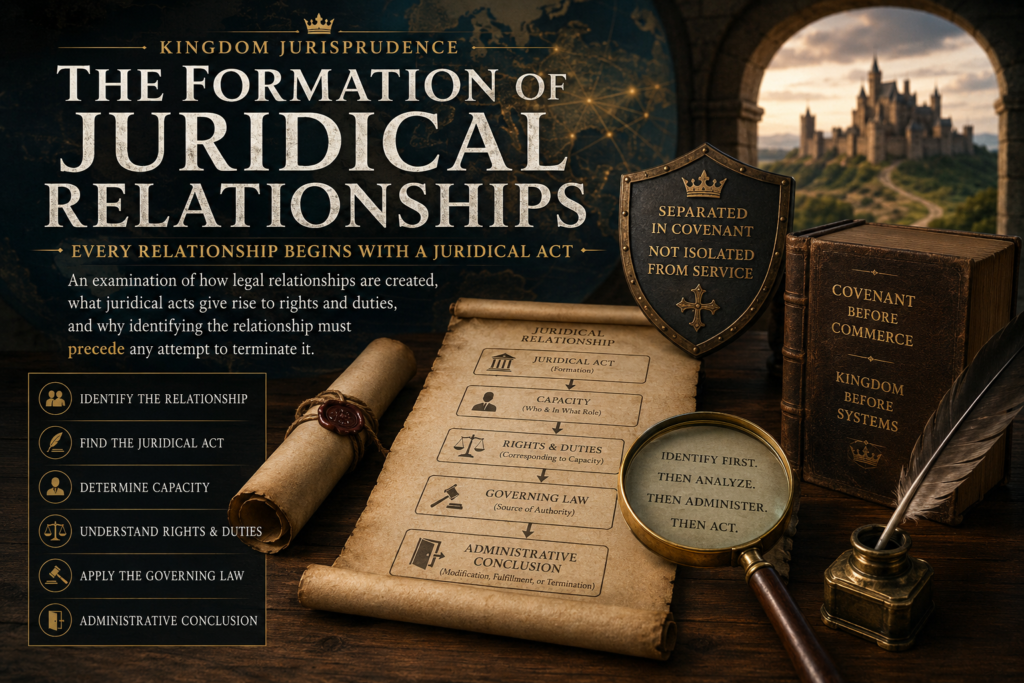
Before attempting to enforce, challenge, avoid, or terminate any legal relationship, have you first identified the juridical act that brought that relationship into existence?
Every exercise of authority presupposes a relationship.
Every claimed duty presupposes a relationship.
Every asserted right presupposes a relationship.
Every remedy presupposes a relationship.
Consequently, the faithful steward should never begin with the remedy, the controversy, or even the law itself. He should begin by identifying the relationship.
Kingdom Jurisprudence teaches that relationships do not arise by assumption. They arise from identifiable juridical acts that establish capacities, rights, duties, responsibilities, liabilities, privileges, and corresponding remedies. Unless the originating relationship is correctly identified, every subsequent legal analysis risks addressing the wrong issue entirely.
Likewise, one should never attempt to administratively terminate a relationship without first understanding how that relationship was formed, what law governs it, what obligations remain, and what lawful process exists for bringing it to its proper conclusion.
“Can two people walk together without having agreed so?”
— Amos 3:3
Agreement establishes relationship.
Relationship establishes responsibility.
Responsibility establishes accountability.
This simple principle echoes throughout Scripture.
YHVH consistently establishes covenant before commandments.
Identity before obligation.
Relationship before responsibility.
The Kingdom pattern never begins with enforcement.
It begins with relationship.
The world teaches people to react.
Kingdom Jurisprudence teaches the steward to investigate.
Whenever conflict arises, the first question is seldom asked:
“What relationship exists?”
Instead, people immediately begin arguing over jurisdiction, authority, rights, duties, procedures, statutes, contracts, or remedies.
Yet every one of those questions depends upon something more fundamental.
A relationship.
Every trust.
Every covenant.
Every marriage.
Every agency.
Every office.
Every contract.
Every license.
Every registration.
Every lawsuit.
Every governmental interaction.
Each first creates—or claims to create—a juridical relationship.
The wise steward therefore learns to identify relationships before attempting to administer them.
This single discipline often determines whether one correctly understands the entire controversy.
Nothing in law simply appears.
Every continuing legal relationship can be traced to one or more identifiable acts.
These acts may include:
The act itself may differ.
The principle does not.
Without an originating act, there is ordinarily no relationship to administer.
The first task of every steward is therefore historical.
What happened?
What act created the claimed relationship?
Only after answering those questions should legal analysis begin.
Relationships determine capacities.
Capacities determine duties.
Duties determine accountability.
The same individual may simultaneously occupy numerous capacities.
For example:
Each relationship carries different legal consequences.
Confusing capacities inevitably produces confused legal conclusions.
The steward therefore asks:
In what capacity am I acting?
Just as importantly:
In what capacity does the other party claim to be acting?
Rights never exist in isolation.
Neither do duties.
Neither does authority.
Each arises because a relationship exists.
If the relationship changes—
The rights change.
The duties change.
The liabilities change.
The remedies change.
This explains why identifying the relationship must always precede arguing over the law.
One of the greatest errors made by those seeking to live faithfully before God is attempting to escape obligations before understanding how those obligations allegedly arose.
Kingdom Jurisprudence teaches a different order.
First—
Identify the relationship.
Second—
Determine the originating juridical act.
Third—
Determine the governing law.
Fourth—
Determine the capacities.
Only then can one intelligently determine whether the relationship should:
One cannot lawfully conclude what one has never accurately identified.
The purpose of KOHTMS is not merely to understand relationships.
It is to faithfully administer them.
Many relationships with the nations are unavoidable.
Commerce.
Travel.
Property.
Litigation.
Family matters.
Inheritance.
Interaction is inevitable.
Unexamined relationship formation is not.
The steward therefore learns to examine every proposed interaction before participating.
Every application.
Every registration.
Every license.
Every agreement.
Every office accepted.
Every benefit received.
Each should first be examined with a single question:
“What relationship will this create?”
Only after understanding the relationship should the steward determine whether entering it remains consistent with faithful covenant administration.
Likewise, where separation becomes appropriate, the steward seeks to conclude relationships lawfully, peacefully, truthfully, and administratively according to the nature of the relationship itself.
Before entering—or attempting to conclude—any relationship, ask:
Before signing, applying, registering, accepting, or participating in any legal process, pause long enough to conduct a relationship audit.
Rather than asking only what the document says, ask what relationship it creates.
Rather than asking what benefits it offers, ask what continuing duties accompany those benefits.
When considering whether to withdraw from or conclude an existing relationship, first identify the juridical act that formed it, the law that governs it, and the lawful administrative process by which it may be modified, fulfilled, rescinded, or otherwise brought to its proper conclusion.
The faithful steward seeks neither unnecessary entanglement nor disorderly separation, but faithful administration consistent with covenant allegiance.
This article introduces one of the foundational methods of Kingdom Jurisprudence: relationship analysis. As you continue your study, you will discover that nearly every legal controversy can be better understood by first identifying the juridical relationship, the act that formed it, the capacities involved, and the governing law. This method provides a consistent framework for examining trusts, contracts, registrations, licenses, representative capacities, court proceedings, and interactions with the nations while remaining anchored in faithful covenant stewardship.
“I will not presume the existence of any claimed authority until I have identified the relationship from which that authority is said to arise. I will examine every juridical act with diligence, every relationship with discernment, and every administrative decision with faithfulness to the everlasting covenant, seeking first my allegiance to the Kingdom of God before entering or continuing any relationship with the kingdoms of this world.”