
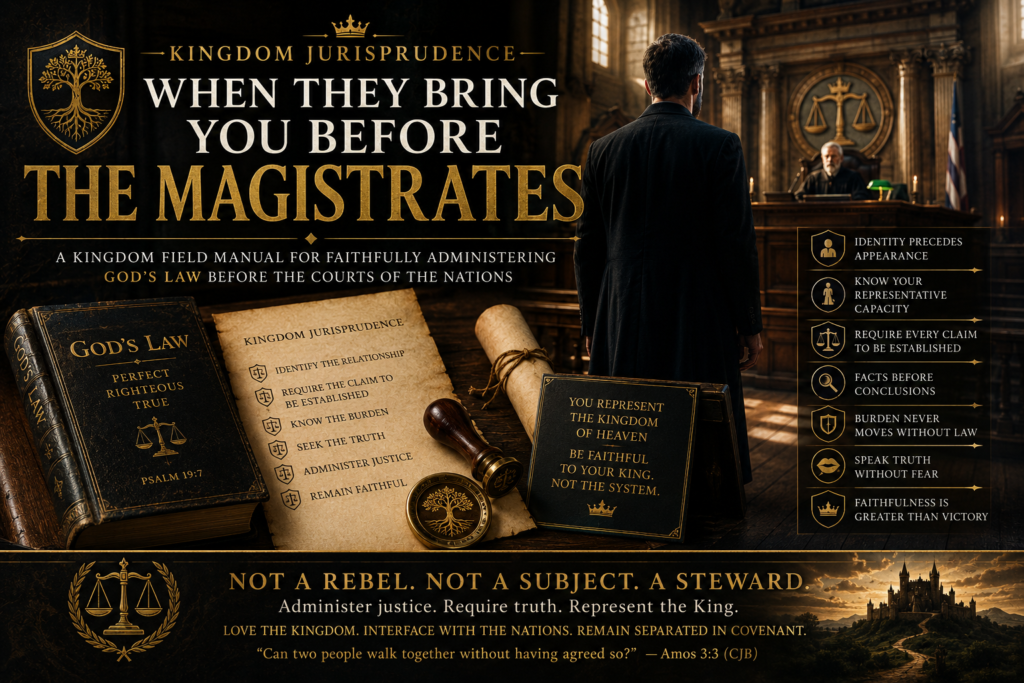
When you stand before the magistrates of the nations, will you react as one subject to fear, or will you faithfully administer the principles of God’s Law while requiring every earthly claim to be established according to truth and righteous judgment?
Yeshua never instructed His disciples to avoid the magistrates.
He instructed them how to stand before them.
Throughout Scripture, the servants of God repeatedly found themselves before kings, judges, governors, councils, rulers, and magistrates. Joseph stood before Pharaoh. Moses confronted Pharaoh. Daniel appeared before Babylonian rulers. Esther entered the king’s court. Nehemiah petitioned Artaxerxes. Paul defended himself before Felix, Festus, Agrippa, and ultimately appealed to Caesar.
None of these appearances were accidental.
Neither were they merely legal proceedings.
They were moments in which the administration of earthly authority intersected with the higher administration of God’s Law.
Kingdom Jurisprudence teaches that whenever the steward stands before the magistrates of the nations, he must first remember that he is not there merely as a litigant, defendant, plaintiff, witness, or petitioner.
He appears first as a faithful steward of the Kingdom of Heaven.
His objective is neither rebellion nor blind submission.
His objective is faithful administration.
“Whenever they bring you before synagogues, rulers and authorities, don’t worry about how you will defend yourself or what you will say, because when the time comes, the Ruach HaKodesh will teach you what you need to say.”
Luke 12:11–12
Notice what Yeshua did not say.
He did not say the rulers would always judge righteously.
He did not promise favorable outcomes.
He did not promise exemption from suffering.
He promised that faithful servants would not stand alone.
The legal systems of the nations frequently encourage people to focus immediately upon procedure, technicalities, accusations, and remedies.
Kingdom Jurisprudence begins somewhere entirely different.
It begins with truth.
It begins with justice.
It begins with properly identifying relationships.
It begins with requiring every claim to be established.
The faithful steward does not enter the courtroom seeking merely to win.
He enters seeking to ensure that every matter is examined according to righteous judgment.
God’s Law repeatedly requires impartiality, truthful testimony, multiple witnesses where applicable, honest weights and measures, and justice without respect of persons.
These principles do not cease to exist simply because the proceeding occurs in the courts of the nations.
They become even more important.
Scripture never condemns upon accusation alone.
Every claim must be established.
Every accusation must be supported.
Every judgment must rest upon evidence rather than assumption.
The steward therefore refuses to argue against assumptions.
He first requires the actual claim to be identified.
Before responding, he asks:
Until these questions are answered, meaningful administration cannot begin.
Every controversy depends upon a relationship.
The steward therefore determines:
Without identifying the relationship, the controversy itself remains poorly understood.
The wise steward never argues remedies before identifying relationships.
One of the most consistent principles of Scripture is that the one making an accusation bears responsibility for establishing it.
The steward therefore distinguishes carefully between:
Facts.
Assumptions.
Opinions.
Legal conclusions.
Administrative presumptions.
Only facts, properly established, can support righteous judgment.
The faithful steward therefore requires every asserted element of a claim to be demonstrated rather than merely asserted.
Many confuse the existence of a tribunal with the existence of lawful authority over every issue before it.
Kingdom Jurisprudence teaches the steward to carefully distinguish between:
These questions should be answered before debating the merits of the controversy itself.
God repeatedly condemns false witness.
Therefore the steward avoids exaggeration.
He avoids speculation.
He avoids assumptions.
He answers facts.
He asks factual questions.
He seeks factual clarification.
He leaves conclusions to arise from properly established evidence.
Truth is strengthened by precision.
The steward seeks neither special treatment nor selective enforcement.
God’s Law condemns partiality toward both the powerful and the weak.
The steward therefore asks only that every party—including himself—be held to the same standard.
Equal measures.
Equal burdens.
Equal accountability.
Equal justice.
The steward prepares diligently.
He studies.
He gathers evidence.
He understands the governing law.
He identifies relationships.
He knows the burdens.
Yet ultimately he measures success differently from the world.
Victory belongs to God.
Faithfulness belongs to the steward.
Whenever you stand before the magistrates, ask:
Before every hearing, appearance, deposition, administrative proceeding, or judicial process, conduct a Kingdom Jurisprudence Audit.
Do not begin with defenses.
Begin with relationships.
Do not begin with arguments.
Begin with facts.
Do not begin with conclusions.
Begin with evidence.
Require every claim to be established.
Require every burden to be carried by the party asserting it.
Maintain truthful speech, disciplined conduct, and faithful administration throughout the proceeding.
In doing so, the steward does more than defend a case.
He bears witness to a higher standard of justice.
Appearing before the magistrates is not an interruption of Kingdom stewardship—it is one of its most demanding applications. The steward who understands relationships, representative capacity, burdens of proof, and righteous judgment is better equipped to engage with the nations without surrendering covenant fidelity. Each article in the Kingdom Jurisprudence series builds another part of that field manual.
“When I am brought before the magistrates of the nations, I will not surrender truth to fear, nor justice to expediency. I will require every claim to be established, every burden to be carried by the one who asserts it, and every matter to be examined with honesty, impartiality, and faithful administration. My conduct, my words, and my judgments will remain subject first to the King whose law is perfect and whose justice is without partiality.”