
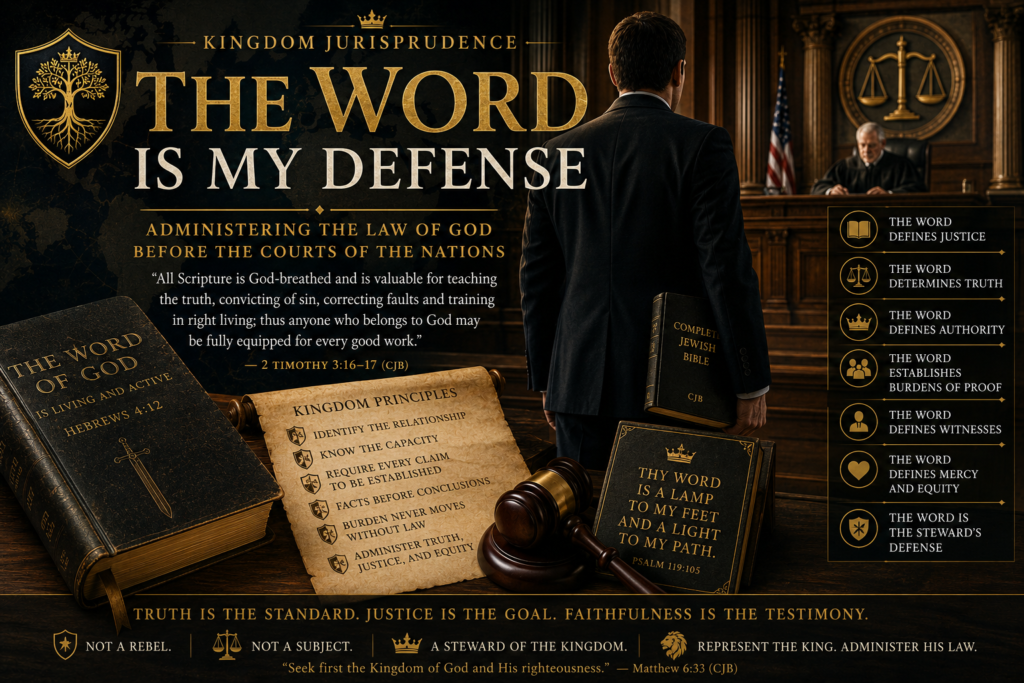
When the nations bring a claim against you, what law will govern your conscience, measure the claim, define justice, establish truth, and guide your defense?
Every defense rests upon a standard.
Some defend themselves by appealing to public opinion.
Others rely upon statutes, precedents, procedures, or technical arguments.
The faithful steward begins somewhere higher.
He begins with the Word of God.
Kingdom Jurisprudence teaches that the written Word is more than a source of comfort. It is the revealed standard by which justice is measured, authority is evaluated, truth is discerned, witnesses are examined, burdens are established, and every earthly claim is tested.
When standing before the magistrates of the nations, the steward’s first defense is not cleverness, rhetoric, or procedural advantage. His first defense is faithful administration of the King’s Law.
“All Scripture is God-breathed and is valuable for teaching the truth, convicting of sin, correcting faults and training in right living; thus anyone who belongs to God may be fully equipped for every good work.”
— 2 Timothy 3:16–17 (CJB)
Yeshua repeatedly answered temptation, accusation, and controversy with the words:
“It is written…”
He appealed to the written Word as the governing standard.
The faithful steward should do likewise.
Every legal controversy raises the same fundamental question:
By what standard shall this matter be judged?
The courts of the nations administer their own laws within their jurisdictions.
The steward, however, remains bound first by the everlasting covenant and the righteous standards revealed by God.
This does not mean rejecting every earthly law.
It means examining every earthly claim through the lens of Scripture before allowing it to bind the conscience or direct faithful conduct.
The Word is therefore not merely quoted.
It is administered.
Justice is not determined by popularity.
Nor by political power.
Nor by administrative convenience.
The steward first asks:
What does God’s Law declare to be just?
Only then does he evaluate the earthly claim before him.
Scripture repeatedly condemns false witness, deceit, and partiality.
Therefore the steward:
Every defense begins with truth.
Not every exercise of power is righteous simply because it is exercised.
Throughout Scripture, kings, judges, priests, and rulers were themselves accountable to God’s Law.
The steward therefore evaluates authority by asking:
God does not condemn on accusation alone.
The Scriptures consistently require that matters be established before judgment.
The steward therefore requires every claim to be supported according to truth and evidence.
The burden remains with the one making the assertion.
Throughout Scripture, witnesses are central to righteous judgment.
The steward understands that testimony carries responsibility.
He refuses to bear false witness.
He examines testimony carefully.
He values truth over expedience.
Justice without mercy becomes oppression.
Mercy without justice becomes partiality.
God’s Law holds both together.
The faithful steward therefore seeks judgments that reflect truth, accountability, restoration where appropriate, and impartial administration.
The steward does not place ultimate confidence in eloquence, procedure, or personal ability.
He prepares diligently.
He studies carefully.
He understands the relationships, capacities, facts, and governing laws involved.
Yet his confidence rests in faithfully administering the Word of God as the highest standard by which every claim is measured.
His defense is not merely what he says.
His defense is the standard by which he evaluates every controversy.
Before responding to any claim, ask:
When preparing for any interaction with the courts, agencies, or magistrates of the nations, begin your preparation in Scripture before you begin with statutes.
Study the principles of justice.
Understand the biblical requirements for truthful testimony, impartial judgment, faithful stewardship, and righteous administration.
Then examine the specific controversy before you.
Identify the relationship.
Clarify the capacities of the parties.
Determine the governing law.
Require every claim to be established.
Respond with honesty, humility, and precision.
In doing so, the Word ceases to be merely a book you carry.
It becomes the governing standard you faithfully administer.
The Word is not merely a source of encouragement for the Kingdom steward—it is the measure by which every claim, every exercise of authority, every asserted duty, and every proposed remedy is examined. As you continue through the Kingdom Jurisprudence series, you will learn how to apply these principles in matters of contracts, trusts, registrations, representative capacity, evidence, jurisdiction, and appearances before the magistrates of the nations.
“I will not measure justice by the shifting opinions of men but by the enduring Word of God. I will examine every claim with truth, every authority with discernment, every judgment with righteousness, and every defense with faithful administration. The Word of God shall remain the first measure of my conscience, my conduct, and my defense before the courts of the nations.”