
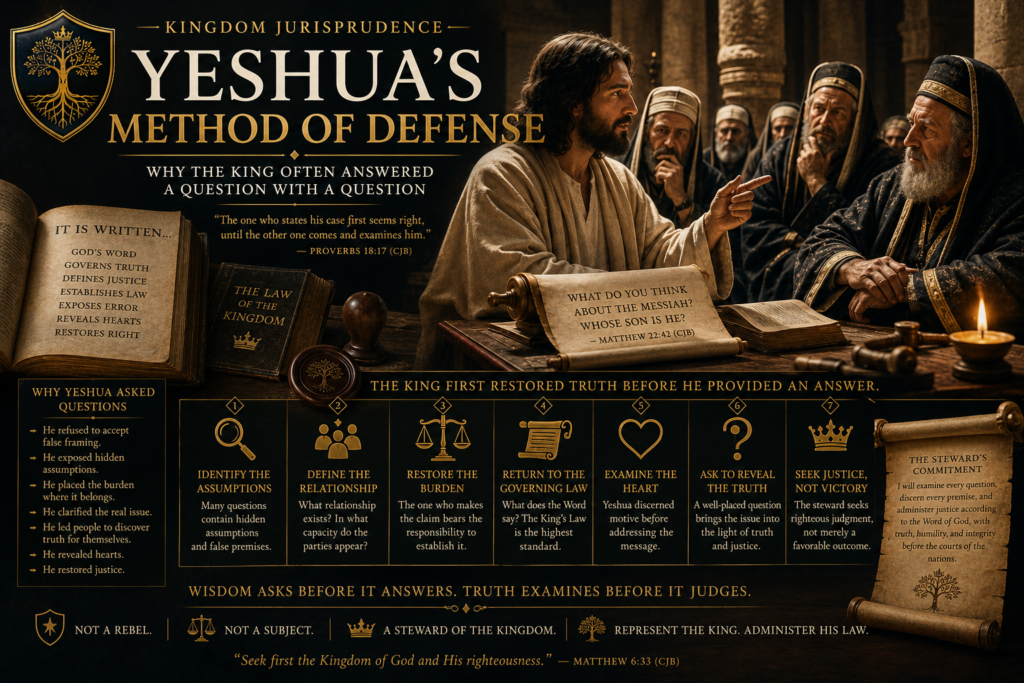
When you are questioned by the magistrates, religious authorities, or rulers of the nations, should you immediately answer their question—or should you first determine whether the question itself has been lawfully framed?
Throughout the Gospels, Yeshua was questioned by rulers, lawyers, Pharisees, Sadducees, priests, scribes, magistrates, disciples, and ordinary people.
Yet He rarely accepted a question exactly as it was presented.
Instead, He often responded with another question.
To the casual observer, this appears evasive.
To the faithful steward, it reveals one of the greatest lessons in Kingdom Jurisprudence.
Yeshua understood that many questions contain hidden assumptions, undefined terms, false premises, misplaced burdens, or improper standards of judgment. Had He accepted those questions as framed, He would have allowed His opponents to define both the controversy and the law governing it.
Instead, He first restored the proper foundation upon which justice could be administered.
The King did not evade the issue.
He corrected it.
“The one who states his case first seems right, until the other one comes and examines him.”
— Proverbs 18:17 (CJB)
Yeshua consistently demonstrated this principle.
Before accepting an accusation, He examined it.
Before accepting a conclusion, He examined its foundation.
Before answering, He often examined the question itself.
Questions are never neutral.
Every question assumes something.
It assumes definitions.
It assumes relationships.
It assumes authority.
It assumes jurisdiction.
It assumes burdens.
It assumes a governing standard.
The faithful steward therefore learns from the King that before answering a question, one should determine whether the question itself deserves to be answered as presented.
Many controversies are won or lost before the first answer is ever given because one party quietly accepts assumptions that have never been established.
Yeshua refused to do so.
Many who questioned Yeshua had already decided the conclusion.
Their questions were designed to trap Him rather than discover truth.
Instead of defending Himself against their assumptions, He exposed them.
A steward should likewise identify the assumptions contained within every claim before responding.
If another person defines the issue incorrectly, every subsequent answer may strengthen an improper premise.
Yeshua frequently redirected conversations back to the real issue.
He refused to defend Himself against false characterizations.
He first established what the controversy actually was.
Many questions improperly shift responsibility.
Yeshua repeatedly placed the burden back where it belonged.
Rather than allowing unsupported assertions to stand, He required those making claims to examine themselves, justify their conclusions, or explain their reasoning.
The steward should likewise recognize that every claim carries its own burden.
Again and again Yeshua asked,
“Haven’t you read…?”
or
“What is written in the Torah?”
He redirected discussion away from tradition, politics, and opinion and back to the revealed standard.
The King consistently restored Scripture as the governing law.
Yeshua often answered the person before He answered the question.
He understood that the condition of the heart frequently explained the question being asked.
Some sought wisdom.
Others sought justification.
Others sought to accuse.
Still others sought to trap Him publicly.
The steward therefore learns to discern motive without abandoning truth or impartiality.
Many disputes arise because words are never defined.
What is meant by “authority”?
What is meant by “law”?
What relationship exists?
What capacity is being discussed?
Yeshua frequently clarified these foundational matters before permitting conclusions to be drawn.
Truth begins with proper definitions.
Yeshua did not ask questions merely to silence His opponents.
His questions exposed error, invited repentance, clarified truth, and restored righteous judgment.
The steward likewise asks questions not to manipulate but to illuminate.
A properly framed question often reveals truth more effectively than a lengthy argument.
Before answering, ask yourself:
When appearing before magistrates, agencies, courts, or any representative of the nations, resist the temptation to answer every question immediately.
First identify what is actually being asked.
Separate facts from assumptions.
Clarify definitions.
Determine the relationship between the parties.
Identify the governing law.
Restore the proper burden of proof.
Only then should the steward respond—and only in a manner that remains faithful to the King’s Law.
Questions, when administered with wisdom and integrity, become instruments of justice rather than tools of controversy.
The faithful steward should not imitate Yeshua’s method merely by answering questions with questions. He should imitate the King’s purpose. Every question should move the discussion toward truth, proper burdens, righteous judgment, and faithful administration of God’s Law. When you learn to identify assumptions, define the controversy, restore the governing standard, and place the burden where it belongs, you begin to administer justice as the King demonstrated before the rulers and magistrates of His day.
“I will not permit assumptions to replace truth, nor undefined claims to govern my conscience. I will examine every question before accepting its premise, restore every controversy to the standard of God’s Word, and seek justice through wisdom rather than argument. As my King administered truth with discernment, so I will faithfully administer every matter entrusted to me.”