
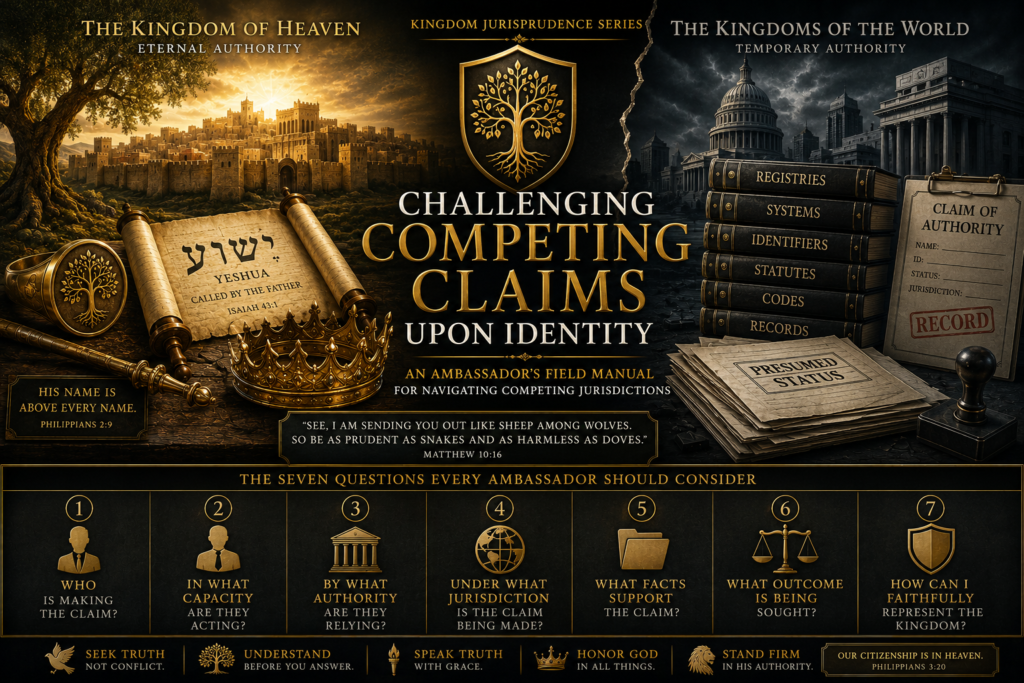
Kingdom Jurisprudence Series
Kingdom of Heaven Trust Management System (KOHTMS)
“See, I am sending you out like sheep among wolves. So be as prudent as snakes and as harmless as doves.” — Matthew 10:16 (CJB)
“Always be prepared to give an answer to anyone who asks you to give the reason for the hope that you have. But do it gently and respectfully.” — 1 Peter 3:15 (CJB)
Every ambassador eventually reaches a border.
Whether that border is a courtroom, a government office, a place of employment, a school, a business, or a simple conversation, there comes a moment when two governments stand before him.
One government asks:
“Who are you?”
The other has already answered.
Kingdom Jurisprudence begins where those two answers collide.
This article is not about conflict.
It is about clarity.
It is not about refusing lawful authority.
It is about understanding authority.
It is not about being argumentative.
It is about being a faithful ambassador of the Kingdom of Heaven.
The ambassador who understands jurisdiction, identity, and representation is far better equipped to walk wisely than the one who merely reacts.
An ambassador does not begin by making assertions. He begins by understanding the claim, identifying the authority behind it, and faithfully representing the King who sent him.
Throughout Scripture, Yeshua demonstrated extraordinary restraint.
He rarely accepted the assumptions built into His opponents’ questions.
Instead, He clarified.
He questioned.
He exposed presumption.
He directed the conversation toward truth.
The faithful ambassador should strive to do the same.
One of the greatest mistakes an ambassador can make is answering a question before understanding what is actually being asked.
Yeshua often responded to questions with questions.
Not to evade truth.
But to expose assumptions.
Many disputes arise because people answer the wrong question.
Wisdom begins with understanding.
Before responding, ask yourself:
What is actually being claimed?
What issue is really before me?
What is the purpose of the question?
Every lawful claim contains identifiable elements.
Before agreeing or disagreeing, seek to understand:
Who is making the claim?
What exactly is being claimed?
What outcome is being sought?
What facts are being relied upon?
What authority is being invoked?
Clarity prevents confusion.
Understanding precedes response.
Scripture teaches that the same individual may serve in different capacities.
A father.
A son.
A shepherd.
A judge.
A servant.
A king.
Capacity matters.
Likewise, others may interact with us in different capacities.
Understanding the role a person is acting in often helps clarify the nature of the interaction.
Likewise, we should ask ourselves:
In what capacity am I responding?
As an ambassador?
As a witness?
As a steward?
As a neighbor?
As a servant of the King?
Faithful representation begins with understanding our own calling.
Every government exercises authority within the sphere entrusted to it.
Scripture itself recognizes different spheres of responsibility—family, community, civil authority, and above all, the Kingdom of Heaven.
The wise ambassador understands that questions of authority should always be considered carefully.
Rather than reacting emotionally, seek to understand:
What authority is being exercised?
What is the purpose of that authority?
How does my duty to God inform my response?
Kingdom citizens are called to honor God above all while conducting themselves with wisdom and integrity toward others.
Yeshua consistently challenged unsupported assumptions.
He did not accept conclusions merely because others asserted them.
He invited people to examine truth.
Likewise, faithful ambassadors should cultivate the habit of asking:
What facts support this conclusion?
What assumptions are being made?
Have all relevant matters been considered?
Truth welcomes careful examination.
Throughout His ministry, Yeshua was repeatedly mischaracterized.
He was accused of violating the Torah.
Of serving Beelzebul.
Of threatening Caesar.
Of blasphemy.
Yet He did not allow false accusations to redefine His identity.
The ambassador of the Kingdom should likewise avoid allowing others to define him contrary to truth.
Our identity is established first by our relationship with the King.
An ambassador never represents only himself.
His words reflect upon the kingdom he serves.
Therefore, our conduct should be marked by:
Humility.
Wisdom.
Patience.
Integrity.
Respect.
Truthfulness.
Self-control.
Yeshua demonstrated remarkable composure before the Sanhedrin, before Pilate, and before Herod.
His confidence rested not in earthly power but in the authority of His Father.
Whenever significant claims or disputes arise, thoughtful reflection can begin with seven questions:
Who is making the claim?
In what capacity are they acting?
What authority are they relying upon?
What jurisdiction is involved?
What facts support the claim?
What outcome is being sought?
How can I faithfully represent the Kingdom of Heaven in my response?
These questions are not formulas.
They are habits of disciplined thinking rooted in Kingdom Jurisprudence.
Faithful ambassadors do not seek unnecessary conflict.
Neither do they surrender truth through confusion or fear.
They seek understanding before responding.
They listen carefully.
They speak truthfully.
They act honorably.
They remember that every conversation reflects upon the King they represent.
Whether standing before neighbors, employers, public officials, judges, or strangers, the ambassador asks first:
How can I honor the King in this moment?
Do I respond before I fully understand the issue?
Am I careful to distinguish facts from assumptions?
Do I recognize the different capacities in which people act?
How does Scripture shape my understanding of authority?
Does my conduct reflect the wisdom and humility of Yeshua?
If someone observed my responses, would they gain a clearer picture of the Kingdom I represent?
The kingdoms of this world will continue to ask:
“Who are you?”
The Kingdom of Heaven has already answered.
The question for every disciple is not whether competing claims will arise.
They will.
The question is whether we will respond as ambassadors worthy of the King.
Not with fear.
Not with anger.
Not with confusion.
But with wisdom.
With humility.
With courage.
With truth.
The greatest ambassador who ever walked the earth never forgot who sent Him.
Neither should we.
Represent the King faithfully.
Speak truth graciously.
Stand firmly.
Walk humbly.
And let every response testify that your highest allegiance belongs to the Kingdom that cannot be shaken.
Kingdom Jurisprudence is a foundational discipline within the Kingdom of Heaven Trust Management System (KOHTMS). It equips faithful stewards to understand the King’s government, discern questions of authority and jurisdiction through the lens of Scripture, and represent the Kingdom of Heaven with wisdom, integrity, and faithful stewardship.
Kingdom of Heaven Trust Management System (KOHTMS)
Recovering the King’s Government.
Restoring Biblical Stewardship.
Equipping Faithful Ambassadors.