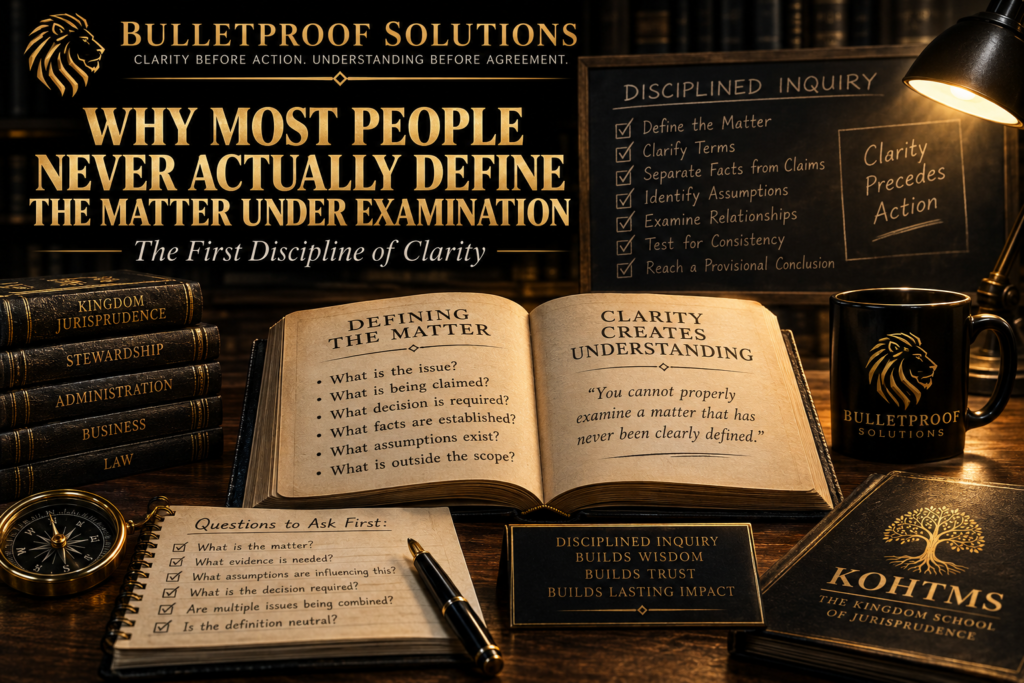
“You cannot properly examine a matter that has never been clearly defined.”
Why do so many discussions, disputes, investigations, and problem-solving efforts begin before anyone has clearly identified the matter being examined?
People often believe they know what a disagreement is about.
They hear a complaint, observe an event, receive an accusation, read a headline, or encounter a problem and immediately begin forming conclusions. Yet when asked to state the precise matter under examination in one clear sentence, many discover that they cannot.
Instead, they describe feelings.
They repeat accusations.
They recount background events.
They identify personalities.
They offer conclusions.
But they never clearly define the matter.
This failure is not minor.
When the matter is undefined, every question that follows may be directed toward the wrong issue. Evidence may be gathered without relevance. Parties may argue past one another. Remedies may be proposed for problems that do not actually exist.
Clarity begins by refusing to proceed until the matter itself has been properly identified.
Most people are trained to respond more quickly than they are trained to examine.
A question is asked, and they feel expected to answer.
An accusation is made, and they feel compelled to defend.
A problem appears, and they immediately search for a solution.
A claim is repeated often enough, and they begin treating it as established.
Very few are taught to pause and ask:
What exactly are we examining?
That question may appear simple, but it controls the entire inquiry.
If the matter is defined too broadly, the inquiry becomes scattered.
If it is defined too narrowly, relevant facts may be excluded.
If one party defines it unfairly, the conclusion may be built into the question itself.
If the matter changes during the discussion, the participants may no longer be addressing the same issue.
The person who controls the framing of a matter often controls the direction of the discussion. That is why defining the matter must never be treated as a casual preliminary step.
It is the first act of disciplined inquiry.
People frequently begin an inquiry with assumptions such as:
Everyone already knows what the issue is.
The first description of the problem is accurate.
The person making the complaint has correctly identified the cause.
The headline fairly represents the underlying event.
The accusation and the matter under examination are the same thing.
The proposed remedy proves what the problem must be.
The loudest concern is the central concern.
The parties are using the same words in the same way.
Background information is the same as defining the issue.
A conclusion can be reached before the question is properly framed.
These assumptions allow confusion to enter before the inquiry has even begun.
Before examining evidence or proposing solutions, ask:
What exactly happened?
What specific claim is being made?
What decision must be made?
What question requires an answer?
Who defined the matter this way?
Does that definition contain an assumption?
Does the wording favor one conclusion?
Are several separate issues being combined?
Are the parties addressing the same matter?
What is outside the scope of this inquiry?
Has the matter changed since the discussion began?
Can the issue be stated in one neutral sentence?
These questions help remove emotion, accusation, and conclusion from the initial framing.
“Foreclosure” is a topic.
“Family conflict” is a topic.
“Government authority” is a topic.
“Contract dispute” is a topic.
A matter under examination must be more precise.
For example:
Did the lender provide the notice required before accelerating the loan?
That is a defined matter.
What specific agreement did the parties reach concerning repayment?
That is a defined matter.
Who possessed authority to make the disputed decision?
That is a defined matter.
A topic identifies a general area.
A properly defined matter identifies the precise question that must be examined.
A person may say:
“They cheated me.”
That is a complaint and a conclusion.
It does not yet define the matter.
A disciplined inquiry might ask:
What representation was made?
By whom?
When?
What did the other party rely upon?
What action followed?
What loss is claimed?
Which fact is disputed?
The matter may eventually become:
Whether the seller knowingly made a false representation that caused the buyer to enter the transaction.
That formulation provides something that can actually be examined.
People often begin with what they want:
The case should be dismissed.
The contract should be canceled.
The employee should be fired.
The debt should be removed.
The relationship should end.
The court should issue an injunction.
But the remedy does not prove the existence or nature of the underlying problem.
Before asking what should be done, disciplined inquiry asks:
What has actually occurred, and what matter must first be established?
Some questions contain hidden conclusions.
Consider:
Why did the administrator misuse the funds?
The question assumes that funds were misused and that the administrator was responsible.
A more disciplined formulation would be:
Were the funds administered consistently with the governing duties and records?
The second formulation permits examination.
The first demands acceptance of an unproven premise.
Begin by stripping away words that announce guilt, innocence, motive, fraud, abuse, bad faith, or entitlement unless those things have already been established.
Instead of:
Why did they violate the agreement?
Ask:
What did the agreement require, and did the conduct comply with those requirements?
An event is what occurred.
An interpretation is what someone believes the event means.
For example:
Event: A payment was not received by the stated date.
Interpretation: The other party intentionally breached the agreement.
The event may be established while the interpretation remains unproven.
The matter should first focus on what can be examined.
Many inquiries become clearer when the necessary decision is identified.
Ask:
Must responsibility be assigned?
Must authority be established?
Must a claim be accepted or rejected?
Must a remedy be selected?
Must a course of action be chosen?
Must additional evidence be gathered?
The required decision helps define the proper scope.
Confusion often arises because several issues are combined into one.
For example:
Was the agreement valid, was it breached, and what damages resulted?
Those are three distinct matters:
Was a valid agreement formed?
Did either party fail to perform a required obligation?
What measurable harm resulted from that failure?
Each matter may require different facts, evidence, definitions, and burdens.
A properly framed matter should not favor either side.
It should be possible for all parties to read it without being forced to accept a disputed conclusion.
A useful formula is:
Whether [specific event, claim, duty, authority, or relationship] has been established under [the relevant facts, terms, or governing standard].
Examples:
Whether the notice was delivered in the manner required by the agreement.
Whether the speaker’s statement accurately represented the available evidence.
Whether the administrator possessed authority to transfer the property.
Whether the parties formed an enforceable agreement.
Whether the proposed action is consistent with the steward’s stated duties.
Before proceeding, ask:
Is this one matter or several?
Is the language neutral?
Does it contain an unproven assumption?
Is it narrow enough to examine?
Is it broad enough to include the relevant facts?
Do the parties agree that this is the actual issue?
What evidence would answer the question?
What evidence would be irrelevant?
If these questions cannot be answered, the matter may not yet be properly defined.
A couple may believe they are arguing about money.
After careful examination, the real matter may be whether one person made a major decision without consultation.
Money was the event.
Authority, communication, and trust may be the actual matters.
A business owner may believe sales are declining because the market is weak.
The defined matter may instead be:
Which stage of the customer journey is producing the greatest loss of prospective buyers?
That question leads to measurable evidence rather than speculation.
A party may believe the case is about fairness.
The court may be examining a narrower matter:
Whether the party has established the legal elements required for the requested remedy.
Understanding the actual matter prevents wasted arguments.
A reader may ask:
What does this verse mean to me?
But the first matter may be:
What issue was being addressed, to whom was it spoken, and within what covenantal and historical context?
Defining the matter protects the text from being reduced to personal preference.
A steward may be asked to approve a proposed transaction.
The matter is not merely whether the transaction appears beneficial.
The inquiry may be:
Whether the transaction is within the steward’s authority, consistent with the governing purpose, and supported by adequate information.
What issue, accusation, complaint, or question was originally presented?
How did the first person describe the matter?
Does that description contain an accusation, assumption, motive, or conclusion?
What event or fact can presently be stated without interpretation?
What decision must ultimately be made?
Are multiple matters being combined?
State the matter in one neutral sentence:
What information is relevant?
What information is outside the present inquiry?
Do all parties agree that this is the matter being examined?
Think of a recent disagreement. Could each person have defined the matter differently?
Did the original wording contain a conclusion or accusation?
Were several separate issues combined into one argument?
What would the matter sound like if stated neutrally?
Would a clearer definition have changed the questions asked?
Was a remedy proposed before the underlying matter was established?
What evidence becomes relevant once the matter is properly defined?
The quality of every inquiry is limited by the accuracy of the matter being examined. Define it poorly, and even excellent reasoning may produce the wrong result. Define it clearly, and confusion begins to lose its power.
Defining the matter does not answer the question.
It makes an honest answer possible.
Once the matter has been stated clearly, the examiner must resist the next common error: rushing toward a conclusion before sufficient questions have been asked.
The next article in the BulletProof Clarity series is:
Clarity before action. Understanding before agreement. Questions before conclusions.