
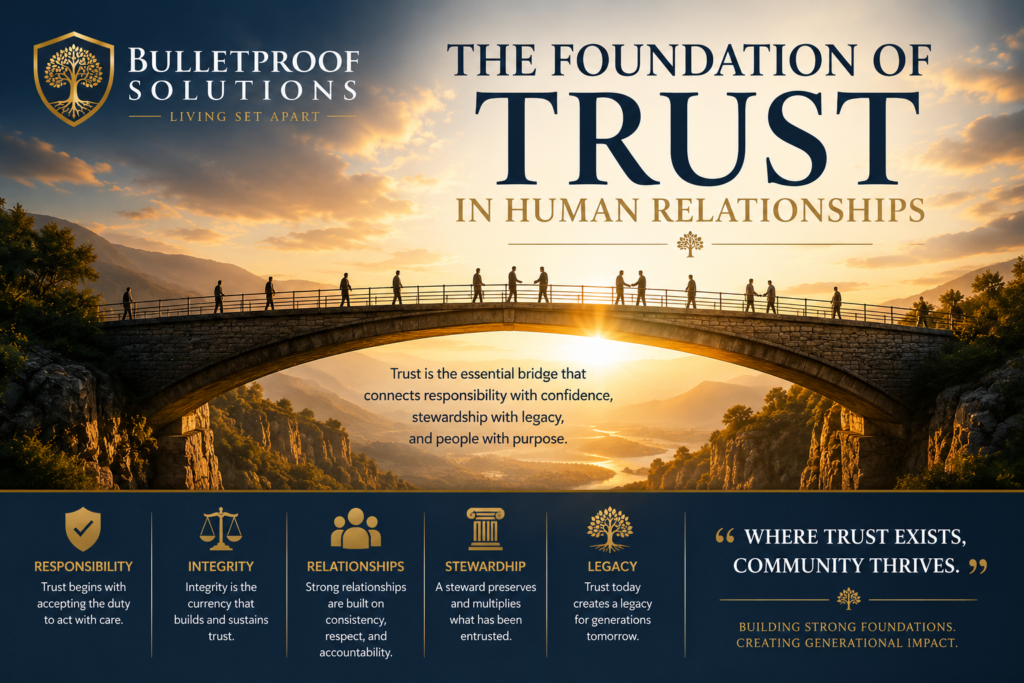
Trust is one of the most important yet least understood concepts in human society.
Every successful family depends upon it.
Every thriving community depends upon it.
Every business depends upon it.
Every meaningful relationship depends upon it.
Without trust, cooperation becomes difficult. Without cooperation, progress becomes nearly impossible.
Despite its importance, most people think of trust only when it has been broken. They recognize its value when promises are not kept, agreements are violated, or confidence is betrayed. Yet trust is far more than a feeling. It is a foundational principle that has shaped human civilization for thousands of years.
Understanding trust is essential for anyone seeking to become a steward, administrator, leader, or trustee.
Many people associate trusts with legal documents, attorneys, or estate planning. While modern legal systems certainly use trust structures, the principle of trust existed long before governments codified it into statutes.
Trust arises naturally whenever one person relies upon another.
Parents are trusted to care for children.
Teachers are trusted to educate students.
Physicians are trusted to provide care.
Community leaders are trusted to act responsibly.
Employers trust employees.
Employees trust employers.
Friends trust one another.
Trust is therefore not merely a legal concept.
It is a relational concept.
Every human interaction depends upon varying degrees of trust.
The legal trust simply formalizes a principle that already exists naturally within human relationships.
Imagine a world without trust.
Every agreement would require constant monitoring.
Every transaction would require exhaustive verification.
Every relationship would operate under suspicion.
Progress would slow to a crawl.
Trust allows human beings to cooperate efficiently because it reduces uncertainty.
When people trust one another, they can focus their energy on creating value rather than protecting themselves from every possible risk.
This principle explains why trust is often described as a form of social capital.
Communities with high levels of trust tend to be more stable.
Businesses with trustworthy leadership tend to perform better.
Families built upon trust tend to be stronger.
Trust creates opportunities that cannot exist where suspicion dominates.
Trust cannot exist without responsibility.
Responsibility is the price of trust.
Whenever someone is entrusted with something valuable, responsibility follows.
Parents receive responsibility when children are entrusted to their care.
Teachers receive responsibility when students are placed under their instruction.
Leaders receive responsibility when communities place confidence in them.
Trust and responsibility are inseparable.
Many people desire authority without responsibility.
Others desire benefits without accountability.
Neither approach produces lasting trust.
Trust grows when responsibility is consistently exercised with integrity.
Every time a person fulfills their obligations, confidence increases.
Every time they neglect those obligations, confidence decreases.
Trust is built through repeated demonstrations of responsibility over time.
One of the most important distinctions a person can learn is the difference between ownership and stewardship.
Ownership focuses primarily on rights.
Stewardship focuses primarily on responsibilities.
A steward recognizes that control over a resource carries obligations.
Consider a community garden.
An owner may focus on their ability to use the garden however they choose.
A steward considers how their decisions affect the long-term health of the garden and the people who depend upon it.
This mindset applies to every area of life.
Money requires stewardship.
Knowledge requires stewardship.
Relationships require stewardship.
Property requires stewardship.
Leadership requires stewardship.
The steward understands that resources are not merely privileges.
They are responsibilities.
Trust flourishes wherever stewardship becomes the governing principle.
If trust is the foundation of relationships, integrity is the currency that sustains it.
Integrity means consistency between words and actions.
It means doing what you said you would do.
It means honoring commitments even when doing so becomes inconvenient.
People often speak about trust as though it appears automatically.
In reality, trust must be earned.
Integrity is how it is earned.
Every promise kept strengthens trust.
Every promise broken weakens trust.
This principle applies whether the relationship involves family, friendship, business, or community.
Trust grows slowly.
Trust can be damaged quickly.
That is why integrity remains one of the most valuable characteristics any person can develop.
Leadership is fundamentally a trust relationship.
Whether the setting is a family, business, congregation, organization, or community, leadership depends upon confidence.
People follow leaders because they trust them.
When leaders demonstrate integrity, competence, and accountability, trust grows.
When leaders become self-serving, dishonest, or irresponsible, trust deteriorates.
History repeatedly demonstrates this principle.
The strongest leaders are rarely those who exercise the greatest force.
They are those who inspire the greatest confidence.
People willingly cooperate with leaders they trust.
They resist leaders they do not trust.
Leadership therefore begins not with authority but with stewardship.
The most effective leaders view themselves as caretakers of responsibilities rather than rulers over people.
Trust requires accountability.
Without accountability, trust eventually deteriorates.
Accountability means being answerable for actions and decisions.
Healthy families maintain accountability.
Successful businesses maintain accountability.
Effective communities maintain accountability.
Accountability is not punishment.
It is protection.
It protects relationships from misunderstandings.
It protects communities from abuse.
It protects organizations from corruption.
When accountability disappears, trust becomes vulnerable.
This is why transparency and accountability are essential components of any healthy trust relationship.
Trust is rarely established through a single action.
Instead, it develops through consistent behavior over time.
People observe:
Do your actions match your words?
Do you honor commitments?
Do you accept responsibility when mistakes occur?
Do you treat others fairly?
Do you act with integrity when no one is watching?
Every interaction contributes to a person’s reputation.
Over months and years, these interactions create either confidence or doubt.
Trust is therefore not built through grand gestures.
It is built through daily consistency.
The small decisions often matter more than the dramatic ones.
Strong communities are impossible without trust.
Community depends upon cooperation.
Cooperation depends upon confidence.
Confidence depends upon trust.
People who trust one another share resources more effectively.
They solve problems more efficiently.
They weather challenges more successfully.
They invest in long-term outcomes rather than short-term gains.
Trust transforms groups of individuals into functioning communities.
Without trust, community becomes fragile.
With trust, community becomes resilient.
This is one reason why the restoration of trust is essential for building strong families, healthy organizations, and thriving communities.
Trust is far more than a legal concept.
It is far more than an emotional feeling.
Trust is one of the foundational principles upon which civilization itself is built.
It enables cooperation.
It strengthens relationships.
It supports leadership.
It creates opportunity.
It makes community possible.
At its core, trust is built upon responsibility, integrity, stewardship, and accountability.
These principles remain as relevant today as they have been throughout history.
Whether one is raising a family, operating a business, leading a community, or administering a trust estate, success ultimately depends upon the same foundation.
Trust.
And trust begins when individuals consistently demonstrate that they are worthy of the confidence placed in them.
Trust is not merely a legal structure—it is a way of understanding relationships, stewardship, responsibility, and administration.
If these principles resonate with you, consider exploring the educational resources, community discussions, and foundational training available through the Exploring Foundations Membership at BulletProof Solutions.
The journey toward stronger stewardship begins with understanding the principles that make trust possible.