
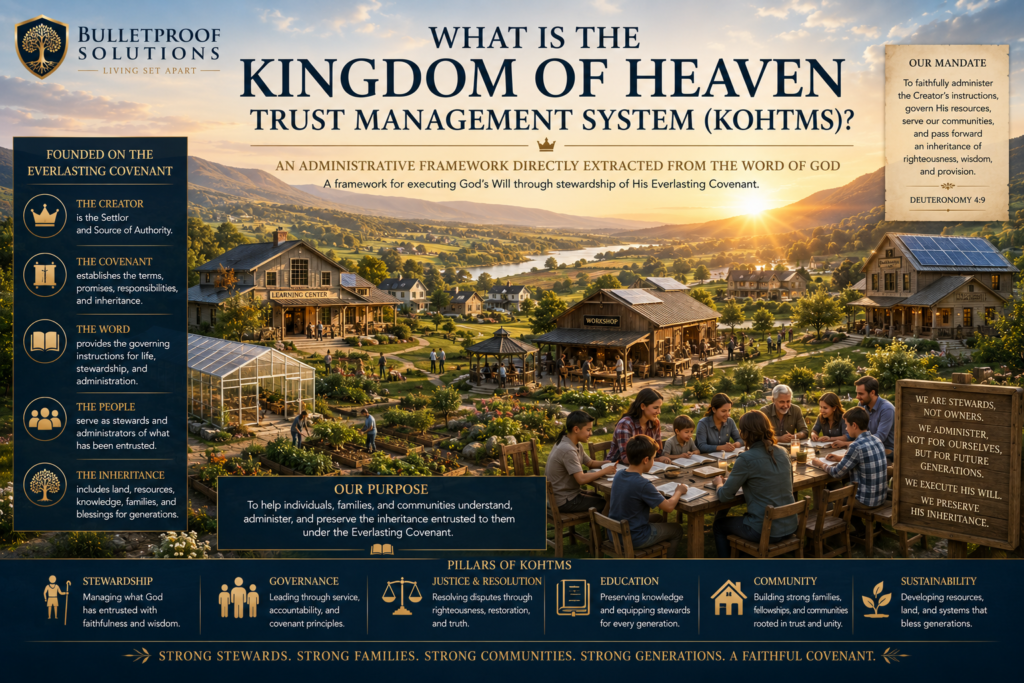
The Kingdom of Heaven Trust Management System (KOHTMS) is an administrative framework derived directly from the Word of God.
It is founded upon the principle that the Creator established an Everlasting Covenant and that mankind was created to serve as steward, trustee, administrator, and beneficiary within that Covenant relationship.
Rather than viewing Scripture merely as a religious text, KOHTMS approaches the Word as the governing charter, indenture, constitution, and administrative handbook of the Kingdom of Heaven.
At its foundation lies a simple premise:
The earth belongs to the Creator.
Human beings are not absolute owners.
They are stewards.
Throughout Scripture, mankind is repeatedly entrusted with responsibilities regarding land, resources, relationships, families, communities, and future generations.
The Kingdom of Heaven Trust Management System is designed to provide a practical framework for carrying out those responsibilities.
Its purpose is not merely education.
Its purpose is administration.
Its purpose is to help individuals, families, fellowships, and communities understand how to execute the Will of the Creator through faithful stewardship of His Everlasting Covenant.
Every trust begins with a trust instrument.
Every administration begins with governing instructions.
Every steward requires direction from the one who established the trust.
KOHTMS recognizes the Everlasting Covenant as the foundational trust relationship established by the Creator.
Within this framework:
The Creator is the Settlor.
The Covenant establishes the terms.
The Word provides the governing instructions.
The inheritance consists of the promises, blessings, responsibilities, and resources entrusted to the covenant community.
The people of the Covenant serve as stewards and administrators charged with carrying out the expressed Will of the Creator.
The central question therefore becomes:
How should faithful stewards administer what has been entrusted to them?
KOHTMS exists to answer that question.
Many people encounter Scripture primarily through the lens of religion.
KOHTMS approaches the Word through the lens of administration.
Administration asks practical questions:
How should resources be managed?
How should disputes be resolved?
How should families function?
How should communities govern themselves?
How should inheritance be preserved?
How should justice be administered?
How should responsibilities be delegated?
How should future generations be prepared?
These questions appear throughout Scripture.
The Word contains principles of stewardship, governance, inheritance, accountability, education, agriculture, economics, dispute resolution, leadership, and community administration.
KOHTMS seeks to organize these principles into a practical framework that can be understood and applied.
One of the foundational distinctions within KOHTMS is the difference between ownership and stewardship.
Modern society largely operates from an ownership model.
The Kingdom operates from a stewardship model.
Ownership asks:
“What belongs to me?”
Stewardship asks:
“What has been entrusted to me?”
Scripture consistently presents mankind as caretakers of resources belonging ultimately to the Creator.
This includes:
Land
Families
Knowledge
Relationships
Communities
Property
Time
Opportunities
The faithful steward recognizes both privilege and responsibility.
Authority and accountability remain connected.
Blessings and obligations remain connected.
Inheritance and stewardship remain connected.
This principle forms the foundation of the entire Kingdom administration model.
The ultimate purpose of every trustee is to execute the expressed Will of the Settlor.
KOHTMS views the Creator’s revealed instructions as the governing expression of His Will.
Therefore, the objective is not self-government according to personal preference.
Nor is it dependence upon external institutions for moral direction.
The objective is faithful administration.
Faithful administration seeks alignment between human conduct and the Creator’s instructions.
It seeks to bring daily life, family life, economic life, community life, and governance into harmony with covenant principles.
The question is not:
“What do I want?”
The question becomes:
“What has the Creator instructed?”
This shift transforms administration into stewardship.
The long-term vision of KOHTMS is the restoration of covenant stewardship across generations.
Strong families.
Strong fellowships.
Strong communities.
Strong systems of mutual support.
Strong inheritance structures.
Strong stewardship of land, resources, and knowledge.
The objective is to equip individuals and communities to faithfully administer what has been entrusted to them while preserving those blessings for future generations.
In this way, KOHTMS serves as both a framework and a roadmap for implementing Kingdom principles in practical daily life.
The Kingdom of Heaven Trust Management System is not merely a management model.
It is not merely an educational program.
It is an administrative framework derived from the Word of God for the purpose of executing the Creator’s Will through faithful stewardship of His Everlasting Covenant.
It recognizes the Creator as the source of authority, the Covenant as the governing relationship, and mankind as stewards entrusted with responsibilities that extend beyond themselves to future generations.
Its purpose is simple:
To help faithful stewards understand, administer, preserve, and pass forward the inheritance entrusted to them under the Everlasting Covenant.