
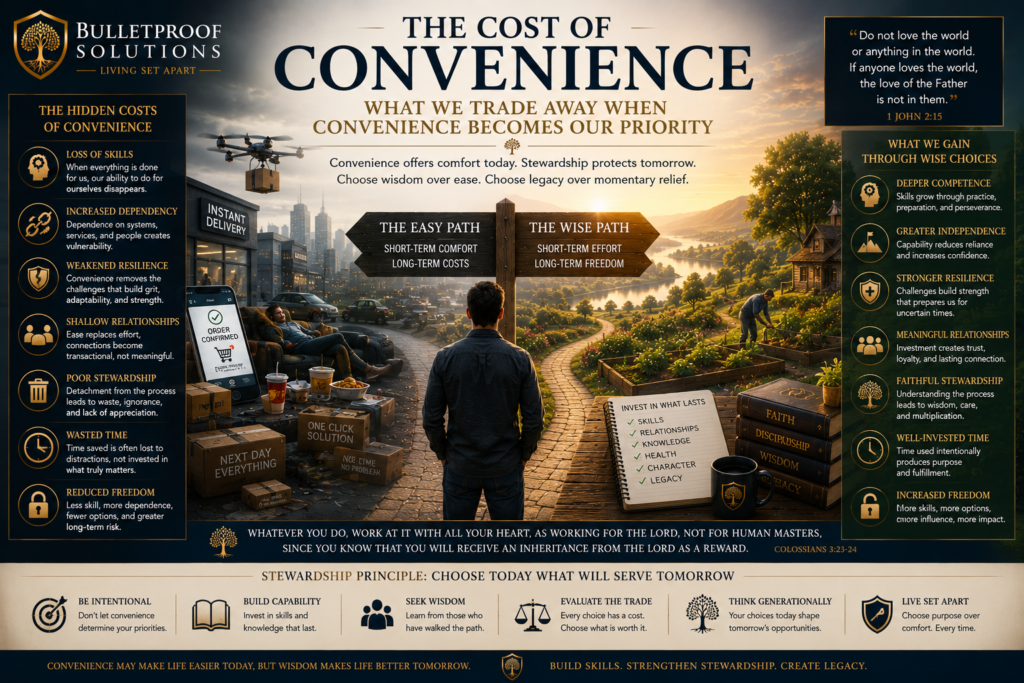
Few forces have shaped modern society more than convenience.
Entire industries are built around it.
Products are designed for it.
Technology advances because of it.
Businesses compete based upon it.
Consumers often choose one option over another because it appears easier, faster, or more comfortable.
Convenience is not inherently bad.
In many situations, convenience saves time, reduces effort, and improves efficiency.
The problem arises when convenience becomes the highest value guiding our decisions.
When convenience becomes the primary goal, something important is often sacrificed.
The question is not whether convenience has benefits.
The question is:
What are we giving up in exchange for it?
Understanding the hidden costs of convenience is essential for anyone seeking to live intentionally and steward life responsibly.
Previous generations often invested significant effort into daily activities.
Food was prepared from scratch.
Clothing was repaired rather than discarded.
Skills were learned through practice and repetition.
Communities relied heavily upon one another.
Modern life operates differently.
Food can arrive at the door within minutes.
Information is available instantly.
Purchases require only a few clicks.
Communication occurs across the globe in seconds.
These developments provide genuine benefits.
Yet they have also changed expectations.
Many people now assume that faster automatically means better.
Easier automatically means better.
More convenient automatically means better.
Unfortunately, reality is often more complicated.
One of the hidden costs of convenience is the gradual loss of competence.
When machines perform tasks for us, skills often deteriorate.
When technology remembers information for us, memory weakens.
When systems solve problems automatically, problem-solving abilities decline.
This principle appears throughout society.
Many people know how to consume information.
Fewer know how to verify it.
Many people know how to purchase products.
Fewer know how to produce them.
Many people know how to use systems.
Fewer understand how those systems actually work.
Convenience often reduces the need for effort.
Effort is frequently where competence is developed.
Stewardship requires involvement.
Convenience often encourages detachment.
A steward understands resources because they interact with them.
They understand where things come from.
They understand how things function.
They understand what is required to maintain them.
Convenience can create distance between people and the things they depend upon.
Food becomes something that simply appears.
Knowledge becomes something that simply appears.
Services become something that simply appears.
The deeper understanding often disappears.
The result is increased dependence upon systems that many people no longer understand.
Perhaps the greatest hidden cost of convenience is dependency.
The more dependent a person becomes upon external systems, the more vulnerable they become when those systems fail.
This does not mean technology is bad.
It means dependence creates risk.
A person who cannot cook is dependent upon others for food preparation.
A person who cannot manage finances is dependent upon others for financial guidance.
A person who cannot solve basic problems becomes dependent upon outside solutions.
The issue is not whether assistance exists.
The issue is whether capability exists when assistance becomes unavailable.
Stewardship seeks capability before convenience.
Many of life’s most valuable lessons emerge through difficulty.
Patience develops through waiting.
Discipline develops through effort.
Competence develops through practice.
Wisdom develops through experience.
Convenience often removes friction.
While friction can be frustrating, it is frequently the mechanism through which growth occurs.
A seed grows by pushing through resistance.
Muscles grow through resistance.
Skills develop through repetition.
Character develops through challenges.
Removing every obstacle may create comfort.
It does not necessarily create strength.
Relationships also suffer when convenience becomes the highest priority.
Healthy relationships require time.
They require effort.
They require communication.
They require patience.
These things are rarely convenient.
A friendship cannot be automated.
Trust cannot be downloaded.
Community cannot be purchased.
Meaningful relationships require investment.
When convenience becomes the dominant value, relationships often become transactional.
People begin evaluating relationships according to ease rather than commitment.
The result is often loneliness despite unprecedented connectivity.
One of the strongest arguments for convenience is that it saves time.
Sometimes it does.
However, many people discover that the time saved simply becomes filled with additional distractions.
Technology promised more free time.
Many people now feel busier than ever.
Convenience creates opportunities.
Whether those opportunities are used wisely remains a separate question.
Time saved is only valuable if it is invested intentionally.
Otherwise, convenience merely accelerates consumption.
Stewards participate.
They engage.
They learn.
They practice.
They contribute.
Convenience often encourages passivity.
The steward asks:
How does this work?
What responsibility do I have here?
What skills should I develop?
What knowledge should I preserve?
What capabilities should I strengthen?
These questions encourage involvement rather than dependence.
The steward recognizes that participation often creates resilience.
Resilience is the ability to adapt and function during uncertainty.
Convenience and resilience are not always aligned.
Convenience often prioritizes efficiency.
Resilience prioritizes stability.
An efficient system may perform exceptionally well under ideal conditions.
A resilient system continues functioning when conditions become difficult.
The same principle applies to individuals.
A person who develops skills, knowledge, and adaptability becomes more resilient.
Resilience provides options.
Options create freedom.
Stewardship therefore seeks resilience even when convenience appears attractive.
Living set apart frequently requires choosing purpose over comfort.
Not because comfort is wrong.
Because purpose matters more.
Many worthwhile pursuits require effort.
Learning requires effort.
Building relationships requires effort.
Developing competence requires effort.
Serving others requires effort.
Creating legacy requires effort.
Convenience may reduce effort.
It cannot replace purpose.
A life organized around convenience often becomes shallow.
A life organized around purpose often becomes meaningful.
Convenience is a tool.
Like any tool, it can be used wisely or poorly.
The problem is not convenience itself.
The problem occurs when convenience becomes the highest value guiding decisions.
When convenience dominates, competence often declines.
Dependency increases.
Resilience decreases.
Relationships weaken.
Stewardship suffers.
Living set apart requires a different perspective.
It requires asking not only:
“What is easiest?”
But also:
“What is wisest?”
“What creates capability?”
“What strengthens stewardship?”
“What builds resilience?”
“What serves future generations?”
These questions help reveal the true cost of convenience.
More importantly, they help ensure that convenience remains a servant rather than becoming a master.
The steward understands that comfort has value.
But purpose has greater value.
Convenience has benefits.
But capability has greater benefits.
And while convenience may improve today, stewardship helps preserve tomorrow.
Stewardship often requires choosing long-term value over short-term convenience.
Explore the educational resources, training, discussions, and community available through BulletProof Solutions and continue building the skills, knowledge, and resilience necessary for living intentionally and stewarding faithfully.