
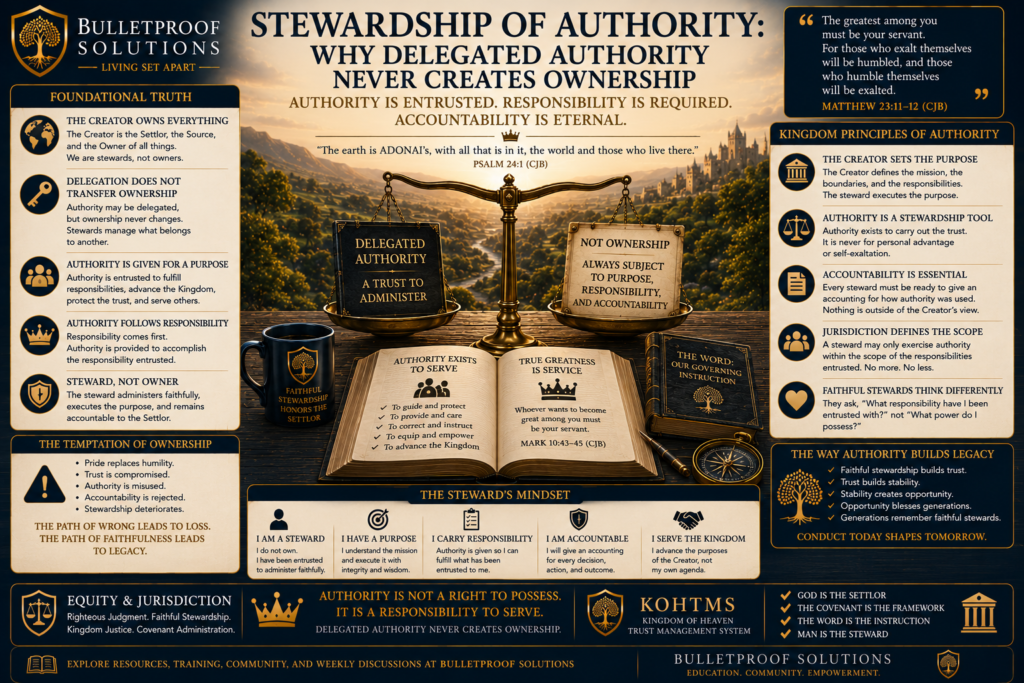
One of the greatest misunderstandings in administration occurs when authority is confused with ownership.
People are entrusted with authority.
Positions are granted.
Responsibilities are delegated.
Offices are established.
Leadership roles are assigned.
Over time, many begin treating delegated authority as though it were ownership.
Scripture consistently rejects this idea.
Throughout the Word of God, authority is presented as a stewardship.
Not ownership.
Not entitlement.
Not personal property.
Authority is entrusted for a purpose.
It remains connected to responsibility.
And it remains subject to accountability.
This principle lies at the very heart of Kingdom administration.
It also lies at the very heart of the Kingdom of Heaven Trust Management System.
The foundation of Kingdom administration begins with a simple truth.
The Creator owns everything.
“The earth is ADONAI’s, with all that is in it,
the world and those who live there.”
(Psalm 24:1 CJB)
This principle establishes the foundation for all stewardship.
The Creator is the source.
The Creator is the Settlor.
The Creator establishes the Covenant.
The Creator establishes the purpose.
The Creator determines the responsibilities.
Human beings therefore function as administrators of what belongs to another.
This truth changes how authority is understood.
Authority does not originate with man.
Authority is entrusted by the Creator.
One of the simplest examples of this principle appears throughout Scripture.
The Creator delegates responsibilities.
He delegates authority.
He delegates assignments.
Yet ownership remains unchanged.
A steward managing land does not become the owner.
A servant managing resources does not become the owner.
A trustee administering property does not become the owner.
The delegation of authority creates responsibility.
It does not create ownership.
This distinction is essential.
Confusing stewardship with ownership is often the first step toward corruption.
Authority exists for a purpose.
Authority is not granted merely to elevate status.
Authority exists to fulfill responsibilities.
Parents receive authority to nurture and guide children.
Elders receive authority to shepherd communities.
Judges receive authority to administer justice.
Trustees receive authority to administer trusts.
Administrators receive authority to execute responsibilities.
The purpose remains consistent.
Authority exists to facilitate faithful stewardship.
The moment authority becomes disconnected from purpose, administration begins to deteriorate.
Modern systems often teach that authority creates responsibility.
Kingdom administration reverses the order.
Responsibility comes first.
Authority follows responsibility.
The Creator entrusts a responsibility.
Authority is then provided to fulfill that responsibility.
This distinction matters because it keeps administration aligned with purpose.
The steward asks:
What responsibility has been entrusted to me?
Only then does the steward consider what authority is necessary to fulfill it.
This perspective protects against abuse.
One of the oldest temptations in human history is the desire to possess what was only entrusted.
Throughout Scripture we repeatedly encounter this pattern.
Stewards begin treating trusts as possessions.
Leaders begin treating authority as personal property.
Administrators begin acting as owners rather than servants.
The result is almost always the same.
Accountability weakens.
Pride increases.
Stewardship deteriorates.
The Creator consistently opposes this pattern because it violates the nature of delegated authority.
Yeshua repeatedly taught that greatness within the Kingdom operates differently from worldly systems.
The world often associates authority with control.
The Kingdom associates authority with service.
The world seeks position.
The Kingdom seeks stewardship.
The world seeks power.
The Kingdom seeks responsibility.
The greater the authority entrusted within the Kingdom, the greater the obligation to serve faithfully.
This principle completely transforms administration.
Trust administration provides a useful example.
A trustee may possess significant authority.
The trustee may manage resources.
Make decisions.
Execute transactions.
Administer property.
Yet none of these powers create ownership.
The trustee remains accountable to the purpose of the trust.
The trustee remains accountable to the responsibilities accepted.
The trustee remains accountable for faithful administration.
Authority therefore serves stewardship.
It does not replace it.
Because authority is delegated rather than owned, accountability becomes essential.
The steward must remain prepared to explain:
Why decisions were made.
How resources were administered.
Whether responsibilities were fulfilled.
Whether authority was exercised faithfully.
Accountability reminds the steward that authority remains connected to trust.
Trust remains connected to responsibility.
Responsibility remains connected to the Creator.
This chain preserves faithful administration.
Jurisdiction and authority are closely connected.
Jurisdiction defines the scope of responsibility.
Authority exists within that scope.
A steward cannot legitimately exercise authority beyond the responsibilities entrusted.
Nor should authority be exercised for purposes unrelated to the trust itself.
Understanding this principle prevents many forms of administrative overreach.
The steward operates within the jurisdiction established by the trust relationship.
Not beyond it.
The faithful steward rarely asks:
What power do I possess?
The faithful steward asks:
What responsibility have I been entrusted with?
This difference may appear subtle.
In reality, it transforms administration.
Power-centered thinking often seeks expansion.
Responsibility-centered thinking seeks faithfulness.
Power-centered thinking seeks control.
Responsibility-centered thinking seeks service.
Kingdom administration consistently favors the latter.
The way authority is exercised influences future generations.
Faithful stewardship creates trust.
Trust creates stability.
Stability creates opportunities.
Future generations inherit the benefits.
Abused authority produces the opposite result.
Trust weakens.
Communities fracture.
Resources are lost.
Future opportunities diminish.
The steward therefore recognizes that authority carries consequences extending far beyond the present moment.
Within KOHTMS, authority is never viewed as ownership.
Authority is a stewardship tool.
It exists to execute the expressed Will of the Creator.
It exists to protect the trust.
It exists to preserve the inheritance.
It exists to advance Kingdom purposes.
This perspective keeps authority properly aligned.
The steward remains a steward.
The Creator remains the Settlor.
The Covenant remains the governing framework.
Faithful administration remains the objective.
One of the most important principles in Kingdom administration is the distinction between ownership and stewardship.
The Creator owns.
The steward administers.
The Creator entrusts.
The steward accounts.
The Creator establishes purpose.
The steward executes that purpose faithfully.
Authority therefore remains a delegated responsibility rather than personal property.
The faithful steward never forgets this distinction.
Because the moment authority becomes ownership, stewardship begins to fail.
But when authority remains connected to responsibility, accountability, and faithful administration, the purposes of the Kingdom can advance through righteous stewardship.
Explore stewardship, trusteeship, jurisdiction, covenant administration, accountability, and Kingdom governance through the educational resources, discussions, training programs, and community available through BulletProof Solutions.