
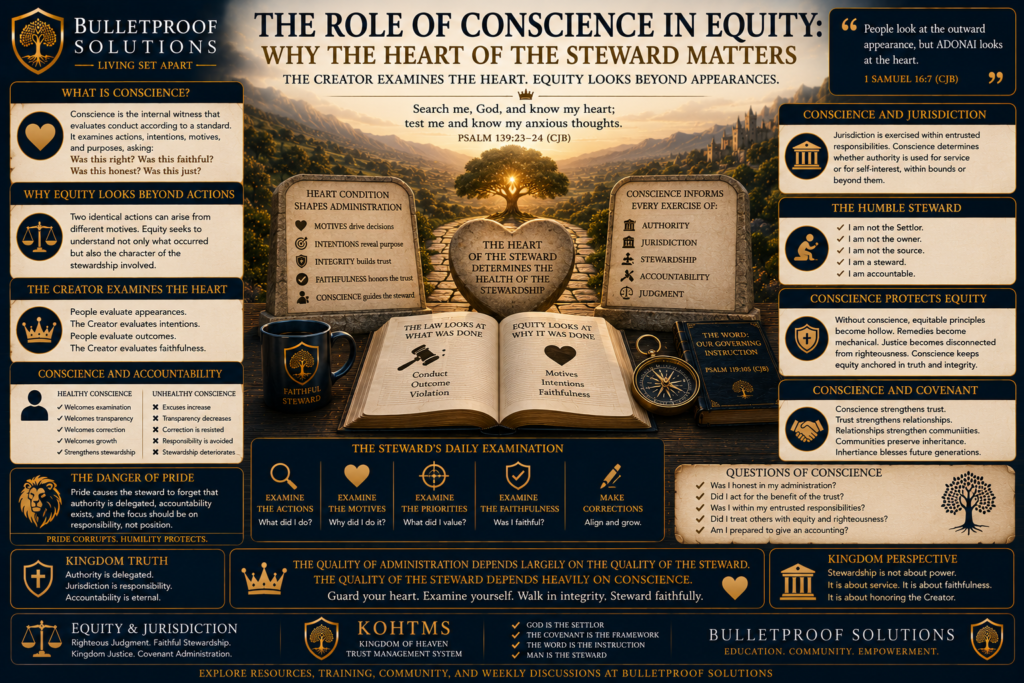
Throughout Scripture, the Creator consistently demonstrates a concern that extends far beyond outward conduct.
Human beings often focus upon appearances.
The Creator examines the heart.
This distinction lies at the center of Kingdom administration.
It also lies at the center of equity.
Many people assume that judgment concerns only actions.
What happened?
Who acted?
What rule was violated?
What remedy should be applied?
These questions are important.
Yet Scripture repeatedly reveals a deeper layer.
Why was the action taken?
What was the intention?
What motivated the steward?
Was the administration faithful?
Was the conduct righteous?
These questions involve conscience.
And conscience plays a vital role in both stewardship and equitable administration.
Conscience may be understood as the internal witness that evaluates conduct according to a standard.
It examines actions.
Intentions.
Motives.
Purposes.
It asks questions such as:
Was this right?
Was this faithful?
Was this honest?
Was this just?
Throughout Scripture, conscience functions as an important aspect of accountability.
Even when others do not see.
The steward sees.
Even when records are incomplete.
The conscience remains.
Even when excuses are available.
The conscience continues to testify.
For this reason, conscience serves as one of the Creator’s most powerful tools of stewardship.
Law often focuses upon conduct.
Equity frequently examines conduct and conscience together.
The reason is simple.
Two identical actions may arise from entirely different motives.
One person may act faithfully.
Another may act deceptively.
One may seek restoration.
Another may seek personal advantage.
The outward conduct appears similar.
The underlying administration is completely different.
Equity therefore seeks to understand not only what occurred but also the character of the stewardship involved.
Scripture repeatedly teaches that the Creator examines the heart.
People evaluate appearances.
The Creator evaluates intentions.
People often evaluate outcomes.
The Creator evaluates faithfulness.
This principle appears throughout Scripture.
Leaders were evaluated by their hearts.
Kings were evaluated by their hearts.
Stewards were evaluated by their hearts.
The issue was not merely performance.
The issue was faithful administration.
The condition of the heart determined the quality of the stewardship.
A healthy conscience strengthens accountability.
The steward with a healthy conscience welcomes examination.
Welcomes transparency.
Welcomes correction.
Welcomes growth.
The steward understands that accountability protects faithful administration.
An unhealthy conscience produces the opposite.
Excuses increase.
Transparency decreases.
Correction is resisted.
Responsibility is avoided.
Over time stewardship deteriorates.
This is why conscience matters so deeply.
It influences every aspect of administration.
One of the least understood aspects of jurisdiction is the role conscience plays in its exercise.
A steward may possess legitimate authority.
The question becomes:
How is that authority exercised?
The answer depends heavily upon conscience.
A steward guided by a healthy conscience remains within proper boundaries.
A steward guided by pride often exceeds them.
A steward guided by service protects the trust.
A steward guided by self-interest exploits it.
Conscience therefore influences whether jurisdiction is exercised faithfully or abused.
Pride is one of the greatest threats to righteous administration.
Pride causes the steward to forget that authority is delegated.
Pride causes the steward to forget accountability.
Pride causes the steward to focus upon position rather than responsibility.
Throughout Scripture, pride repeatedly undermines stewardship.
The steward begins serving self.
The trust suffers.
The community suffers.
Future generations suffer.
This is why humility remains essential to faithful administration.
Humility protects conscience.
The humble steward understands several important truths.
I am not the Settlor.
I am not the owner.
I am not the source.
I am a steward.
This perspective shapes conscience.
It encourages service.
It encourages accountability.
It encourages faithfulness.
Humility keeps the steward aligned with the purpose of the trust.
The steward remains focused upon administration rather than self-glorification.
Equity seeks justice.
Justice requires faithful administration.
Faithful administration requires healthy conscience.
Without conscience, equitable principles become hollow.
Remedies become mechanical.
Administration becomes technical.
Justice becomes disconnected from righteousness.
The faithful steward therefore cultivates conscience carefully.
Because conscience helps ensure that equity remains connected to righteousness.
Wise stewards regularly examine themselves.
Not merely their actions.
Their motives.
Their priorities.
Their intentions.
Their conduct.
Scripture repeatedly encourages self-examination.
The purpose is not condemnation.
The purpose is correction.
The steward who examines themselves regularly remains better prepared for faithful administration.
Small problems are corrected before becoming large problems.
The conscience remains sensitive.
Stewardship remains healthy.
The Everlasting Covenant is relational.
Relationships require trust.
Trust requires integrity.
Integrity requires conscience.
For this reason conscience plays a critical role in covenant administration.
A steward with a healthy conscience strengthens trust.
Trust strengthens relationships.
Relationships strengthen communities.
Communities preserve inheritance.
Inheritance blesses future generations.
The chain begins with faithful stewardship.
And faithful stewardship begins in the heart.
Within the Kingdom of Heaven Trust Management System, administration is never merely procedural.
It is relational.
It is covenantal.
It is stewardship-based.
The quality of administration depends largely upon the quality of the steward.
The quality of the steward depends heavily upon conscience.
This is why conscience matters.
It influences every decision.
Every exercise of authority.
Every act of stewardship.
Every accounting.
Every judgment.
The heart of the steward ultimately shapes the administration of the trust.
Many systems focus almost exclusively upon external conduct.
The Kingdom focuses upon something deeper.
The heart.
Conscience serves as the steward’s internal witness.
It evaluates motives.
Intentions.
Purposes.
Faithfulness.
A healthy conscience strengthens stewardship.
Strengthens accountability.
Strengthens equity.
Strengthens covenant relationships.
For this reason, the faithful steward guards conscience carefully.
Because administration ultimately flows from the heart.
And the heart of the steward often determines whether authority produces blessing or corruption.
Whether jurisdiction produces service or domination.
Whether stewardship produces legacy or loss.
The Creator therefore examines more than actions.
The Creator examines the steward.
And faithful Kingdom administration begins with a conscience aligned with the Creator’s Will.
Explore stewardship, conscience, covenant administration, jurisdiction, accountability, equity, and Kingdom governance through the educational resources, discussions, training programs, and community available through BulletProof Solutions.