
One of the most important questions a person can ask is:
Who am I?
Many people spend their lives searching for the answer.
Some define themselves by occupation.
Others by nationality.
Others by education.
Achievements.
Organizations.
Institutions.
Positions.
Relationships.
Scripture presents identity differently.
The Creator defines identity through relationship with Him.
When a person enters covenant with the Creator, they enter more than a spiritual relationship.
They enter a stewardship relationship.
An administrative relationship.
A Kingdom relationship.
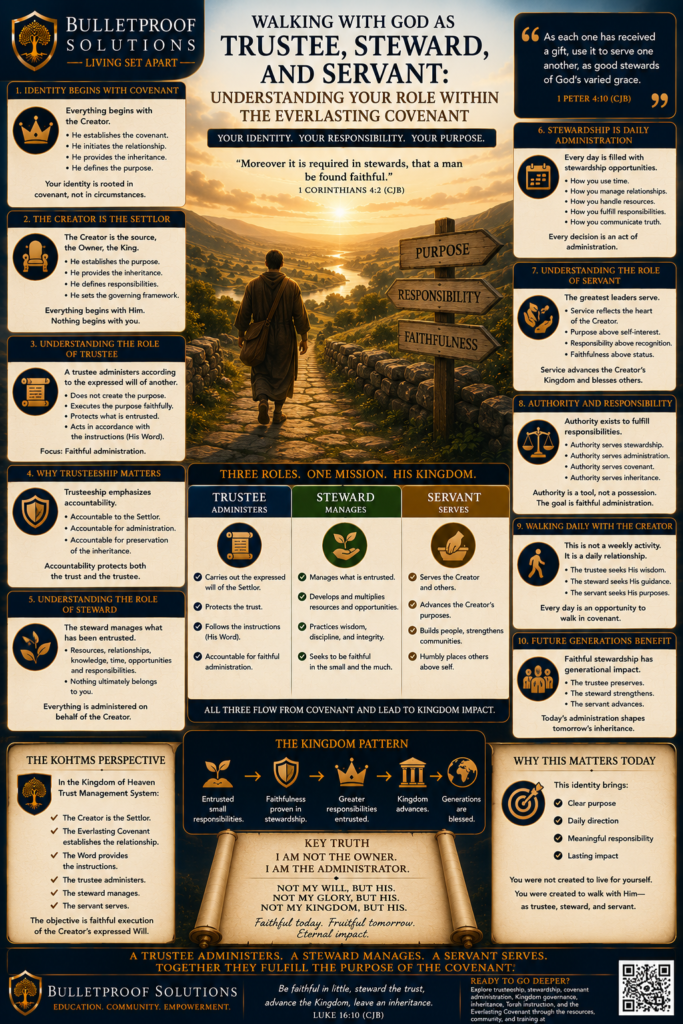
Within the Kingdom of Heaven Trust Management System, this relationship can be understood through three interconnected roles:
Trustee.
Steward.
Servant.
Understanding these roles helps clarify purpose, responsibility, authority, accountability, and daily living within the Everlasting Covenant.
Before discussing responsibilities, we must begin with relationship.
The Creator establishes the covenant.
The Creator initiates the relationship.
The Creator provides the inheritance.
The Creator establishes the purpose.
Everything begins with Him.
The steward’s identity therefore does not originate from self-definition.
It originates from covenant.
This distinction matters.
Because identity rooted in covenant remains stable regardless of circumstances.
The Creator remains constant.
The covenant remains constant.
The relationship remains constant.
The steward therefore builds life upon a solid foundation.
Throughout Scripture, the Creator consistently appears as the source.
The Owner.
The King.
The Author.
The Provider.
The One from whom all things originate.
Within KOHTMS terminology, the Creator may be understood as the Settlor of the Everlasting Covenant.
He establishes the purpose.
Provides the inheritance.
Defines the responsibilities.
Creates the governing framework.
The faithful steward never forgets this reality.
Everything begins with the Creator.
Nothing begins with the steward.
A trustee administers according to the expressed will of another.
This concept appears throughout Scripture.
The faithful trustee does not create the purpose.
The faithful trustee executes the purpose.
The trustee protects what has been entrusted.
Administers faithfully.
Acts in accordance with the instructions provided.
The Creator’s expressed Will is revealed through His Word.
The faithful trustee therefore seeks to understand and implement those instructions.
The trustee’s focus is not personal preference.
The trustee’s focus is faithful administration.
Many people desire authority.
Far fewer desire accountability.
Trusteeship emphasizes accountability.
The trustee remains accountable to the Settlor.
Accountable to the expressed purpose.
Accountable for administration.
Accountable for preservation of the inheritance.
This accountability protects both the trust and the trustee.
The faithful trustee welcomes accountability because accountability strengthens stewardship.
While trusteeship emphasizes administration, stewardship emphasizes care.
The steward manages what has been entrusted.
Resources.
Relationships.
Knowledge.
Time.
Opportunities.
Responsibilities.
The steward recognizes that everything originates with the Creator.
Nothing ultimately belongs to the steward.
Everything is administered on behalf of the Creator.
This perspective transforms daily life.
Life itself becomes stewardship.
Many people imagine stewardship as something occasional.
Scripture presents stewardship as continuous.
Every day presents stewardship opportunities.
How time is used.
How relationships are managed.
How resources are administered.
How responsibilities are fulfilled.
How truth is communicated.
How opportunities are handled.
The faithful steward recognizes that every decision contributes to administration of the trust.
Stewardship becomes a way of life.
Modern culture often misunderstands servanthood.
The world frequently associates service with weakness.
Scripture presents service differently.
The greatest leaders serve.
The greatest stewards serve.
The greatest administrators serve.
The Kingdom consistently elevates faithful service.
Because service reflects the character of the Creator.
Service places purpose above self-interest.
Responsibility above recognition.
Faithfulness above status.
This perspective transforms leadership itself.
Trusteeship without service can become rigid.
Stewardship without service can become self-focused.
Service keeps administration aligned with Kingdom purposes.
The servant remembers:
I am here to advance the Creator’s purposes.
Not merely my own.
This perspective protects humility.
Protects relationships.
Protects faithful administration.
The servant remains focused upon the well-being of others and the advancement of the Kingdom.
Many people focus on authority.
Scripture consistently emphasizes responsibility.
Within the Kingdom, authority exists to fulfill responsibilities.
Authority serves stewardship.
Authority serves administration.
Authority serves covenant.
Authority serves inheritance.
The faithful trustee, steward, and servant therefore view authority as a tool rather than a possession.
The objective is faithful administration.
Not personal power.
Walking with the Creator is not merely a weekly activity.
It is a daily relationship.
Every decision becomes an opportunity for stewardship.
Every challenge becomes an opportunity for trust.
Every responsibility becomes an opportunity for faithful administration.
The trustee seeks His wisdom.
The steward seeks His guidance.
The servant seeks His purposes.
The relationship becomes active.
Living.
Practical.
This is what it means to walk in covenant.
The Kingdom consistently develops people through responsibility.
The Creator entrusts small things before larger things.
Faithfulness precedes expansion.
Character precedes authority.
Stewardship precedes inheritance.
This pattern appears repeatedly throughout Scripture.
The faithful trustee, steward, and servant embraces this process.
Growth occurs through faithful administration.
One of the most remarkable aspects of faithful stewardship is its generational impact.
The trustee preserves inheritance.
The steward strengthens inheritance.
The servant advances inheritance.
Future generations receive the benefits.
Knowledge is preserved.
Wisdom is preserved.
Resources are preserved.
Communities are strengthened.
The Kingdom advances.
The faithful steward therefore recognizes that today’s administration shapes tomorrow’s opportunities.
Within the Kingdom of Heaven Trust Management System, the Creator remains the Settlor.
The Everlasting Covenant establishes the relationship.
The Word provides the instructions.
The trustee administers.
The steward manages.
The servant serves.
These roles function together.
Each supports the others.
Together they provide a practical framework for understanding life within the Kingdom.
The objective is faithful execution of the Creator’s expressed Will.
Many people feel disconnected from purpose.
They know what they do.
But not why they do it.
The Everlasting Covenant provides clarity.
The faithful participant understands their role.
Trustee.
Steward.
Servant.
This identity provides direction.
Purpose.
Responsibility.
Meaning.
The relationship becomes practical rather than abstract.
The Creator’s Kingdom operates through covenant.
Covenant creates stewardship.
Stewardship creates administration.
Administration requires faithful participants.
The faithful participant therefore learns to walk with the Creator as:
A trustee who faithfully administers His expressed Will.
A steward who faithfully manages what has been entrusted.
A servant who faithfully advances His purposes.
These roles provide clarity.
Purpose.
Responsibility.
Identity.
The faithful steward no longer asks:
Who am I?
The covenant already provides the answer.
I am a trustee.
A steward.
A servant.
And my responsibility is to faithfully administer the Creator’s trust until the day I give an accounting.
Explore trusteeship, stewardship, covenant administration, Kingdom governance, inheritance, Torah instruction, and the Everlasting Covenant through the educational resources, discussions, training programs, and community available through BulletProof Solutions.