
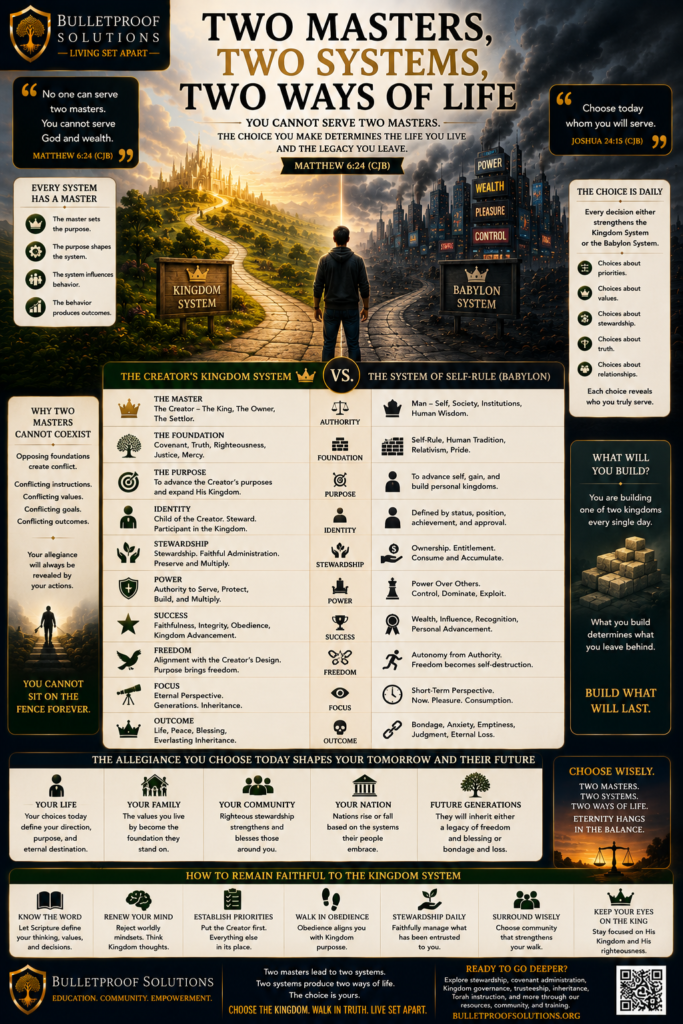
One of the most profound statements found in Scripture is also one of the simplest.
No man can serve two masters.
At first glance, the statement appears straightforward.
Yet the implications reach into every area of life.
Identity.
Stewardship.
Authority.
Governance.
Purpose.
Inheritance.
Allegiance.
The Creator consistently presents life as a matter of choice.
Not merely a choice between actions.
But a choice between masters.
Between systems.
Between ways of life.
Every person ultimately serves something.
Every person ultimately submits to some source of authority.
Every person ultimately organizes life around a central allegiance.
The question is not whether a master exists.
The question is which master is being served.
Understanding this principle is essential for anyone seeking to live set apart within the Everlasting Covenant.
Systems do not arise from nothing.
Every system reflects assumptions.
Values.
Priorities.
Goals.
Those assumptions originate somewhere.
Behind every system stands a source of authority.
Behind every authority stands a master.
The master determines purpose.
The purpose shapes the system.
The system influences behavior.
The behavior produces outcomes.
This pattern appears repeatedly throughout Scripture.
The faithful steward learns to look beyond appearances and ask:
Who does this system serve?
What values does it promote?
What purpose does it advance?
The Creator established His Kingdom upon covenant.
Truth.
Stewardship.
Faithfulness.
Justice.
Mercy.
Inheritance.
Service.
The Kingdom exists to advance His purposes.
The Creator remains the source.
The Owner.
The Settlor.
The King.
Everything within the Kingdom flows from that reality.
Authority exists to serve.
Resources exist to steward.
Relationships exist to strengthen.
Inheritance exists to preserve.
The Kingdom system reflects the character of the Creator Himself.
Scripture repeatedly contrasts the Creator’s Kingdom with systems built upon self-rule.
These systems may appear in different forms throughout history.
Different nations.
Different institutions.
Different cultures.
Different governments.
Yet the underlying principle remains the same.
Man becomes the highest authority.
Human wisdom becomes the standard.
Human desire becomes the guide.
Human ambition becomes the objective.
This is the spirit that Scripture often associates with Babylon.
Not merely a location.
A way of thinking.
A way of governing.
A way of living.
Many people attempt to divide allegiance.
A little of one system.
A little of another.
A little covenant.
A little compromise.
A little stewardship.
A little self-rule.
The difficulty is that opposing foundations eventually create conflict.
When two authorities give conflicting instructions, a choice must be made.
When two systems define success differently, a choice must be made.
When two masters demand loyalty, a choice must be made.
Eventually the steward reveals true allegiance through action.
This is why Scripture repeatedly emphasizes wholehearted devotion.
The master a person serves shapes identity.
Under the Babylon mindset, identity often comes from:
Occupation.
Possessions.
Status.
Recognition.
Power.
Titles.
Public approval.
The Kingdom establishes identity differently.
The faithful steward understands:
I belong to the Creator.
I participate in His covenant.
I administer His trust.
I serve His purposes.
Identity becomes rooted in relationship rather than circumstance.
The world often defines freedom as autonomy.
The ability to answer to no one.
The ability to do whatever one desires.
Scripture presents freedom differently.
Freedom comes through alignment with the Creator’s design.
The fish experiences freedom in water.
The bird experiences freedom in flight.
The steward experiences freedom through faithful administration.
The Kingdom understands that purpose and freedom work together.
Babylon often separates them.
The Kingdom teaches stewardship.
Babylon teaches ownership.
The Kingdom asks:
How should this be administered?
Babylon asks:
How can this be used for me?
The Kingdom focuses on responsibility.
Babylon focuses on entitlement.
The Kingdom preserves inheritance.
Babylon consumes inheritance.
This distinction influences how resources, relationships, and opportunities are handled.
One system measures success through accumulation.
The other measures success through faithfulness.
One seeks recognition.
The other seeks obedience.
One seeks personal advancement.
The other seeks Kingdom advancement.
The faithful steward eventually discovers that success in one system may appear as failure in the other.
This is why Kingdom priorities often seem strange to the world.
The measurements are different.
Many people imagine allegiance as a single event.
Scripture presents it as a daily reality.
Every day presents choices.
Choices about priorities.
Choices about values.
Choices about stewardship.
Choices about truth.
Choices about relationships.
Each decision strengthens one system or the other.
The faithful steward continually chooses covenant.
Continually chooses stewardship.
Continually chooses Kingdom administration.
Living set apart is ultimately about allegiance.
Not geography.
Not appearances.
Not labels.
Allegiance.
The steward may live among worldly systems while remaining loyal to the Creator.
The issue is not proximity.
The issue is loyalty.
The faithful steward learns to participate where necessary without surrendering identity.
Without surrendering purpose.
Without surrendering allegiance.
Within the Kingdom of Heaven Trust Management System, this principle becomes foundational.
The Creator remains the Settlor.
The Everlasting Covenant remains the governing framework.
The Word provides the instructions.
The steward administers according to those instructions.
The Kingdom operates according to covenant.
Other systems may operate according to different assumptions.
The faithful steward must determine which framework governs their administration.
This decision influences every area of life.
Every generation inherits the consequences of prior allegiances.
Families inherit values.
Communities inherit priorities.
Nations inherit systems.
The faithful steward therefore thinks beyond personal benefit.
The question becomes:
What am I passing forward?
What system am I strengthening?
What inheritance am I preserving?
Future generations will live with the results.
This makes faithful stewardship even more important.
Scripture presents a reality that many people spend their entire lives attempting to avoid.
No man can serve two masters.
Every person ultimately chooses a source of authority.
A system.
A way of life.
The Kingdom calls the faithful steward into covenant.
Stewardship.
Service.
Inheritance.
Faithfulness.
Babylon calls people toward autonomy.
Self-rule.
Consumption.
Self-interest.
The choice is not always obvious.
The choice is not always easy.
But the choice is unavoidable.
Every day the steward decides which system will guide decisions.
Which master will receive loyalty.
Which way of life will shape the future.
Because two masters lead to two systems.
Two systems produce two ways of life.
And those two ways of life ultimately lead to two very different destinations.
Explore stewardship, covenant administration, Kingdom governance, trusteeship, inheritance, Torah instruction, and practical pathways for living set apart through the educational resources, discussions, training programs, and community available through BulletProof Solutions.