
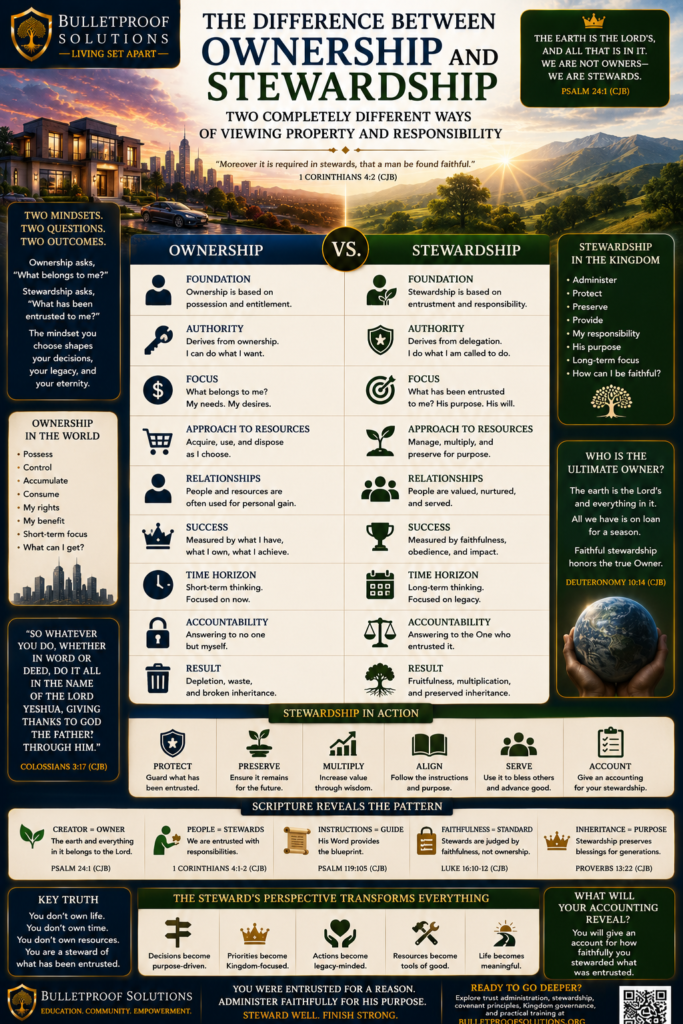
One of the most important distinctions a person can learn is the difference between ownership and stewardship.
At first glance the difference may appear small.
Both involve property.
Both involve responsibility.
Both involve administration.
Yet beneath the surface they represent two completely different ways of viewing life.
One asks:
“What belongs to me?”
The other asks:
“What has been entrusted to me?”
This distinction affects how people view resources.
Relationships.
Authority.
Inheritance.
Responsibilities.
Even life itself.
Throughout Scripture, the Creator consistently teaches stewardship.
The world often emphasizes ownership.
Understanding the difference helps explain not only trust administration, but also covenant administration, Kingdom governance, and faithful living.
Ownership generally describes a relationship in which a person possesses legal or beneficial rights to something.
An owner typically enjoys broad authority over the thing owned.
The owner may use it.
Transfer it.
Sell it.
Destroy it.
Preserve it.
The owner’s authority arises from ownership itself.
Modern society places tremendous emphasis upon ownership.
People are encouraged to acquire.
Accumulate.
Possess.
Control.
Protect.
Ownership becomes one of the primary ways people define success.
The focus often becomes:
What do I own?
What can I acquire?
What belongs to me?
Stewardship begins from a different foundation.
The steward administers something entrusted by another.
The steward possesses responsibility.
The steward may possess authority.
The steward may even possess control.
Yet the steward recognizes that administration and ownership are not necessarily the same thing.
The steward’s primary question becomes:
How should this be administered faithfully?
The focus shifts from possession to responsibility.
From entitlement to accountability.
From consumption to preservation.
Throughout Scripture, the Creator consistently presents Himself as the ultimate Owner.
The earth belongs to Him.
Creation belongs to Him.
Time belongs to Him.
Life belongs to Him.
Inheritance belongs to Him.
Human beings therefore appear primarily as stewards.
Entrusted administrators.
Caretakers.
Managers.
Servants.
Trustees.
This perspective changes how life is viewed.
The faithful steward recognizes that everything ultimately originates with the Creator.
Nothing exists independently from Him.
The pattern appears at the very beginning.
Adam was placed within the Garden.
Responsibilities were entrusted.
Authority was delegated.
Instructions were provided.
Accountability existed.
The Garden illustrates stewardship.
Adam administered.
Protected.
Cultivated.
Managed.
Yet the Garden remained the Creator’s.
This pattern becomes the foundation for understanding stewardship throughout Scripture.
Ownership naturally emphasizes rights.
What may I do?
What am I entitled to?
What belongs to me?
Rights certainly have their place.
Yet when rights become the primary focus, responsibility often diminishes.
The conversation shifts toward entitlement.
Protection of interests.
Personal benefit.
The steward operates differently.
The steward asks first about responsibilities.
Duties.
Obligations.
Purpose.
Faithful administration.
The steward recognizes that authority exists for a purpose.
Responsibilities accompany privileges.
Accountability accompanies authority.
The faithful steward understands:
The greater the stewardship, the greater the responsibility.
The greater the authority, the greater the accountability.
This perspective creates humility.
The steward views administration as a trust rather than an entitlement.
Ownership often encourages accumulation.
Stewardship encourages administration.
The owner may ask:
How much can I acquire?
The steward asks:
How faithfully can I manage what has been entrusted?
This difference affects spending.
Saving.
Investing.
Preservation.
Inheritance planning.
Community building.
The steward consistently evaluates decisions through the lens of responsibility.
The distinction extends beyond property.
It influences relationships as well.
People are not possessions.
Children are not possessions.
Communities are not possessions.
The faithful steward recognizes responsibilities toward others.
Responsibilities to nurture.
Protect.
Teach.
Serve.
Encourage.
Build.
Relationships become opportunities for stewardship rather than instruments of control.
The ownership mindset often views authority as power.
Control.
Influence.
Advantage.
The stewardship mindset views authority as delegated responsibility.
Authority exists to serve.
Protect.
Build.
Administer.
Preserve.
This distinction appears repeatedly throughout Scripture.
The greatest leaders are often the greatest servants.
The greatest authority carries the greatest accountability.
One of the greatest strengths of stewardship is its generational perspective.
The steward thinks beyond immediate benefit.
The steward considers future beneficiaries.
Future opportunities.
Future generations.
Inheritance becomes something to preserve rather than consume.
The faithful steward recognizes that today’s administration influences tomorrow’s opportunities.
This perspective strengthens families and communities.
This is one reason trusts exist.
The trustee functions as a steward.
Responsibilities are entrusted.
Instructions are provided.
Purpose is established.
Beneficiaries exist.
The trustee administers according to the purpose rather than personal desire.
Trust administration therefore reflects stewardship far more than ownership.
Understanding this principle helps clarify the true nature of trusts.
Owners often ask:
What belongs to me?
What may I do?
What are my rights?
Stewards often ask:
What has been entrusted to me?
What is my responsibility?
How can I administer faithfully?
What serves the purpose?
The questions reveal the mindset.
The mindset influences the administration.
Within the Kingdom of Heaven Trust Management System, stewardship serves as one of the foundational principles.
The Creator remains the ultimate Owner and Settlor.
The Everlasting Covenant establishes the relationship.
The Word provides the instructions.
The steward administers what has been entrusted.
This framework emphasizes responsibility over entitlement.
Administration over control.
Faithfulness over possession.
The objective is not merely acquiring.
The objective is faithfully administering according to the Creator’s purposes.
Modern culture frequently celebrates ownership while neglecting stewardship.
The result is often short-term thinking.
Consumption.
Waste.
Broken inheritance.
Weak accountability.
The stewardship model offers something better.
Purpose.
Responsibility.
Preservation.
Faithfulness.
Long-term thinking.
The faithful steward becomes a builder rather than merely a consumer.
Ownership and stewardship may appear similar from a distance.
Both involve administration.
Both involve authority.
Both involve responsibility.
Yet they begin from entirely different foundations.
Ownership asks:
What belongs to me?
Stewardship asks:
What has been entrusted to me?
Ownership emphasizes rights.
Stewardship emphasizes responsibilities.
Ownership often focuses upon possession.
Stewardship focuses upon faithful administration.
The Creator consistently teaches stewardship because stewardship reflects the reality of life itself.
Everything we possess.
Everything we manage.
Everything we influence.
Everything we administer.
Has ultimately been entrusted for a season.
The faithful steward therefore lives differently.
Thinks differently.
Administers differently.
Because stewardship recognizes a truth that ownership often forgets:
We are not merely possessors of resources.
We are caretakers of an inheritance.
And one day every steward will give an accounting for how faithfully that inheritance was administered.
Explore trust administration, stewardship, trusteeship, inheritance, covenant principles, Kingdom governance, and practical trust estate education through the educational resources, discussions, training programs, and community available through BulletProof Solutions.