
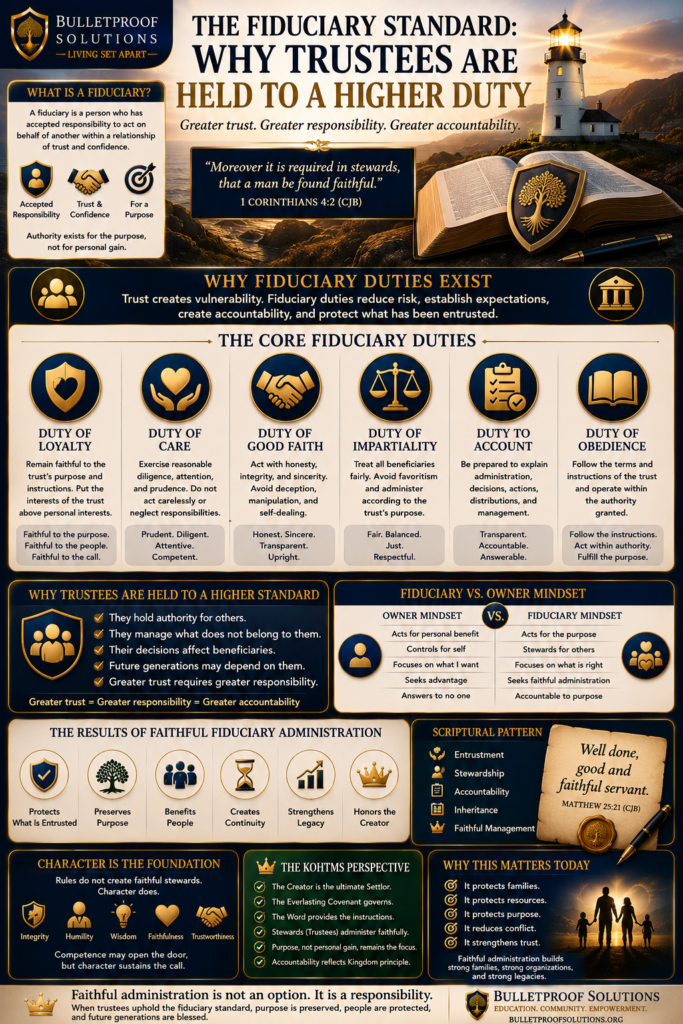
Not all responsibilities are equal.
Some responsibilities carry greater consequences.
Greater authority.
Greater trust.
Greater accountability.
Throughout society, certain positions require a higher standard of conduct because others depend upon the decisions being made.
Among the highest of these standards is the fiduciary standard.
Trustees occupy positions of confidence.
Resources are entrusted to them.
Responsibilities are entrusted to them.
People depend upon them.
Purposes depend upon them.
Inheritance may depend upon them.
For this reason, trustees are generally held to a higher duty than ordinary participants in a transaction.
Understanding this fiduciary standard is essential for anyone seeking to understand trusts, stewardship, and faithful administration.
A fiduciary is a person who has accepted responsibility to act on behalf of another within a relationship of trust and confidence.
The fiduciary does not merely possess authority.
The fiduciary possesses responsibility.
The fiduciary’s authority exists for a purpose.
That purpose guides the exercise of the authority.
A fiduciary therefore operates differently than someone acting solely for personal benefit.
The fiduciary must continually consider the interests and purposes connected to the position.
This principle lies at the heart of trust administration.
Fiduciary duties exist because trust creates vulnerability.
Whenever one person entrusts something valuable to another, risk emerges.
Property may be mismanaged.
Instructions may be ignored.
Purpose may be abandoned.
Beneficiaries may be harmed.
The fiduciary standard exists to reduce these risks.
It establishes expectations.
Creates accountability.
Encourages faithful administration.
Protects what has been entrusted.
Without fiduciary obligations, trust relationships become significantly weaker.
The fiduciary standard begins with a simple principle.
The position exists for the benefit of the purpose being administered.
Not for personal gain.
This distinction is critical.
The trustee is not supposed to ask:
How can I benefit from this position?
The trustee should ask:
How can I faithfully administer this responsibility?
This shift transforms the entire relationship.
The focus moves from self-interest to stewardship.
One of the most important fiduciary duties is loyalty.
Loyalty requires the trustee to remain faithful to the trust’s purpose.
Faithful to the instructions.
Faithful to the responsibilities accepted.
The trustee must avoid placing personal interests above the purpose of the trust.
This duty helps preserve integrity within administration.
Without loyalty, trust relationships quickly deteriorate.
The fiduciary standard also includes a duty of care.
The trustee is expected to exercise reasonable diligence, attention, and prudence.
The trustee should not act carelessly.
Should not ignore responsibilities.
Should not neglect administration.
Faithful stewardship requires effort.
Attention.
Competence.
The duty of care recognizes that entrusted responsibilities deserve serious administration.
Good faith requires honesty and sincerity.
The trustee should act with integrity.
The trustee should pursue the purpose honestly.
The trustee should avoid deception.
The trustee should avoid manipulation.
Good faith strengthens confidence.
Confidence strengthens trust.
Trust strengthens administration.
This principle remains essential to every fiduciary relationship.
Many trusts involve multiple beneficiaries.
Current beneficiaries.
Future beneficiaries.
Different interests.
Different needs.
The trustee often has a duty to remain impartial.
This does not mean every beneficiary receives identical treatment.
It means the trustee administers according to purpose rather than favoritism.
The trustee serves the trust.
Not personal preferences.
Perhaps no fiduciary duty illustrates accountability more clearly than the duty to account.
The trustee must be prepared to explain administration.
Decisions.
Actions.
Distributions.
Management.
Protection of assets.
The duty to account reflects a simple reality.
Authority without accountability often leads to abuse.
The faithful trustee welcomes accountability because accountability protects the integrity of administration.
Many people wonder why trustees are often judged more strictly than others.
The answer is simple.
Greater trust creates greater responsibility.
The trustee receives authority that belongs to the office.
Resources may be placed under administration.
Important decisions may affect beneficiaries.
Future generations may depend upon faithful stewardship.
Because the consequences are greater, the standard becomes greater as well.
Owners generally act for themselves.
Trustees act for a purpose.
Owners exercise personal discretion.
Trustees exercise fiduciary discretion.
Owners focus upon personal benefit.
Trustees focus upon faithful administration.
This distinction explains why fiduciary duties exist.
The trustee occupies a stewardship position rather than a purely personal position.
Scripture repeatedly emphasizes accountability for stewardship.
Servants are entrusted with responsibilities.
Administrators are evaluated.
Stewards are expected to act faithfully.
Accountings are required.
Inheritance is preserved through faithful administration.
The Creator consistently evaluates how entrusted responsibilities are managed.
This pattern closely resembles the principles underlying fiduciary administration.
The steward receives responsibility.
The steward acts faithfully.
The steward eventually gives an accounting.
The fiduciary standard ultimately depends upon character.
Rules alone cannot create faithful administration.
Documents alone cannot create integrity.
Procedures alone cannot create loyalty.
Character remains essential.
Honesty.
Faithfulness.
Humility.
Wisdom.
Patience.
Integrity.
These qualities strengthen fiduciary administration more than any technical skill.
The best trustees combine competence with character.
Within the Kingdom of Heaven Trust Management System, fiduciary administration reflects stewardship principles found throughout Scripture.
The Creator remains the ultimate Settlor.
The Everlasting Covenant remains the governing framework.
The Word provides the instructions.
The steward functions as trustee.
Faithful administration becomes the standard.
The steward is expected to administer according to purpose rather than personal advantage.
Accountability remains central.
This mirrors the broader Kingdom principle that authority is always connected to responsibility.
Modern culture often celebrates power.
Control.
Personal advantage.
The fiduciary standard teaches something different.
Authority exists to serve.
Responsibility accompanies privilege.
Stewardship accompanies administration.
Accountability accompanies authority.
These principles strengthen families.
Organizations.
Communities.
Trust relationships.
Most importantly, they strengthen faithful administration.
Trustees are held to a higher duty because they occupy positions of confidence.
Responsibilities are entrusted to them.
Resources are entrusted to them.
Purpose is entrusted to them.
The fiduciary standard exists to protect that trust.
Loyalty.
Care.
Good faith.
Impartiality.
Accountability.
These duties help ensure that administration remains faithful to the purpose for which it was established.
The fiduciary standard is not a burden.
It is a recognition of responsibility.
The greater the trust placed in a steward, the greater the obligation to administer faithfully.
And where faithful administration exists, purpose is preserved, beneficiaries are protected, inheritance is strengthened, and stewardship fulfills its highest calling.
Explore trust administration, fiduciary duties, stewardship, trusteeship, inheritance, covenant principles, Kingdom governance, and practical trust estate education through the educational resources, discussions, training programs, and community available through BulletProof Solutions.