
Many people assume administration works the same way regardless of who holds authority.
If someone controls property, they must be free to do whatever they choose.
If someone manages resources, they must be acting for their own benefit.
If someone holds title, they must be the owner.
These assumptions are common.
They are also often incorrect.
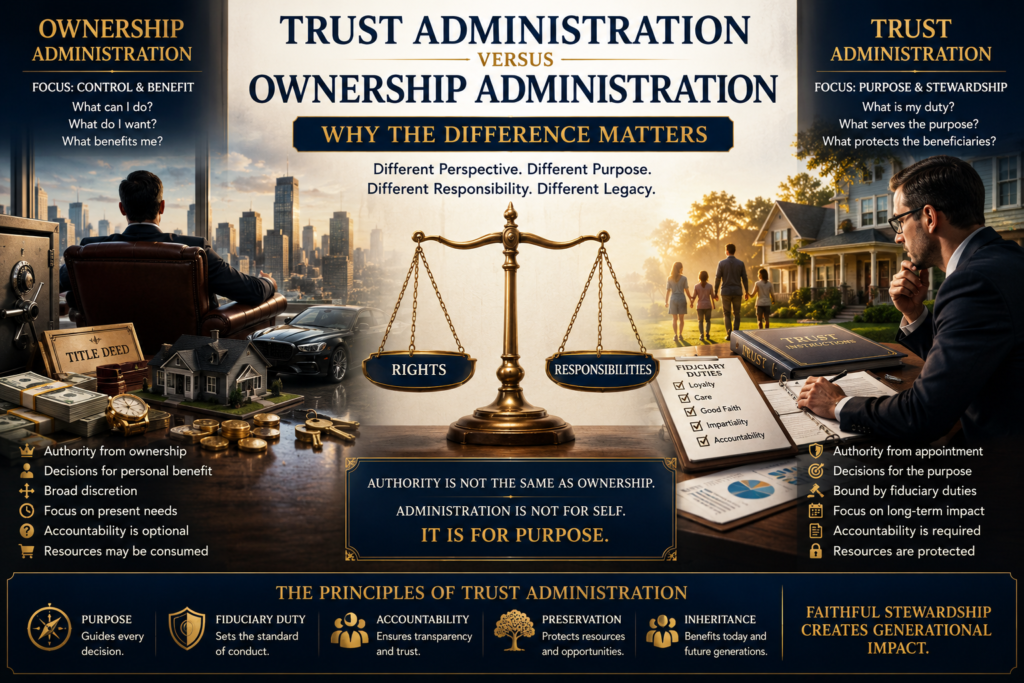
One of the most important distinctions in trust administration is the difference between ownership administration and trust administration.
Although both involve authority, decision-making, and management, they operate from entirely different foundations.
Understanding this distinction helps explain not only how trusts function, but why trustees are held to a higher standard than ordinary owners.
Many people use the terms administration and ownership interchangeably.
They are not the same.
Ownership answers the question:
Who possesses the beneficial interest?
Administration answers the question:
Who manages the responsibility?
Sometimes the same person occupies both positions.
Sometimes they do not.
Trust administration exists specifically because administration and beneficial ownership can be separated.
This distinction forms the foundation of the trust relationship.
Owners generally administer property for themselves.
The owner decides how property will be used.
Whether it will be sold.
Improved.
Consumed.
Transferred.
Preserved.
The owner’s authority arises from ownership itself.
The owner’s decisions are primarily evaluated according to personal objectives.
The owner asks:
What do I want to accomplish?
How does this benefit me?
What serves my interests?
This approach is not necessarily improper.
It simply reflects the nature of ownership.
The trustee approaches administration differently.
The trustee’s authority exists because responsibility has been entrusted.
The trustee does not administer for personal purposes.
The trustee administers according to the purpose of the trust.
This changes everything.
The trustee asks:
What serves the purpose?
What do the instructions require?
What protects the beneficiaries?
What preserves the inheritance?
What fulfills the trust’s objectives?
The trustee’s focus remains external to personal interests.
Purpose is the dividing line between ownership administration and trust administration.
The owner may define purpose personally.
The trustee receives purpose from the trust itself.
The trust’s purpose becomes the trustee’s guide.
This purpose influences:
Investments.
Distributions.
Protection strategies.
Management decisions.
Administrative priorities.
The trustee’s role is not to invent purpose.
The trustee’s role is to carry out purpose faithfully.
The source of authority differs as well.
Owners derive authority through ownership.
Trustees derive authority through appointment and acceptance of responsibility.
The owner possesses authority because the property belongs to them.
The trustee possesses authority because administration has been entrusted to them.
This distinction explains why trustee authority often comes with limitations.
The trustee’s authority must remain connected to the trust’s purpose.
Ownership administration generally permits broad discretion.
Trust administration requires fiduciary conduct.
The owner may pursue personal benefit.
The trustee must pursue faithful administration.
The owner answers primarily to personal objectives.
The trustee answers to the trust’s purpose and responsibilities.
This difference explains why trustees often face stricter accountability requirements.
Greater responsibility creates greater accountability.
Trust administration requires accountability because the trustee manages what has been entrusted.
Records matter.
Accountings matter.
Transparency matters.
Documentation matters.
Beneficiaries often depend upon proper administration.
Future generations may depend upon proper administration.
The trustee therefore operates within a framework of accountability.
The owner may choose accountability.
The trustee is expected to embrace it.
One of the greatest strengths of trust administration is its focus on preservation.
The owner may consume resources entirely.
The trustee generally operates with broader responsibilities.
Future beneficiaries.
Future opportunities.
Future generations.
The trustee often considers impacts extending beyond immediate circumstances.
This generational perspective helps explain why trusts remain effective tools for preserving inheritance.
Ownership administration often asks:
What can I do?
What do I want?
What benefits me?
Trust administration often asks:
What is my duty?
What serves the purpose?
What protects the beneficiaries?
What preserves the inheritance?
The questions themselves reveal the difference in mindset.
The answers determine the quality of administration.
Scripture repeatedly emphasizes stewardship rather than ownership.
The faithful steward administers what has been entrusted.
The steward receives instructions.
The steward remains accountable.
The steward eventually gives an accounting.
These themes closely resemble trust administration.
The emphasis remains upon faithfulness rather than possession.
Responsibility rather than entitlement.
Administration rather than consumption.
Trust administration depends upon more than technical knowledge.
Character remains essential.
Integrity.
Faithfulness.
Wisdom.
Patience.
Humility.
Self-control.
The trustee may possess authority.
Yet character determines how that authority is exercised.
Without character, administration often becomes self-serving.
With character, administration remains faithful to purpose.
Within the Kingdom of Heaven Trust Management System, trust administration mirrors stewardship principles found throughout Scripture.
The Creator remains the ultimate Settlor.
The Everlasting Covenant establishes the relationship.
The Word provides the instructions.
The steward functions as trustee.
Administration remains purpose-driven.
The objective is faithful stewardship rather than personal ownership.
This perspective helps explain why Kingdom administration emphasizes accountability, inheritance, and faithful service.
Modern culture frequently celebrates ownership.
Ownership certainly has value.
Yet ownership alone does not guarantee faithful administration.
Resources may still be wasted.
Inheritance may still be consumed.
Opportunities may still be lost.
Trust administration reminds us that responsibility matters.
Purpose matters.
Accountability matters.
Faithful administration matters.
These principles strengthen individuals, families, organizations, and future generations.
Ownership administration and trust administration may appear similar from a distance.
Both involve management.
Both involve decision-making.
Both involve authority.
Yet they begin from very different foundations.
Ownership administration asks:
What belongs to me?
Trust administration asks:
What has been entrusted to me?
Ownership focuses on rights.
Trust administration focuses on responsibilities.
Ownership often focuses upon personal benefit.
Trust administration focuses upon purpose.
The faithful trustee therefore thinks differently than the owner.
Acts differently.
Evaluates decisions differently.
Because trust administration is not primarily about control.
It is about stewardship.
And where faithful stewardship exists, purpose is preserved, inheritance is protected, beneficiaries are served, and future generations receive the benefits of responsible administration.
Explore trust administration, fiduciary duties, stewardship, trusteeship, inheritance, covenant principles, Kingdom governance, and practical trust estate education through the educational resources, discussions, training programs, and community available through BulletProof Solutions.