
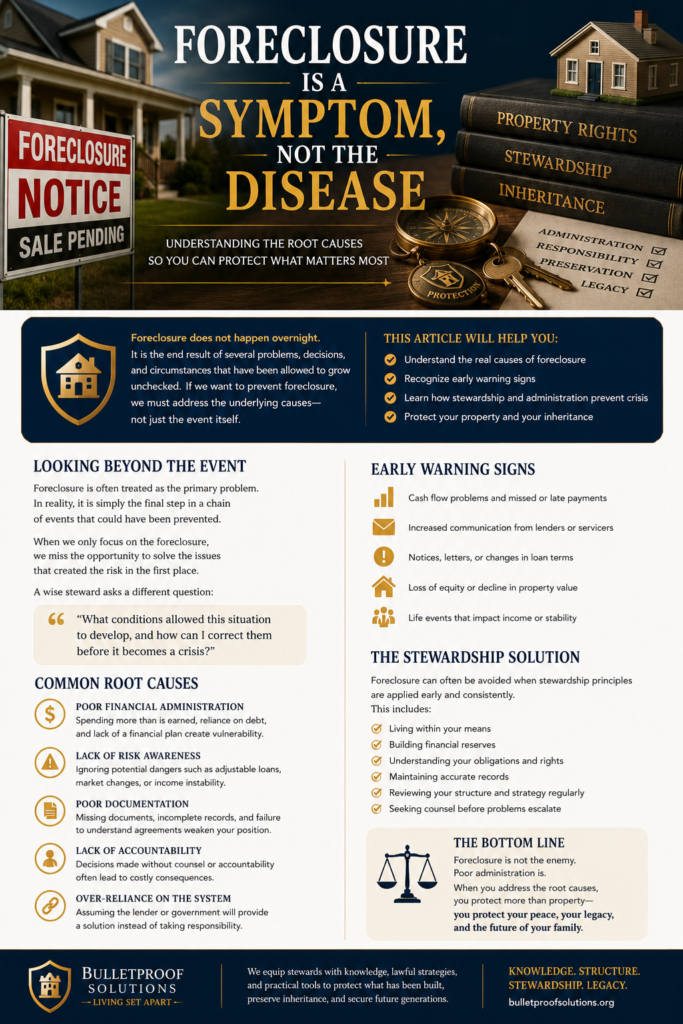
When most people think about foreclosure, they focus on the event itself.
The notice.
The lawsuit.
The auction.
The loss of the property.
The removal of the occupants.
These events are dramatic.
They are visible.
They demand attention.
Yet they are rarely the true problem.
Foreclosure is often the final stage of a much longer process.
It is the symptom.
Not the disease.
Just as a fever may indicate an underlying illness, foreclosure often reveals deeper issues that have existed long before the foreclosure action begins.
If we wish to understand foreclosure properly, we must look beyond the event itself and examine the conditions that made it possible.
Only then can meaningful protection occur.
Most people become interested in foreclosure only after receiving a notice.
A demand letter.
A default notice.
A summons.
A complaint.
By this stage, the situation has usually been developing for months or years.
Financial pressures.
Administrative failures.
Poor record keeping.
Lack of planning.
Misunderstanding rights and obligations.
Failure to respond to problems early.
The foreclosure becomes visible because the underlying issues have reached a critical point.
Yet focusing only on the foreclosure is like focusing only on smoke while ignoring the fire.
One of the most common causes of foreclosure is not lack of income.
It is poor administration.
Many people assume foreclosure occurs simply because someone cannot make payments.
Sometimes that is true.
Often it is more complicated.
Important documents may never be reviewed.
Errors may go unnoticed.
Communications may be ignored.
Available options may never be explored.
Records may be incomplete.
Rights may never be asserted.
The issue becomes administrative long before it becomes legal.
The faithful steward understands that administration is protection.
Scripture warns repeatedly about the consequences of ignorance.
Knowledge alone does not solve every problem.
Yet ignorance creates vulnerability.
Many property holders do not understand:
How loans function.
How servicing works.
How foreclosure procedures operate.
How records are maintained.
How interests are transferred.
How rights may be preserved.
The result is often confusion and inaction.
The system generally favors those who understand it.
The faithful steward therefore seeks understanding before a crisis develops.
Foreclosures rarely appear overnight.
They often begin with smaller issues.
A missed payment.
A temporary hardship.
An unresolved dispute.
A failure to review correspondence.
An assumption that the problem will resolve itself.
Over time these issues compound.
Interest accumulates.
Penalties increase.
Deadlines expire.
Options disappear.
The situation becomes more difficult to correct.
The wise steward addresses problems while they remain manageable.
Many people view property as something they own.
Fewer view property as something they must continually steward.
Property requires administration.
Taxes must be monitored.
Insurance must be maintained.
Records must be preserved.
Obligations must be tracked.
Communications must be reviewed.
Risks must be evaluated.
Without ongoing stewardship, vulnerability increases.
The property itself may not create the problem.
The lack of administration often does.
Debt is not always the disease.
Debt is often the symptom of deeper issues.
Lack of planning.
Lack of reserves.
Overextension.
Consumption without preparation.
Short-term thinking.
The faithful steward learns to examine causes rather than merely reacting to outcomes.
The question becomes:
What conditions allowed this situation to develop?
The answer often reveals the real problem.
Every system contains strengths and weaknesses.
Families do.
Businesses do.
Trusts do.
Property holdings do.
Foreclosure often exposes weaknesses that existed long before the notice arrived.
Weak documentation.
Poor communication.
Lack of organization.
Lack of planning.
Lack of accountability.
The foreclosure did not create these weaknesses.
It revealed them.
Understanding this distinction helps people focus on solutions that strengthen administration rather than merely delaying consequences.
One of the most important lessons in asset protection is that preparation must occur before the crisis.
A person cannot effectively protect what they do not understand.
They cannot preserve what they have failed to organize.
They cannot administer what they have failed to monitor.
Protection begins long before the threat appears.
This principle applies to families.
Businesses.
Trusts.
Properties.
And inheritance.
The faithful steward thinks ahead.
Throughout Scripture, faithful stewardship involves preparation.
Planning.
Administration.
Accountability.
Preservation.
The wise steward prepares before the crisis.
The wise steward manages resources carefully.
The wise steward protects what has been entrusted.
This pattern appears repeatedly.
The lesson is simple.
Faithful administration today prevents unnecessary loss tomorrow.
Within the Kingdom of Heaven Trust Management System, foreclosure is viewed through the lens of stewardship.
Property represents responsibility.
Inheritance represents responsibility.
Administration represents responsibility.
The goal is not merely defending property after a crisis emerges.
The goal is faithful administration that reduces the likelihood of crisis in the first place.
Protection begins with stewardship.
Stewardship begins with knowledge.
Knowledge leads to action.
Action strengthens preservation.
Modern society often encourages people to react rather than prepare.
Most people wait until a problem becomes urgent.
By then options are frequently limited.
The faithful steward adopts a different approach.
Learn early.
Plan early.
Organize early.
Protect early.
The best defense is often established long before the threat arrives.
Foreclosure is rarely the true problem.
It is usually the visible result of deeper issues.
Administrative failures.
Lack of planning.
Lack of knowledge.
Weak stewardship.
Unaddressed risks.
The foreclosure itself is merely the final symptom.
The faithful steward therefore looks deeper.
Not merely at the event.
But at the causes.
Not merely at the notice.
But at the conditions that produced it.
Because when the underlying causes are understood and corrected, far more than property can be preserved.
Inheritance can be preserved.
Resources can be preserved.
Opportunities can be preserved.
Future generations can be protected.
And that is ultimately what faithful stewardship is all about.
Explore foreclosure defense, asset protection, stewardship, trust administration, inheritance preservation, Kingdom governance, and practical educational resources through the courses, discussions, tools, and community available through BulletProof Solutions.