
When people discuss property, they often speak as though ownership is simple.
Someone owns the property.
Someone else does not.
The matter appears straightforward.
Yet property relationships are often far more complex.
Beneath the surface may exist multiple interests.
Multiple claims.
Multiple responsibilities.
Multiple rights.
Multiple parties.
One of the most misunderstood distinctions involves the difference between ownership and equitable interest.
Understanding this distinction helps explain many property disputes, trust relationships, inheritance issues, and foreclosure conflicts.
It also helps people better understand the difference between legal control and beneficial interest.
Most people think of ownership in terms of title.
Whose name appears on the deed?
Whose name appears on the account?
Whose name appears on the registration?
These questions are important.
Yet they do not always reveal the complete picture.
Title often identifies legal ownership.
But legal ownership is only one part of a property relationship.
The person holding title may not be the only person possessing a legitimate interest.
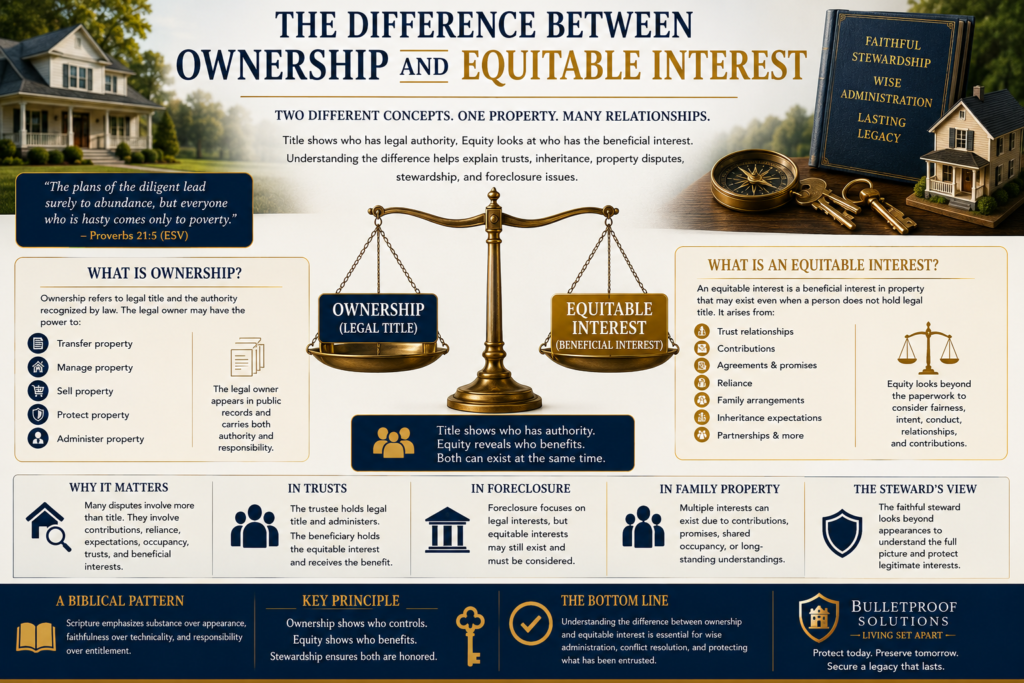
Legal ownership generally refers to recognized authority over property.
The legal owner may possess authority to:
Transfer property.
Manage property.
Sell property.
Protect property.
Administer property.
The legal owner often appears in public records.
Legal ownership creates responsibilities as well as authority.
Yet legal ownership does not automatically answer every question regarding beneficial interests.
An equitable interest generally refers to a beneficial interest in property.
The person holding the equitable interest may not hold legal title.
Yet they may still possess a legitimate claim arising from circumstances, agreements, contributions, relationships, trusts, or principles of equity.
Equity often looks beyond appearances.
Beyond paperwork.
Beyond formal titles.
Beyond technical arrangements.
Equity asks a different question:
Who possesses the beneficial interest?
Who should receive the benefit?
Who has been affected?
Who contributed?
Who relied upon promises or obligations?
The answers may differ from what title alone suggests.
Courts of law traditionally focused heavily on legal rights.
Equity developed to address situations where strict legal outcomes produced unjust results.
Equity examines substance.
Intent.
Conduct.
Relationships.
Reliance.
Fairness.
This does not mean title becomes irrelevant.
It means title may not be the only factor considered.
The equitable interest often reveals a deeper layer of the property relationship.
Trust administration provides one of the clearest examples of this distinction.
A trustee may hold legal title.
The trustee possesses authority to administer.
Manage.
Protect.
Distribute.
Yet the trustee does not necessarily hold the beneficial interest.
The beneficiary may possess the equitable interest.
The trustee administers.
The beneficiary benefits.
This distinction forms one of the foundations of trust administration.
Property disputes frequently arise within families because multiple interests may exist simultaneously.
Contributions may have been made.
Promises may have been relied upon.
Expectations may have developed.
Responsibilities may have been assumed.
Inheritance interests may exist.
Occupancy interests may exist.
The title alone may not fully explain the relationship.
This is one reason many property disputes become highly fact-specific.
Equitable interests may arise through:
Trust relationships.
Inheritance expectations.
Contributions toward property.
Reliance upon agreements.
Family arrangements.
Partnerships.
Constructive trust situations.
Resulting trust situations.
Long-standing understandings.
The specific facts matter.
The underlying principle remains consistent.
Equity seeks to identify the true beneficial interests involved.
When disputes arise, parties often focus exclusively on title.
Yet many disputes involve more than title.
They involve administration.
Contribution.
Reliance.
Inheritance.
Occupancy.
Trust relationships.
Beneficial interests.
Understanding these distinctions helps explain why some cases become more complex than a simple ownership question.
The issue may involve multiple layers of interest.
Foreclosure actions frequently involve questions of ownership and interest.
Who holds title?
Who possesses rights?
Who occupies the property?
Who may be affected?
Who possesses a beneficial interest?
These questions often influence how parties view the situation.
The foreclosure process may focus heavily upon legal interests.
Yet equitable interests may still exist and remain important to the overall circumstances.
Understanding the distinction helps people better evaluate their positions.
From a stewardship perspective, equitable interests often reflect responsibilities as well as benefits.
The faithful steward recognizes that property relationships are not always as simple as possession.
Rights may exist.
Responsibilities may exist.
Expectations may exist.
Future generations may be affected.
The steward therefore seeks to understand the complete relationship rather than merely the surface appearance.
Scripture repeatedly emphasizes substance over appearance.
Intent over form.
Faithfulness over technicality.
Responsibility over entitlement.
This does not eliminate legal structures.
It reminds us that relationships often involve deeper realities than what appears on the surface.
The faithful steward therefore seeks understanding beyond appearances.
Within the Kingdom of Heaven Trust Management System, administration and beneficial interest are often treated as distinct concepts.
The Creator remains the ultimate Owner and Settlor.
Human beings function as stewards and trustees.
Responsibilities are administered.
Benefits may flow to others.
This distinction helps explain why stewardship and ownership are not always identical concepts.
The focus remains upon faithful administration of what has been entrusted.
Modern society often assumes title answers every question.
Sometimes it does.
Sometimes it does not.
Property relationships frequently involve multiple interests, responsibilities, and expectations.
Understanding equitable interests helps people better understand trusts, inheritance, stewardship, and property administration.
It encourages deeper analysis.
Better planning.
Better administration.
And better protection of legitimate interests.
Ownership and equitable interest are related concepts.
They are not identical.
Legal ownership often identifies authority.
Equitable interest often identifies beneficial rights and relationships.
The distinction helps explain trusts.
Inheritance.
Property disputes.
Stewardship.
Foreclosure issues.
And many other aspects of property administration.
The faithful steward therefore learns to look beyond appearances.
Beyond title alone.
Beyond surface assumptions.
Because understanding the full nature of a property relationship is often the first step toward protecting it.
Explore foreclosure defense, asset protection, stewardship, trust administration, inheritance preservation, equitable principles, and practical educational resources through the courses, discussions, tools, and community available through BulletProof Solutions.