Every person makes decisions based upon a time horizon.
Some think about today.
Some think about next week.
Some think about next year.
A few think about the next generation.
The time horizon we adopt affects nearly every decision we make.
How we spend money.
How we raise children.
How we build businesses.
How we manage property.
How we preserve resources.
How we prepare for the future.
At the heart of many economic, social, and stewardship challenges lies a simple contrast:
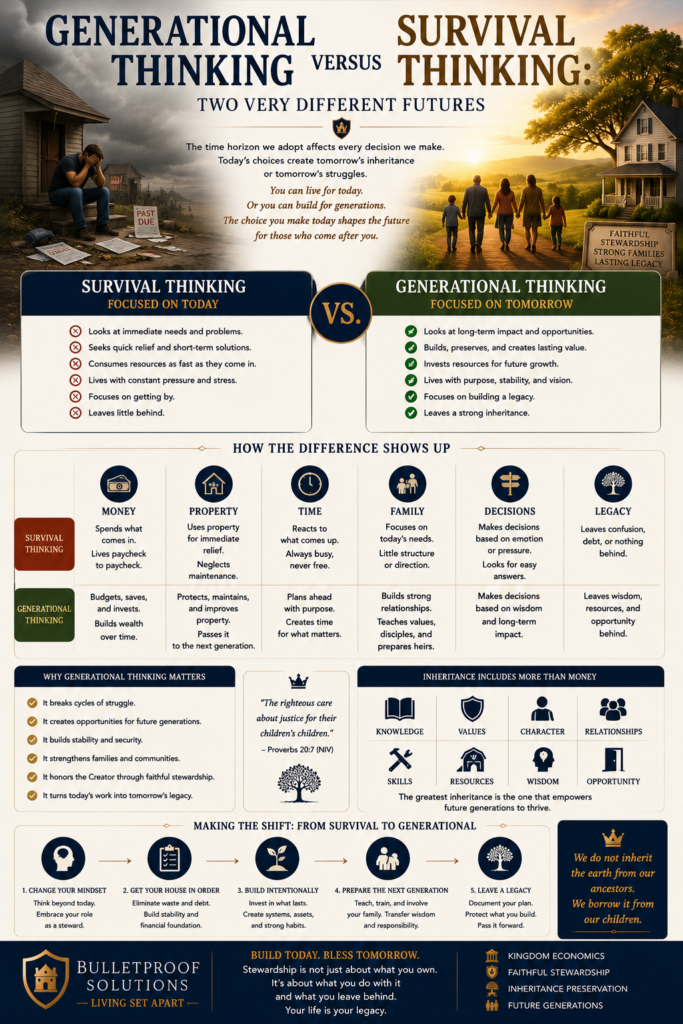
Generational thinking versus survival thinking.
These two mindsets produce very different behaviors.
They create very different outcomes.
And ultimately, they create very different futures.
Survival thinking focuses primarily on immediate needs.
The next meal.
The next payment.
The next crisis.
The next problem.
The next emergency.
Survival thinking is not inherently wrong.
There are times when survival must become the priority.
A family facing disaster may need to focus entirely on immediate needs.
A community facing hardship may need to concentrate on short-term stability.
The problem arises when survival thinking becomes permanent.
What should be temporary becomes a lifestyle.
The result is a cycle that becomes increasingly difficult to escape.
Generational thinking operates from a different perspective.
It asks questions that extend beyond the present moment.
What will remain?
What can be preserved?
What can be improved?
What opportunities can be created?
How will today’s decisions affect future generations?
The generational thinker understands that stewardship extends beyond one’s own lifetime.
Actions taken today create conditions that others will inherit tomorrow.
This mindset naturally encourages planning, preservation, and long-term responsibility.
Survival thinking often narrows vision.
The focus becomes immediate concerns.
Immediate pressures.
Immediate solutions.
Generational thinking expands vision.
The focus includes future consequences.
Future opportunities.
Future responsibilities.
The steward understands that today’s choices become tomorrow’s circumstances.
Because of this, the faithful steward learns to look beyond the immediate horizon.
When people operate exclusively in survival mode, resources are often consumed as quickly as they are acquired.
Income is spent.
Assets are liquidated.
Time is exhausted.
Energy is depleted.
The objective becomes getting through another day.
Another week.
Another month.
There is little opportunity to build.
Little opportunity to preserve.
Little opportunity to create continuity.
The focus remains on immediate survival.
Generational thinking naturally encourages construction.
Building knowledge.
Building relationships.
Building resources.
Building systems.
Building inheritance.
Building opportunities.
The faithful steward understands that not every benefit must be enjoyed immediately.
Some benefits are preserved for the future.
Some opportunities are created for future generations.
This willingness to build creates lasting impact.
Few places reveal this contrast more clearly than the family.
The survival mindset asks:
How do we make it through today?
The generational mindset asks:
How do we strengthen the family for decades to come?
One focuses on immediate pressures.
The other focuses on continuity.
The faithful steward recognizes that both concerns matter.
Yet one must not permanently replace the other.
Property administration provides another example.
The survival thinker often evaluates property according to immediate value.
What can it provide today?
How quickly can it be converted into cash?
What immediate problem can it solve?
The generational thinker asks different questions.
How can it be preserved?
How can it be improved?
How can it benefit future generations?
How can it continue creating opportunity?
The same asset may be viewed entirely differently depending upon the time horizon.
Inheritance cannot exist without generational thinking.
Inheritance is, by definition, future-oriented.
The steward who plans inheritance must think beyond personal circumstances.
Beyond personal comfort.
Beyond personal consumption.
The steward asks:
What should continue after I am gone?
What opportunities should remain?
What wisdom should be transferred?
What resources should be preserved?
Inheritance transforms stewardship from an individual activity into a generational responsibility.
One reason many people struggle to think generationally is because obligations consume attention.
Debt.
Financial instability.
Constant emergencies.
Unexpected crises.
These conditions often force people into short-term thinking.
The objective becomes making it through another month.
The faithful steward understands this reality.
The solution is not condemnation.
The solution is gradually creating enough stability to begin thinking beyond immediate circumstances.
Generational thinking often begins when survival pressures are reduced.
Communities also reveal their time horizons.
Some communities consume resources without replacing them.
Others invest in future generations.
Some focus entirely on present needs.
Others build institutions that outlast individual members.
Strong communities frequently emerge where generational thinking becomes common.
People plant trees whose shade they may never personally enjoy.
They build systems that future generations will benefit from.
This is stewardship in action.
Throughout Scripture, faithful stewards consistently think beyond themselves.
Covenants span generations.
Inheritance spans generations.
Promises span generations.
Responsibilities span generations.
The Creator repeatedly emphasizes continuity.
Faithfulness today creates blessing tomorrow.
Stewardship today creates opportunity tomorrow.
This pattern appears throughout the biblical record.
The focus is not merely survival.
The focus is faithful continuity.
Within the Kingdom of Heaven Trust Management System, generational thinking serves as a foundational principle.
The Creator remains the ultimate Owner and Settlor.
Each steward administers resources for a season.
Future stewards continue the work.
Knowledge is preserved.
Resources are preserved.
Communities are strengthened.
Inheritance is protected.
The objective is not merely surviving the present.
The objective is creating continuity into the future.
Modern culture often encourages short-term thinking.
Immediate gratification.
Immediate results.
Immediate consumption.
Immediate convenience.
The faithful steward recognizes the danger of becoming trapped in a permanent survival mindset.
Long-term stability requires long-term thinking.
Inheritance requires long-term thinking.
Stewardship requires long-term thinking.
The future is built by those willing to think beyond themselves.
Generational thinking and survival thinking create very different futures.
One consumes opportunity.
The other creates opportunity.
One focuses primarily on the present.
The other considers future generations.
One struggles to preserve continuity.
The other intentionally builds it.
The faithful steward understands that survival may occasionally be necessary.
But stewardship ultimately calls us beyond survival.
Toward preservation.
Toward inheritance.
Toward continuity.
Toward building something that remains after we are gone.
Because the greatest measure of stewardship is not simply surviving today.
It is helping create a stronger tomorrow for those who follow.
Explore Kingdom economics, inheritance preservation, stewardship, trust administration, generational planning, community development, and practical educational resources through the courses, discussions, tools, and community available through BulletProof Solutions.