
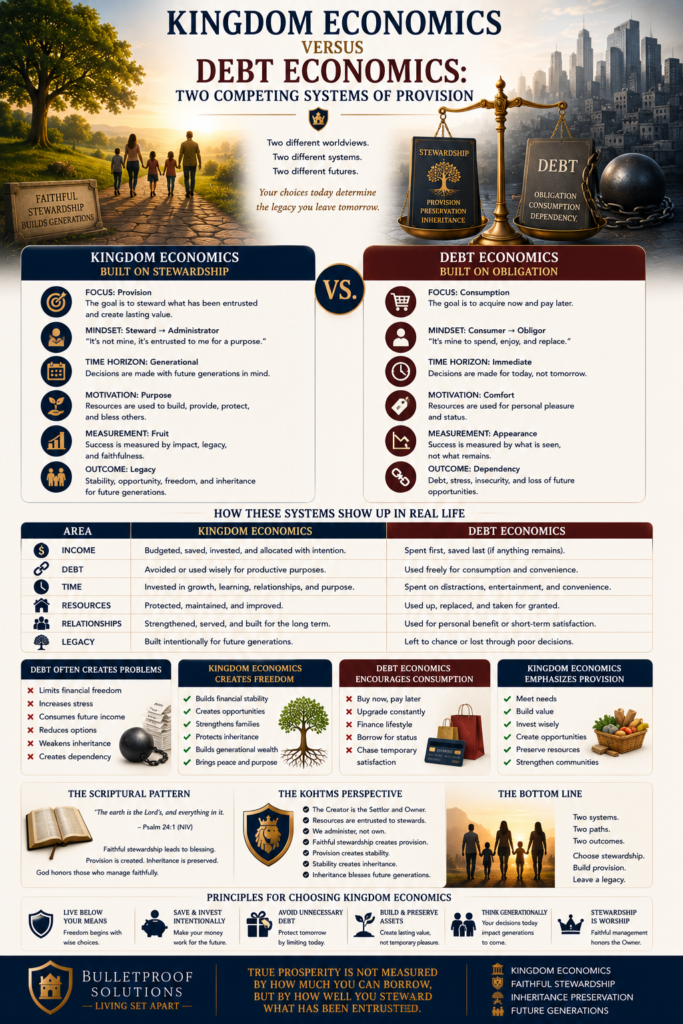
Every economic system must answer a simple question.
How will needs be met?
How will resources be obtained?
How will growth occur?
How will provision be created?
Different systems answer these questions differently.
Some systems depend heavily upon borrowing.
Others emphasize stewardship.
Some prioritize consumption.
Others prioritize preservation.
Within modern society, debt has become one of the primary engines of economic activity.
Homes are financed.
Vehicles are financed.
Businesses are financed.
Education is financed.
Consumption is financed.
Entire lifestyles are often financed.
As a result, many people spend decades working to satisfy obligations created years earlier.
The Kingdom perspective approaches economics differently.
It begins with stewardship rather than debt.
Provision rather than consumption.
Preservation rather than dependency.
This creates two very different economic models.
One of the greatest misconceptions in modern economics is the assumption that access to debt equals wealth.
It does not.
Debt may provide access to resources.
Debt may provide temporary purchasing power.
Debt may create opportunities.
Debt itself is not wealth.
True wealth consists of assets, resources, skills, relationships, knowledge, and productive capacity.
Borrowed resources remain obligations until those obligations are satisfied.
The faithful steward understands the distinction.
Debt economics operates by moving future resources into the present.
Future labor.
Future income.
Future productivity.
Future opportunities.
The benefit is received today.
The obligation remains tomorrow.
This is why debt often feels attractive.
The reward appears immediate.
The cost appears distant.
The steward understands that future obligations eventually become present realities.
Kingdom economics begins with a different question.
What has already been entrusted?
What resources already exist?
What opportunities already exist?
What skills already exist?
What relationships already exist?
How can these be administered wisely?
The focus begins with stewardship rather than borrowing.
Faithfulness rather than leverage.
Administration rather than acquisition.
This approach may appear slower.
It often proves more sustainable.
Debt itself is not always harmful.
The danger emerges when dependency develops.
When every objective requires borrowing.
When every opportunity requires financing.
When every crisis requires additional obligations.
Dependency gradually reduces flexibility.
Choices become constrained.
Resources become committed.
Future income becomes obligated.
The faithful steward seeks freedom rather than dependency.
This often requires careful evaluation of obligations.
One of the greatest strengths of Kingdom economics is stability.
Resources are preserved.
Assets are maintained.
Liabilities are evaluated carefully.
Growth occurs intentionally.
The objective is not rapid expansion at any cost.
The objective is sustainable stewardship.
Stability creates resilience.
Resilience creates opportunity.
Opportunity strengthens future stewardship.
Modern debt systems frequently encourage consumption.
Buy now.
Pay later.
Upgrade now.
Finance the difference.
Borrow for convenience.
Borrow for comfort.
Borrow for status.
This mindset can gradually transform economics into a consumption-driven system.
The faithful steward asks a different question.
Will this create lasting value?
Or merely temporary satisfaction?
The answer often determines whether the decision strengthens or weakens future stewardship.
Provision differs from consumption.
Provision creates stability.
Provision meets legitimate needs.
Provision supports families.
Provision strengthens communities.
Provision preserves inheritance.
The faithful steward focuses on creating provision rather than maximizing consumption.
This shift dramatically changes economic priorities.
Many economic decisions appear similar in the short term.
The differences often emerge over time.
Years later.
Decades later.
Generations later.
The stewardship model tends to accumulate stability.
The debt-dependent model often accumulates obligations.
The faithful steward recognizes that time magnifies economic decisions.
Small choices repeated consistently create substantial outcomes.
One reason debt economics can become problematic is its impact on inheritance.
Future resources become committed.
Future opportunities become restricted.
Future flexibility becomes limited.
The more future income is obligated, the less freedom exists for future stewardship.
Inheritance becomes more difficult to preserve.
The faithful steward therefore evaluates obligations through a generational lens.
How will this affect those who come after me?
Kingdom economics emphasizes multiplication.
Skills multiply.
Knowledge multiplies.
Resources multiply.
Relationships multiply.
Opportunities multiply.
Stewardship seeks productive increase.
Not merely increased consumption.
The objective is to create more value than is consumed.
This principle appears repeatedly throughout Scripture and throughout successful stewardship models.
Throughout Scripture, faithful stewardship receives consistent emphasis.
Resources are administered.
Responsibilities are honored.
Provision is created.
Inheritance is preserved.
The focus remains upon faithfulness.
Wisdom.
Diligence.
Accountability.
The objective is not dependence.
The objective is faithful administration of what has been entrusted.
Within the Kingdom of Heaven Trust Management System, economics begins with stewardship.
The Creator remains the ultimate Owner and Settlor.
Resources are entrusted to stewards.
The steward’s responsibility is faithful administration.
Preservation.
Provision.
Inheritance.
Community strengthening.
Future generations.
The objective is not maximizing debt capacity.
The objective is maximizing stewardship capacity.
Many people spend years increasing income while simultaneously increasing obligations.
The result is often frustration.
More resources.
Yet less freedom.
More earnings.
Yet less flexibility.
The faithful steward seeks a different outcome.
More stewardship.
More stability.
More provision.
More inheritance.
More freedom to serve future generations.
Kingdom economics and debt economics represent two very different approaches to provision.
One begins with borrowing.
The other begins with stewardship.
One often pulls tomorrow into today.
The other seeks to preserve tomorrow while administering today faithfully.
Debt may sometimes serve a legitimate purpose.
It should never replace stewardship.
The faithful steward understands that true prosperity is not measured by how much can be borrowed.
It is measured by how well what has been entrusted is administered.
Because lasting provision is rarely built upon dependency.
It is built upon faithful stewardship, wise administration, and a commitment to preserving opportunity for future generations.
Explore Kingdom economics, inheritance preservation, stewardship, trust administration, generational planning, community development, and practical educational resources through the courses, discussions, tools, and community available through BulletProof Solutions.