
When people hear the word government, they often think of institutions.
Capitols.
Courthouses.
Legislatures.
Presidents.
Kings.
Officials.
Agencies.
Yet long before any of these institutions existed, another form of government already existed.
The family.
The family is the oldest and most enduring form of human governance.
Before nations existed, families existed.
Before legal systems existed, families existed.
Before bureaucracies existed, families existed.
The family served as the primary place where responsibilities were taught, resources were managed, conflicts were resolved, and future generations were prepared.
For this reason, many of the principles that later appear in larger forms of governance first appear within the family.
The family is where stewardship begins.
The family is where responsibility begins.
The family is where self-government is first learned.
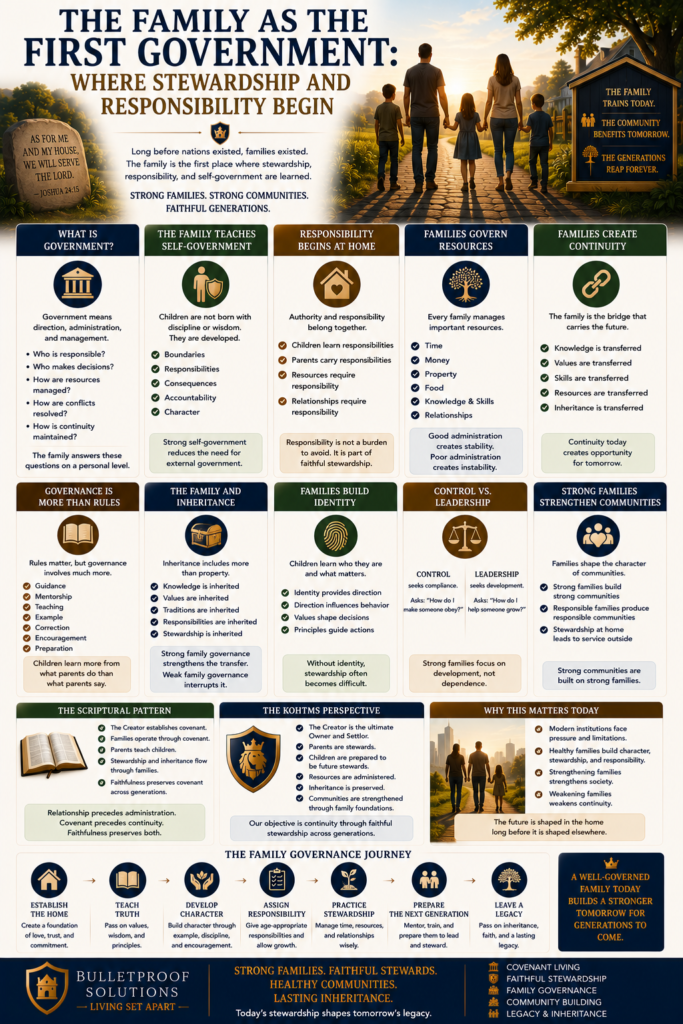
At its most basic level, government means direction, administration, and management.
Every form of government attempts to answer several questions.
Who is responsible?
Who makes decisions?
How are resources managed?
How are conflicts resolved?
How is continuity maintained?
These questions exist within nations.
They also exist within families.
The difference is primarily one of scale.
The family addresses these responsibilities on a smaller and more personal level.
One of the most important functions of the family is teaching self-government.
Children are not born with discipline.
Responsibility.
Patience.
Wisdom.
Stewardship.
These qualities are developed.
Parents teach boundaries.
Responsibilities.
Consequences.
Accountability.
Character.
The objective is not merely obedience.
The objective is developing individuals capable of governing themselves responsibly.
Strong self-government reduces the need for external government.
Weak self-government often increases dependence upon external control.
Many people want authority.
Fewer people seek responsibility.
The family teaches that authority and responsibility belong together.
Children learn responsibilities.
Parents carry responsibilities.
Resources require responsibility.
Relationships require responsibility.
The faithful steward learns early that responsibility is not a burden to avoid.
It is part of stewardship.
The family becomes the training ground where this lesson is first learned.
Every family manages resources.
Time.
Money.
Property.
Food.
Knowledge.
Skills.
Relationships.
The specific resources may differ.
The need for administration remains.
Good administration creates stability.
Poor administration often creates instability.
The family therefore serves as a practical school of stewardship.
Children observe how resources are managed.
Eventually they learn to manage resources themselves.
Governments often seek continuity.
Businesses seek continuity.
Organizations seek continuity.
Families do the same.
Knowledge is transferred.
Values are transferred.
Skills are transferred.
Resources are transferred.
Inheritance is transferred.
The family provides continuity across generations.
Without families, much knowledge and wisdom would disappear within a single lifetime.
The faithful steward recognizes the importance of preserving continuity through family relationships.
Many people assume governance means rules.
Rules matter.
Governance involves much more.
Guidance.
Mentorship.
Teaching.
Example.
Correction.
Encouragement.
Preparation.
The strongest families often rely less on control and more on leadership through example.
Children frequently learn more from what parents do than from what parents say.
The faithful steward understands the power of example.
One of the primary functions of family governance is preparing inheritance.
Inheritance includes more than property.
Knowledge is inherited.
Values are inherited.
Traditions are inherited.
Responsibilities are inherited.
Stewardship is inherited.
The family serves as the bridge through which inheritance moves from one generation to the next.
Strong family governance strengthens this transfer.
Weak family governance often interrupts it.
Another important role of family is identity formation.
Children learn who they are.
Where they came from.
What responsibilities they carry.
What values matter.
What principles guide decision-making.
Identity provides direction.
Direction influences behavior.
The family therefore plays a critical role in preparing future stewards.
Without identity, stewardship often becomes difficult.
Healthy family governance is not built solely upon control.
Control seeks compliance.
Leadership seeks development.
Control asks:
How do I make someone obey?
Leadership asks:
How do I help someone grow?
The faithful steward recognizes that strong families focus upon development.
The objective is preparing capable future stewards rather than creating perpetual dependence.
Communities are often reflections of families.
Strong families tend to produce stronger communities.
Responsible families tend to produce responsible communities.
Families that teach stewardship often produce individuals capable of serving others effectively.
The relationship is difficult to ignore.
Strong communities rarely emerge from weak family foundations.
The faithful steward therefore recognizes the importance of strengthening families as a means of strengthening communities.
Throughout Scripture, family serves as a primary vehicle for stewardship, inheritance, instruction, and continuity.
Parents teach children.
Children inherit responsibilities.
Families preserve knowledge.
Families preserve covenant.
Families preserve inheritance.
The pattern appears repeatedly.
The family serves as the foundation upon which larger forms of stewardship are built.
Within the Kingdom of Heaven Trust Management System, the family functions as the first stewardship institution.
The Creator remains the ultimate Owner and Settlor.
Parents serve as stewards.
Children are prepared to become future stewards.
Knowledge is transferred.
Resources are administered.
Inheritance is preserved.
Communities are strengthened through strong family foundations.
The objective is continuity through faithful stewardship across generations.
Many modern institutions attempt to solve problems that historically were addressed within families.
This often places enormous pressure upon external systems.
The faithful steward recognizes that healthy families remain one of the most effective environments for developing responsibility, character, stewardship, and continuity.
Strengthening families strengthens society.
Weakening families weakens continuity.
The relationship remains significant.
The family is the first government because it is the first place where stewardship, responsibility, accountability, and continuity are learned.
Before there are institutions, there are families.
Before there are officials, there are parents.
Before there are administrators, there are stewards.
The family teaches self-government.
The family teaches responsibility.
The family teaches stewardship.
The family prepares future generations.
For this reason, strong families remain one of the most important foundations of strong communities, strong inheritance, and faithful stewardship.
Because when families govern well, future generations are better prepared to steward whatever has been entrusted to their care.
Explore covenant living, family governance, stewardship, inheritance preservation, Kingdom administration, community building, and practical educational resources through the courses, discussions, tools, and community available through BulletProof Solutions.