
Human history is filled with attempts to build societies.
Empires have risen.
Kingdoms have expanded.
Governments have formed.
Institutions have been established.
Yet despite countless systems and structures, one challenge remains constant.
How do people live together in peace, cooperation, and mutual prosperity?
Most human systems attempt to answer this question through increasing layers of control.
More rules.
More regulations.
More oversight.
More enforcement.
More bureaucracy.
The assumption is simple:
If enough control exists, order will follow.
Scripture presents a very different pattern.
The Creator builds communities through covenant.
Not control.
This distinction lies at the heart of Kingdom administration and the Kingdom of Heaven Trust Management System.
Understanding the difference may be one of the most important lessons a steward can learn.
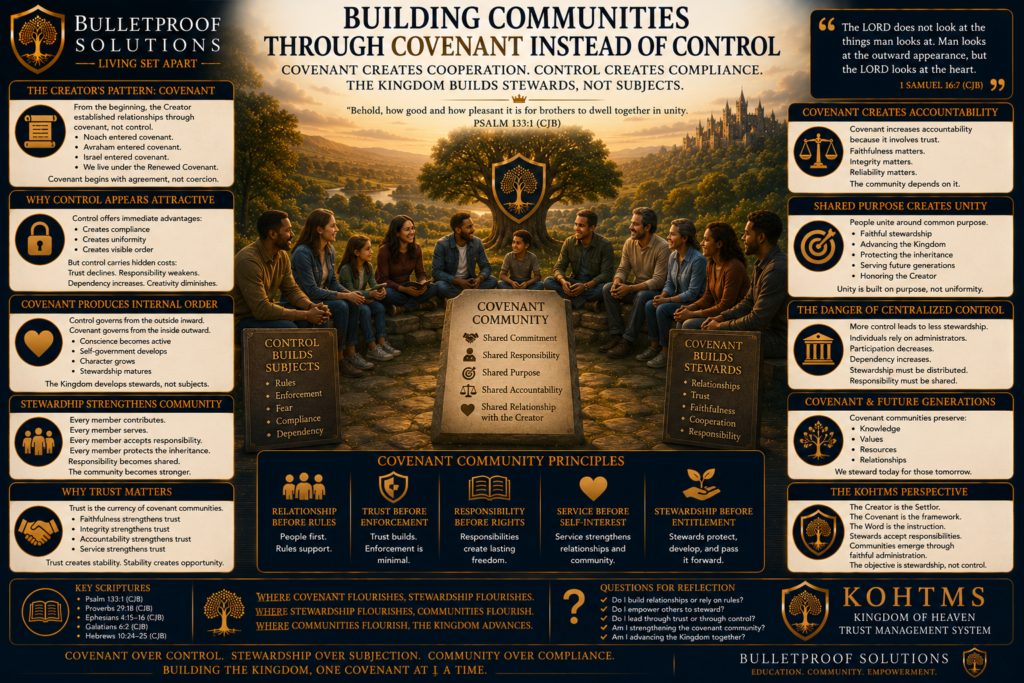
From the beginning, the Creator established relationships through covenant.
Noach entered covenant.
Avraham entered covenant.
Israel entered covenant.
The Renewed Covenant was established through Messiah.
The pattern remains consistent.
The Creator initiates relationship.
The covenant establishes responsibilities.
The participants voluntarily embrace those responsibilities.
The relationship grows through faithfulness.
This pattern creates cooperation without requiring domination.
Because covenant begins with agreement rather than coercion.
A covenant community is a group of people united by shared commitments, shared responsibilities, and shared purpose.
Its foundation is not force.
Its foundation is trust.
Its members recognize:
Common principles.
Common responsibilities.
Common objectives.
Common accountability.
Most importantly, they recognize a common relationship with the Creator.
The covenant becomes the framework through which community develops.
Not merely a set of rules.
But a living relationship.
Control offers immediate advantages.
Control creates compliance.
Control creates uniformity.
Control often creates visible order.
These outcomes can appear successful.
Yet control carries hidden costs.
Trust declines.
Creativity diminishes.
Personal responsibility weakens.
Dependency increases.
People begin acting from fear rather than conviction.
The appearance of order may exist.
True stewardship often does not.
This is one reason human systems frequently require ever-increasing layers of enforcement.
Control struggles to sustain itself.
Control governs from the outside inward.
Covenant governs from the inside outward.
The covenant participant voluntarily embraces responsibilities.
Conscience becomes active.
Self-government develops.
Character grows.
Stewardship matures.
As internal order increases, external control becomes less necessary.
This reflects the Creator’s pattern.
Transformation begins within.
Administration follows.
The Kingdom therefore develops stewards rather than subjects.
The family illustrates this principle clearly.
Healthy families are rarely sustained by constant control.
Healthy families are sustained by relationships.
Trust.
Service.
Responsibility.
Mutual care.
Shared purpose.
Parents may establish boundaries.
Yet lasting family strength develops through covenant relationships rather than perpetual enforcement.
The family therefore serves as one of the earliest examples of covenant community.
Stewardship naturally strengthens communities.
Every member contributes.
Every member serves.
Every member accepts responsibility.
Every member protects the inheritance.
This creates resilience.
Communities built upon stewardship become less dependent upon centralized control.
The burden of administration becomes distributed.
Responsibility becomes shared.
The community becomes stronger.
This reflects the Creator’s design.
Trust is the currency of covenant communities.
Without trust, cooperation becomes difficult.
Without trust, relationships weaken.
Without trust, stewardship suffers.
Faithful stewardship strengthens trust.
Integrity strengthens trust.
Accountability strengthens trust.
Service strengthens trust.
Over time, trust creates stability.
Stability creates opportunity.
Opportunity allows communities to flourish.
This process cannot be manufactured through control alone.
Trust must be cultivated.
Some people assume covenant eliminates accountability.
The opposite is true.
Covenant increases accountability.
Because covenant relationships involve trust.
The steward becomes accountable not merely to rules but also to relationships.
Faithfulness matters.
Integrity matters.
Reliability matters.
The community depends upon these qualities.
This form of accountability often proves stronger than external enforcement.
Because it is rooted in conscience and commitment.
One of the strongest forces in any community is shared purpose.
People naturally unite around common objectives.
The Creator’s Kingdom provides the highest common purpose.
Faithful stewardship.
Advancing the Kingdom.
Protecting the inheritance.
Serving future generations.
Honoring the Creator.
These objectives create unity without requiring uniformity.
Members may possess different gifts.
Different roles.
Different responsibilities.
Yet they remain united by common purpose.
The more control becomes centralized, the more stewardship tends to weaken.
Individuals begin relying upon administrators rather than accepting responsibility.
Participation decreases.
Dependency increases.
The community becomes less resilient.
The Creator’s pattern generally moves in the opposite direction.
Stewardship becomes distributed.
Responsibilities become shared.
Communities become stronger because more people actively participate in administration.
This principle appears throughout Scripture.
One of the greatest strengths of covenant communities is their ability to preserve inheritance.
Knowledge is preserved.
Values are preserved.
Resources are preserved.
Relationships are preserved.
Future generations benefit from faithful administration.
This is one reason covenant remains so important.
It creates continuity across generations.
The community becomes more than a collection of individuals.
It becomes a living inheritance.
Within the Kingdom of Heaven Trust Management System, community building begins with covenant.
The Creator is the Settlor.
The Everlasting Covenant establishes the relationship.
The Word provides the governing instructions.
Stewards voluntarily accept responsibilities.
Communities emerge through faithful administration.
The objective is not control.
The objective is stewardship.
The objective is not domination.
The objective is cooperation through covenant.
This distinction changes how governance is viewed.
How leadership is viewed.
How community itself is viewed.
Modern society often struggles with isolation.
Distrust.
Fragmentation.
Dependency.
Many institutions attempt to solve these problems through greater control.
The Creator’s pattern offers a different solution.
Stronger stewardship.
Stronger relationships.
Stronger covenant commitments.
Stronger communities.
The solution begins not with more control.
It begins with more faithful stewardship.
The Creator has always built communities through covenant rather than control.
Control seeks compliance.
Covenant cultivates faithfulness.
Control governs from the outside inward.
Covenant transforms from the inside outward.
Control creates subjects.
Covenant develops stewards.
This distinction lies at the heart of Kingdom administration.
The faithful steward therefore seeks to strengthen relationships.
Build trust.
Share responsibility.
Protect inheritance.
Serve future generations.
Because healthy Kingdom communities are not built through domination.
They are built through covenant.
And where covenant flourishes, stewardship flourishes.
Where stewardship flourishes, communities flourish.
And where communities flourish, the Kingdom advances from generation to generation.
Explore covenant administration, stewardship, Kingdom governance, trusteeship, community building, and the Everlasting Covenant through the educational resources, discussions, training programs, and community available through BulletProof Solutions.