
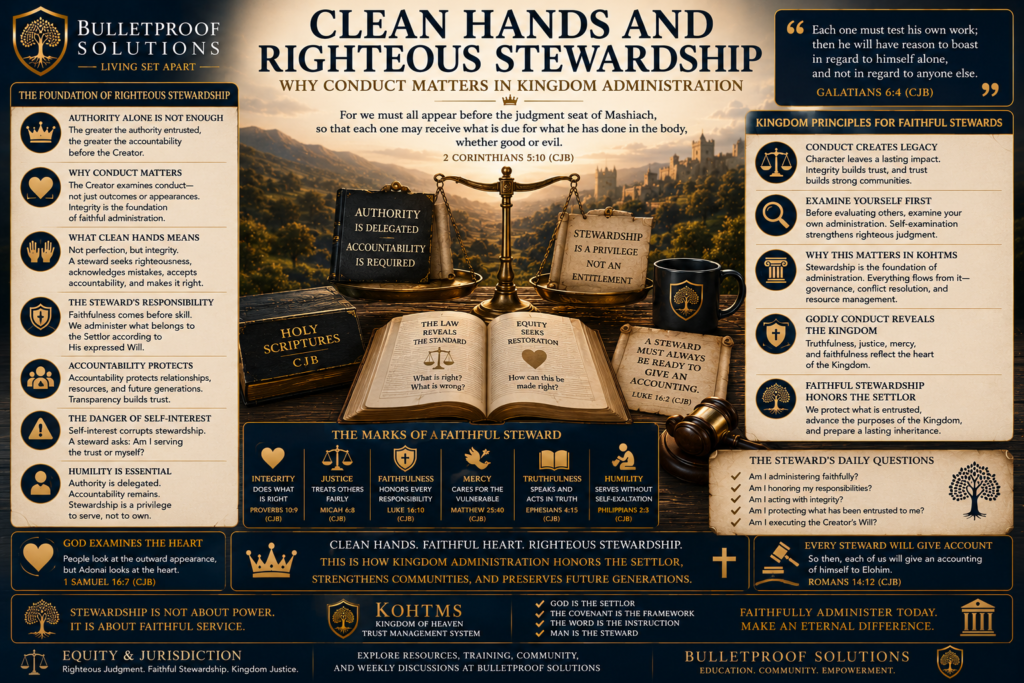
One of the most misunderstood principles in administration is the relationship between authority and conduct.
Many people focus on power.
Others focus on rights.
Some focus on titles.
Others focus on positions.
Yet throughout Scripture, the Creator repeatedly focuses on something far deeper.
Character.
The Kingdom of Heaven is not administered merely through authority.
It is administered through stewardship.
And stewardship is inseparable from conduct.
A steward may possess authority.
A steward may possess knowledge.
A steward may possess resources.
Yet if the steward lacks integrity, the administration itself becomes compromised.
This principle lies at the heart of what equity traditionally describes as clean hands.
Within the Kingdom of Heaven Trust Management System, the principle is even broader.
The question is not simply whether a person has legal authority.
The question is whether they are faithfully administering what has been entrusted to them according to the expressed Will of the Creator.
Modern society often assumes that authority justifies action.
A title is obtained.
A position is granted.
An office is occupied.
Authority is presumed.
Scripture repeatedly demonstrates a different principle.
Authority and accountability are inseparable.
The greater the authority entrusted to a steward, the greater the accountability before the Creator.
This principle applies to:
Parents
Elders
Trustees
Administrators
Teachers
Community leaders
Judges
Kings
No steward operates independently of accountability.
All authority remains subject to righteous judgment.
The Creator consistently examines conduct.
Not merely outcomes.
Not merely appearances.
Conduct.
The Scriptures repeatedly emphasize:
Faithfulness.
Integrity.
Justice.
Mercy.
Humility.
Truthfulness.
These qualities are not incidental.
They are essential.
The Kingdom is administered through people.
The character of the steward therefore directly influences the quality of the administration.
A steward may possess authority.
Yet if conduct becomes corrupt, stewardship begins to fail.
One of the recurring themes throughout Scripture is that the Creator examines the heart.
Human beings frequently evaluate appearances.
The Creator evaluates intentions.
Motives.
Purposes.
Conduct.
This principle explains why two individuals may perform similar actions while producing very different outcomes.
One acts faithfully.
The other acts selfishly.
One seeks restoration.
The other seeks advantage.
One serves the Kingdom.
The other serves self.
The outward actions may appear similar.
The underlying administration is entirely different.
The concept of clean hands is often misunderstood.
Many assume it refers to perfection.
It does not.
Scripture repeatedly demonstrates that human beings make mistakes.
The issue is not perfection.
The issue is integrity.
A steward with clean hands seeks righteousness.
A steward acknowledges mistakes.
A steward accepts accountability.
A steward corrects errors.
A steward acts honestly.
The steward’s conduct remains aligned with faithful administration.
Clean hands therefore describe integrity of administration rather than flawless performance.
The first responsibility of every steward is faithfulness.
Before skill.
Before expertise.
Before influence.
Faithfulness.
The steward is entrusted with responsibilities belonging ultimately to another.
Within KOHTMS, that reality is foundational.
The Creator is the Settlor.
The Everlasting Covenant establishes the relationship.
The Word provides the governing instructions.
The steward’s responsibility is faithful execution of the Creator’s expressed Will.
Faithfulness therefore becomes the measure of administration.
Many people view accountability as a burden.
Scripture presents accountability as protection.
Accountability protects:
Relationships.
Communities.
Resources.
Future generations.
The steward who welcomes accountability strengthens trust.
The steward who resists accountability weakens trust.
This principle appears repeatedly throughout Scripture.
Faithful stewards remain willing to provide an accounting.
Not because they fear scrutiny.
Because faithful administration welcomes transparency.
One of the greatest threats to stewardship is self-interest.
The moment personal advantage becomes the primary objective, administration begins to drift away from faithful stewardship.
This danger exists in every area of life.
Family administration.
Community administration.
Trust administration.
Leadership.
Governance.
The faithful steward continually asks:
Am I serving the purpose of the trust?
Am I fulfilling the Creator’s Will?
Am I protecting what has been entrusted to me?
Or am I serving myself?
These questions help preserve righteous administration.
Humility is one of the defining characteristics of faithful stewardship.
Humility recognizes that authority is delegated.
Humility recognizes that accountability remains.
Humility recognizes that stewardship is a privilege rather than an entitlement.
The humble steward understands:
I am not the owner.
I am not the source.
I am not the Settlor.
I am a steward.
This perspective transforms administration.
Pride seeks control.
Humility seeks faithful service.
Stewards rarely appreciate the full impact of their conduct.
Children observe conduct.
Communities observe conduct.
Future generations inherit the results of conduct.
Faithful stewardship creates stability.
Integrity creates trust.
Trust creates cooperation.
Cooperation strengthens communities.
Communities preserve knowledge and resources.
The result is legacy.
Many people attempt to build legacy through possessions.
Scripture consistently points toward a different reality.
Character creates legacy.
Conduct creates legacy.
Faithful stewardship creates legacy.
Before a steward evaluates others, the steward must evaluate themselves.
Before correcting others, the steward should examine their own administration.
This principle appears repeatedly throughout Scripture.
The faithful steward begins with self-examination.
Am I administering faithfully?
Am I honoring my responsibilities?
Am I acting with integrity?
Am I protecting what has been entrusted to me?
This perspective strengthens administration because it begins with accountability rather than accusation.
Within the Kingdom of Heaven Trust Management System, stewardship is the central organizing principle.
Everything flows from stewardship.
Administration.
Governance.
Education.
Conflict resolution.
Resource management.
Community development.
The quality of each depends upon the quality of the steward.
This is why conduct matters.
Kingdom administration is not sustained by documents alone.
It is sustained by faithful stewards.
Faithful stewards produce righteous administration.
Righteous administration advances the purposes of the Kingdom.
The Creator does not merely examine authority.
The Creator examines stewardship.
Titles matter less than faithfulness.
Positions matter less than integrity.
Power matters less than righteous administration.
Clean hands therefore represent something far greater than technical compliance.
They represent faithful stewardship.
The steward who administers with integrity strengthens trust.
The steward who strengthens trust strengthens community.
The steward who strengthens community preserves future generations.
Ultimately, Kingdom administration depends not merely upon authority.
It depends upon the character of the steward exercising that authority.
For this reason, conduct will always matter.
And faithful stewardship will always begin with clean hands and a heart committed to executing the Creator’s Will.
Explore the principles of stewardship, covenant administration, fiduciary responsibility, Kingdom governance, and the Everlasting Covenant through the educational resources, training, community, and discussions available through BulletProof Solutions.