Every relationship eventually faces challenges.
Misunderstandings occur.
Expectations differ.
Mistakes happen.
Communication breaks down.
Disagreements arise.
These realities affect families.
Communities.
Organizations.
Businesses.
Fellowships.
Stewardship groups.
The presence of conflict does not necessarily indicate failure.
In many cases, conflict simply reflects the reality that people are working together.
The true measure of a community is often not whether conflict occurs.
The true measure is how conflict is handled.
The faithful steward understands that preserving relationships while resolving problems is one of the most important skills any community can develop.
Many people assume healthy relationships should be free from conflict.
This expectation is unrealistic.
Different people possess different perspectives.
Different experiences.
Different priorities.
Different expectations.
Whenever people work together, disagreements will occasionally arise.
Conflict itself is not the problem.
Poorly managed conflict becomes the problem.
The faithful steward understands that conflict can become an opportunity for growth when addressed properly.
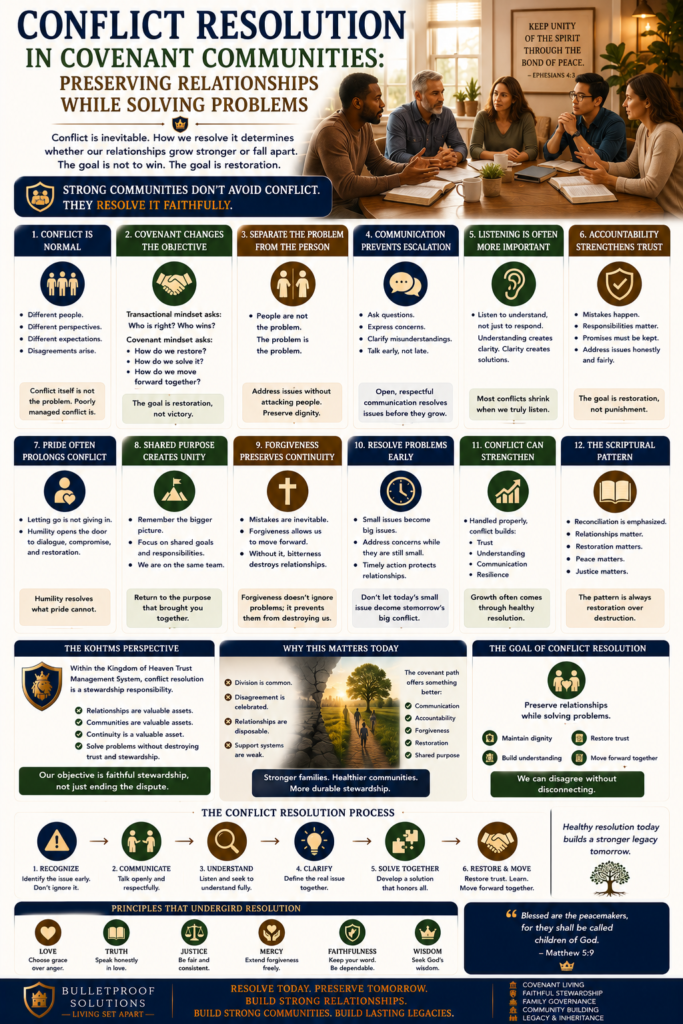
The covenant mindset approaches conflict differently than the transactional mindset.
The transactional mindset often asks:
Who wins?
Who loses?
Who is right?
Who is wrong?
The covenant mindset asks:
How do we preserve the relationship?
How do we solve the problem?
How do we restore trust?
How do we move forward together?
The objective shifts from victory to restoration.
This shift dramatically changes the way conflict is approached.
One of the most valuable conflict-resolution principles is learning to separate the issue from the individual.
People are not the problem.
The problem is the problem.
When people become identified with the disagreement, resolution becomes difficult.
Defensiveness increases.
Resentment grows.
Communication weakens.
The faithful steward seeks to address issues without attacking people.
This preserves dignity while creating space for solutions.
Many conflicts grow because communication diminishes.
Assumptions replace conversations.
Interpretations replace clarification.
Frustration replaces understanding.
The faithful steward understands the value of direct, respectful communication.
Questions are asked.
Concerns are expressed.
Misunderstandings are clarified.
Open communication often resolves issues before they become serious conflicts.
Many people enter conflict focused primarily on explaining their own position.
Few focus on understanding the other person’s position.
Listening creates understanding.
Understanding creates clarity.
Clarity creates solutions.
The faithful steward listens carefully because understanding often reveals the true source of the disagreement.
Many conflicts appear larger than they actually are once understanding develops.
Healthy communities require accountability.
Mistakes happen.
Poor decisions occur.
Responsibilities may be neglected.
Promises may be broken.
Accountability allows these issues to be addressed honestly.
The objective is not punishment.
The objective is restoration.
The faithful steward understands that accountability strengthens trust when applied fairly and consistently.
Many conflicts continue longer than necessary because pride prevents resolution.
People become attached to positions.
Attached to appearances.
Attached to being right.
The faithful steward recognizes that humility often resolves problems that pride cannot.
Humility creates room for dialogue.
Room for compromise.
Room for restoration.
Strong communities value restoration more than personal victory.
Communities remain strongest when members remember their shared purpose.
Families share a future.
Communities share goals.
Stewards share responsibilities.
When people focus exclusively on disagreements, unity weakens.
When people remember shared objectives, cooperation becomes easier.
The faithful steward continually returns attention to the larger purpose that brought people together in the first place.
No community survives long without forgiveness.
Mistakes are inevitable.
Misunderstandings are inevitable.
Human imperfection is inevitable.
Without forgiveness, resentment accumulates.
Relationships deteriorate.
Trust weakens.
Continuity suffers.
Forgiveness does not require ignoring problems.
It allows problems to be addressed without permanently destroying relationships.
The faithful steward recognizes forgiveness as one of the strongest tools for preserving community.
Small problems tend to become larger problems when ignored.
Minor misunderstandings become major disputes.
Unaddressed concerns become resentment.
The faithful steward understands the value of addressing issues while they remain manageable.
Early intervention often prevents larger conflicts from developing.
Timely communication preserves relationships.
Many people assume conflict always weakens relationships.
Handled poorly, it often does.
Handled properly, conflict can strengthen relationships.
Trust deepens.
Understanding increases.
Communication improves.
Expectations become clearer.
The community becomes more resilient.
The faithful steward views conflict as a stewardship responsibility rather than merely an inconvenience.
Throughout Scripture, reconciliation receives significant emphasis.
Relationships matter.
Restoration matters.
Forgiveness matters.
Peace matters.
Justice matters.
The pattern repeatedly encourages resolving disputes in ways that preserve community whenever possible.
The emphasis remains upon restoration rather than destruction.
Within the Kingdom of Heaven Trust Management System, conflict resolution is viewed as a stewardship function.
Relationships represent valuable assets.
Communities represent valuable assets.
Continuity represents a valuable asset.
The objective is not simply ending disputes.
The objective is preserving stewardship, trust, and continuity whenever possible.
Problems should be solved without unnecessarily destroying relationships.
Modern society often rewards division.
Conflict becomes entertainment.
Disagreement becomes identity.
Relationships become disposable.
The covenant model offers another path.
A path built upon communication.
Accountability.
Forgiveness.
Restoration.
Shared purpose.
This path creates stronger families, healthier communities, and more durable stewardship relationships.
Conflict is not the enemy of community.
Unresolved conflict is.
The faithful steward understands that healthy communities are not built by avoiding disagreements.
They are built by learning how to resolve disagreements faithfully.
Communication.
Humility.
Accountability.
Forgiveness.
Shared purpose.
These principles preserve relationships while solving problems.
Because strong communities are not communities that never experience conflict.
They are communities that know how to navigate conflict without losing the relationships that make community possible in the first place.
Explore covenant living, family governance, stewardship, inheritance preservation, Kingdom administration, community building, and practical educational resources through the courses, discussions, tools, and community available through BulletProof Solutions.