
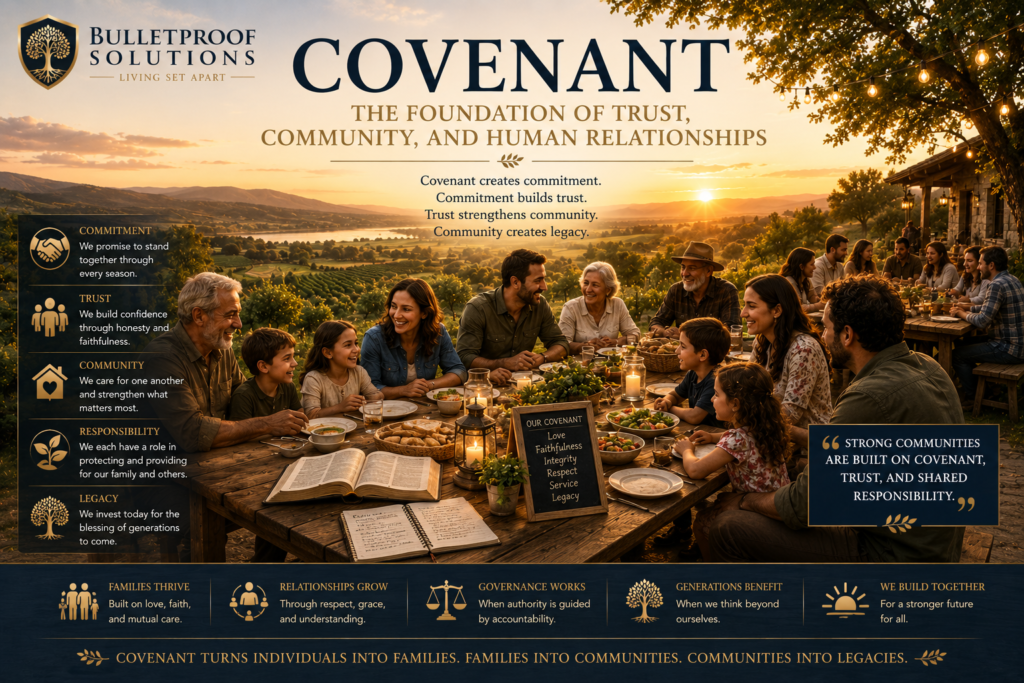
Throughout history, civilizations have been built upon agreements.
Families are formed through agreements.
Businesses operate through agreements.
Communities survive through agreements.
Nations function through agreements.
Whether written or unwritten, every stable relationship depends upon some form of mutual understanding regarding responsibilities, expectations, and conduct.
Yet among all forms of agreement, one stands apart from the rest.
Covenant.
The concept of covenant has influenced families, tribes, communities, governments, and societies for thousands of years. It is one of the oldest frameworks through which human beings have organized relationships and established trust.
Unfortunately, many modern people hear the word covenant and immediately think only of religion.
While covenant certainly appears throughout religious history, the concept itself is far broader.
At its core, covenant is about relationship.
It is about trust.
It is about responsibility.
It is about commitment.
Most importantly, it is about creating stability through mutual obligations.
Understanding covenant provides valuable insight into how healthy relationships, strong communities, and effective governance are built.
Not all agreements are covenants.
Many agreements are transactional.
A person purchases a product.
A service is provided.
The transaction ends.
The relationship may never continue beyond that moment.
A covenant is different.
A covenant creates an ongoing relationship.
It establishes continuing responsibilities.
It defines expectations extending into the future.
The focus is not merely the exchange itself.
The focus is the relationship created by the exchange.
This distinction is important.
Transactions often prioritize immediate benefit.
Covenants prioritize long-term trust.
Transactions focus on performance.
Covenants focus on faithfulness.
Both have value.
But they operate according to different principles.
Every meaningful relationship eventually requires commitment.
Trust cannot develop without consistency.
Consistency cannot develop without commitment.
Commitment creates stability.
Stability allows trust to grow.
Consider a family.
Families function because members accept responsibilities toward one another.
Parents commit to children.
Spouses commit to one another.
Extended family members often assume responsibilities as well.
Without commitment, relationships become fragile.
The same principle applies to communities.
People cooperate because they share expectations.
They rely upon one another.
They contribute toward common goals.
This creates social stability.
At the heart of these arrangements lies covenant thinking.
The recognition that relationships involve obligations as well as benefits.
One of the defining features of covenant is responsibility.
Modern culture frequently emphasizes rights.
Rights matter.
However, rights alone do not sustain relationships.
Responsibilities sustain relationships.
A healthy marriage depends upon responsibilities.
A healthy family depends upon responsibilities.
A healthy community depends upon responsibilities.
A healthy organization depends upon responsibilities.
The covenant mindset asks:
“What am I responsible for?”
before asking:
“What am I entitled to?”
This perspective changes the entire relationship.
Instead of approaching relationships as consumers, people begin approaching them as stewards.
The focus shifts from extraction to contribution.
From receiving to serving.
From control to responsibility.
Trust is what makes covenant possible.
Without trust, every interaction becomes a negotiation.
Every promise requires enforcement.
Every relationship becomes vulnerable to collapse.
Trust reduces uncertainty.
Trust encourages cooperation.
Trust creates confidence.
Trust allows individuals to invest themselves in relationships with the expectation that commitments will be honored.
This is why integrity is so important.
Integrity creates trust.
Trust strengthens covenant.
Strong covenants produce stable communities.
The breakdown of integrity often leads directly to the breakdown of relationships.
The connection between trust and covenant cannot be overstated.
Trust is the glue that holds commitments together.
Healthy communities are rarely built by accident.
They emerge when individuals share common principles and mutual commitments.
Historically, strong communities developed because people accepted obligations toward one another.
They provided assistance during hardship.
They shared resources.
They resolved conflicts.
They contributed toward common goals.
These activities created trust.
Trust strengthened community.
Community increased resilience.
The covenant mindset encourages people to think beyond themselves.
It asks:
How do my actions affect others?
What responsibilities do I have toward my community?
How can I contribute to the common good?
These questions help transform groups of individuals into functioning communities.
Governance exists wherever groups of people make collective decisions.
Families require governance.
Businesses require governance.
Communities require governance.
Organizations require governance.
The question is not whether governance exists.
The question is what principles guide it.
Governance rooted in covenant emphasizes responsibility and accountability.
Authority is viewed as a stewardship.
Leadership is viewed as a trust.
Decisions are evaluated according to their impact upon the broader community.
This perspective differs significantly from systems focused solely upon power or control.
Covenant-oriented governance seeks long-term stability through mutual responsibility.
It recognizes that authority without accountability eventually undermines trust.
One of the most overlooked aspects of covenant is faithfulness.
Faithfulness means consistency over time.
It means honoring commitments when circumstances become difficult.
It means remaining dependable.
Many people are willing to commit when conditions are favorable.
The true strength of a covenant becomes visible when challenges arise.
Faithfulness is what transforms promises into reality.
It demonstrates integrity.
It builds trust.
It creates stability.
Without faithfulness, covenants become little more than temporary arrangements.
With faithfulness, they become the foundation of lasting relationships.
Perhaps the greatest strength of covenant is its ability to create legacy.
Transactions influence the present.
Covenants influence generations.
Families built upon covenant transmit values.
Communities built upon covenant transmit culture.
Organizations built upon covenant transmit purpose.
Legacy emerges when commitments extend beyond immediate interests.
People begin investing in outcomes they may never personally experience.
They build for future generations.
They preserve knowledge.
They strengthen institutions.
They create opportunities.
This long-term perspective is one of the reasons covenant has remained influential throughout history.
Modern society often emphasizes individualism.
Personal goals.
Personal success.
Personal achievement.
While these things have value, they can sometimes weaken the relationships upon which healthy communities depend.
Covenant provides balance.
It reminds us that freedom and responsibility work together.
It reminds us that trust requires commitment.
It reminds us that relationships require stewardship.
It reminds us that communities are strengthened when individuals contribute rather than merely consume.
These principles remain as relevant today as they were thousands of years ago.
Covenant is far more than an ancient concept.
It is a framework for understanding relationships.
It explains how trust develops.
It explains how communities thrive.
It explains how governance becomes stable.
It explains how legacy is created.
At its heart, covenant recognizes a simple truth:
Healthy relationships require commitment.
That commitment creates trust.
Trust creates cooperation.
Cooperation creates resilience.
Resilience creates thriving communities.
Whether in families, businesses, organizations, or communities, the principles of covenant continue to provide a powerful foundation for responsible living and meaningful relationships.
Trust, stewardship, governance, community, and covenant are deeply interconnected principles.
Explore the educational resources, discussions, and training available through the Exploring Foundations Membership at BulletProof Solutions and continue building a deeper understanding of the principles that create strong relationships and thriving communities.