
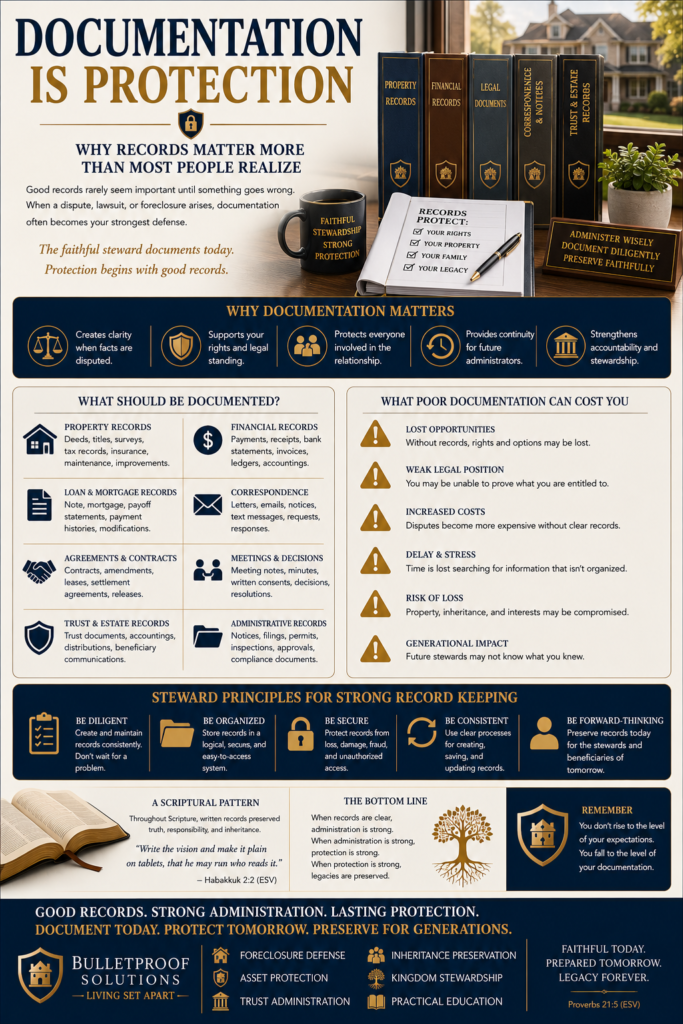
Most people think of protection in terms of defenses.
Insurance.
Locks.
Security systems.
Safes.
Legal structures.
These tools can certainly provide protection.
Yet one of the most powerful forms of protection is often overlooked.
Documentation.
Good records rarely seem important until something goes wrong.
A dispute arises.
A payment is questioned.
An agreement is denied.
A claim is made.
A foreclosure begins.
An inheritance is challenged.
Suddenly everyone begins looking for records.
The steward who maintained those records often stands in a much stronger position than the person who did not.
Documentation may not prevent every problem.
It frequently determines how effectively a problem can be addressed.
Many people rely upon memory.
They remember conversations.
Promises.
Payments.
Agreements.
Understandings.
The difficulty is that memory changes.
People remember events differently.
Details fade.
Interpretations shift.
Years pass.
What seemed obvious at the time may later become unclear.
Documentation preserves information that memory cannot reliably protect.
The faithful steward understands that records provide certainty where memory often cannot.
Property relationships generate information.
Business relationships generate information.
Trust relationships generate information.
Family relationships generate information.
Payments create records.
Communications create records.
Meetings create records.
Agreements create records.
Decisions create records.
The question is not whether information exists.
The question is whether it is preserved.
Many disputes arise because facts become unclear.
Who said what?
When did it occur?
What agreement existed?
What payment was made?
What notice was sent?
What obligations remained?
Good documentation helps answer these questions.
Clarity often prevents misunderstandings from becoming larger problems.
The faithful steward values clarity because clarity strengthens administration.
Administration depends upon information.
Without information, decisions become difficult.
Without records, accountability becomes difficult.
Without documentation, continuity becomes difficult.
Good administration requires access to accurate information.
This is true for families.
Businesses.
Trusts.
Properties.
Organizations.
The steward preserves records because records support responsible administration.
Some people view documentation as protection for only one side of a relationship.
Good records protect everyone.
The person making payments.
The person receiving payments.
The trustee.
The beneficiary.
The property holder.
The administrator.
The family.
The organization.
Accurate documentation reduces uncertainty for all parties involved.
Property administration generates a significant amount of information.
Deeds.
Titles.
Tax records.
Insurance records.
Surveys.
Mortgage documents.
Payment histories.
Correspondence.
Maintenance records.
Improvement records.
Each document contributes to the overall picture.
The faithful steward recognizes that property protection often begins with preserving these records.
Many important disputes involve communication.
Letters.
Emails.
Notices.
Text messages.
Meeting notes.
Written requests.
Written responses.
People often underestimate the importance of preserving communications.
Years later, those communications may become extremely important.
The steward treats communication as part of administration.
One of the greatest benefits of good record keeping is continuity.
People move.
Administrators change.
Trustees change.
Family circumstances change.
Businesses change.
Generations change.
Good records allow future administrators to understand what occurred before they arrived.
Without documentation, valuable knowledge is often lost.
The steward thinks beyond the present.
The steward preserves information for those who may someday need it.
Foreclosure matters frequently highlight the value of documentation.
Payment histories become important.
Correspondence becomes important.
Notices become important.
Property records become important.
Administrative records become important.
The stronger the documentation, the easier it becomes to understand the facts.
The weaker the documentation, the greater the uncertainty.
The steward therefore maintains records before a dispute arises.
Not after.
Accountability requires information.
A trustee may be required to account.
An administrator may be required to explain decisions.
A property holder may need to verify payments.
A beneficiary may request information.
Without records, accountability becomes difficult.
Documentation provides the foundation for meaningful accountability.
The faithful steward welcomes accountability because accountability strengthens trust.
Many people think asset protection begins with legal structures.
In reality, documentation is often one of the most effective forms of protection available.
Good records preserve facts.
Good records preserve history.
Good records preserve evidence.
Good records preserve continuity.
Without documentation, valuable rights may become difficult to prove.
The steward understands that records are not merely paperwork.
They are protection.
Throughout Scripture, memorials, genealogies, covenants, accountings, inventories, and written records appear repeatedly.
Important events were recorded.
Responsibilities were recorded.
Inheritance was recorded.
Boundaries were recorded.
These records preserved continuity and accountability.
The pattern remains instructive today.
Faithful stewardship values accurate records.
Within the Kingdom of Heaven Trust Management System, documentation is viewed as part of faithful administration.
Stewards administer.
Trustees account.
Records preserve continuity.
Documentation strengthens accountability.
The objective is not bureaucracy.
The objective is faithful stewardship.
Strong records support strong administration.
Strong administration supports strong protection.
Modern technology makes record keeping easier than ever.
Yet many people maintain fewer organized records than previous generations.
Important documents become scattered.
Emails become lost.
Files become disorganized.
Knowledge becomes fragmented.
The faithful steward takes a different approach.
Organize.
Preserve.
Maintain.
Review.
Update.
The effort invested today often prevents significant problems tomorrow.
Documentation is one of the most powerful forms of protection available to any steward.
Records preserve facts.
Records preserve accountability.
Records preserve continuity.
Records preserve inheritance.
The faithful steward understands that good documentation is not merely administrative housekeeping.
It is stewardship.
The strongest position is often not created by argument.
It is created by evidence.
And evidence is preserved through documentation.
Because when records are maintained properly, administration becomes stronger, disputes become clearer, accountability becomes easier, and what has been entrusted is far better protected.
Explore foreclosure defense, asset protection, trust administration, inheritance preservation, stewardship principles, Kingdom governance, and practical educational resources through the courses, discussions, tools, and community available through BulletProof Solutions.