
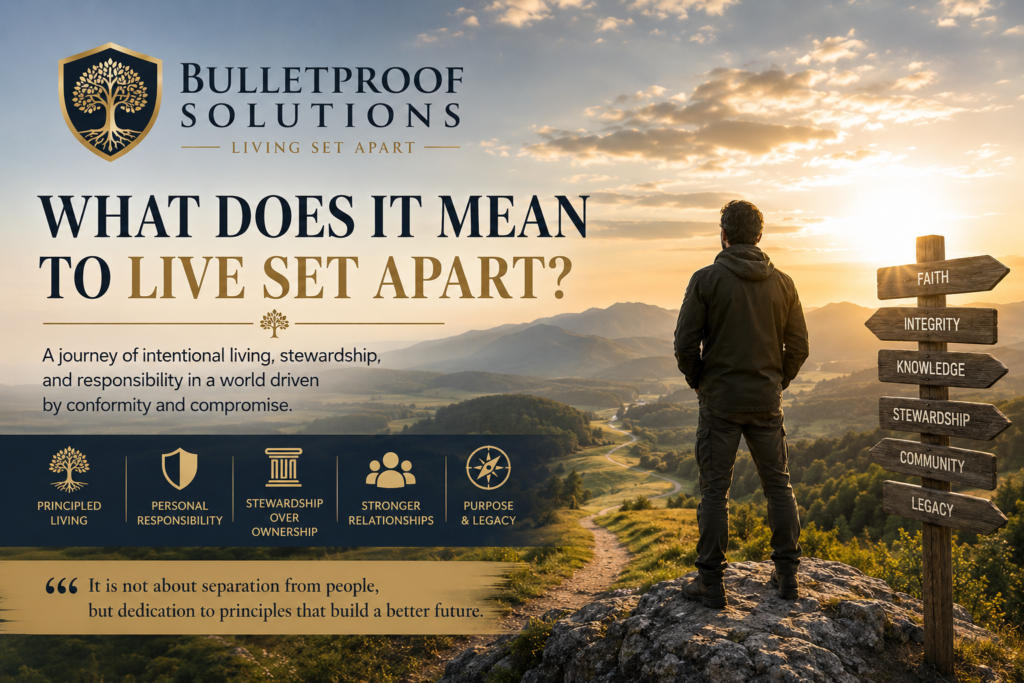
In a world increasingly driven by speed, convenience, and conformity, many people find themselves asking a simple but profound question:
“Is there another way to live?”
For some, the question arises after a personal crisis. For others, it comes after years of frustration with institutions, systems, or expectations that seem disconnected from their values. Regardless of how the question emerges, it often leads to the concept of living set apart.
Unfortunately, the phrase has accumulated many misconceptions. Some associate it with isolation. Others assume it means rejecting society entirely. Still others view it solely through a religious lens.
In reality, living set apart is neither isolation nor withdrawal. It is the intentional decision to govern one’s life according to principles rather than pressures.
At its heart, living set apart is a commitment to stewardship.
Most people inherit a way of life.
They inherit assumptions about work.
They inherit assumptions about money.
They inherit assumptions about education.
They inherit assumptions about success.
Often these assumptions are never examined. They are simply accepted because they are familiar.
Living set apart begins when a person starts asking questions.
Why do I believe this?
Who taught me this?
Is it true?
Does this align with my values?
Does this produce the results I actually desire?
These questions are powerful because they move a person from passive participation to active stewardship.
Instead of allowing circumstances to dictate their future, they begin taking responsibility for the direction of their life.
That shift is the beginning of living set apart.
One of the defining characteristics of modern culture is consumption.
People consume entertainment.
They consume news.
They consume products.
They consume information.
Much of society is organized around encouraging individuals to consume more.
Stewardship operates differently.
A steward asks:
How should this resource be used?
What purpose does it serve?
What responsibilities accompany it?
How can it benefit future generations?
The steward understands that every resource carries responsibility.
Time is a resource.
Knowledge is a resource.
Relationships are a resource.
Property is a resource.
Money is a resource.
Community is a resource.
Living set apart means viewing these things through the lens of stewardship rather than consumption.
Instead of asking, “What can I get?”
The steward asks, “What am I responsible for?”
Modern culture often emphasizes rights.
Rights are important.
However, responsibility is what makes rights sustainable.
A society in which everyone demands rights but no one accepts responsibility eventually experiences conflict.
Strong families are built upon responsibility.
Strong communities are built upon responsibility.
Strong organizations are built upon responsibility.
Strong relationships are built upon responsibility.
Living set apart requires a person to become accountable for their choices rather than blaming circumstances, institutions, or other people.
This does not mean external factors do not exist.
They do.
It simply means that stewardship begins by focusing on what can be controlled rather than what cannot.
Responsibility transforms victims into participants.
Responsibility transforms participants into builders.
Responsibility transforms builders into stewards.
Perhaps nowhere is stewardship more important than in relationships.
Trust forms the foundation of every healthy relationship.
Trust cannot exist without integrity.
Integrity means consistency between words and actions.
When individuals say one thing and do another, trust deteriorates.
When promises are repeatedly broken, confidence disappears.
Living set apart requires a commitment to integrity.
This includes:
Keeping commitments.
Honoring agreements.
Speaking truthfully.
Acting consistently.
Accepting accountability when mistakes occur.
Healthy relationships are not built upon perfection.
They are built upon trust.
Trust grows where integrity is consistently demonstrated over time.
Many people desire community.
Fewer people understand what creates it.
Community is not created by proximity alone.
People can live next door to one another for decades and never form meaningful community.
Community develops when individuals share responsibility for one another’s well-being.
Historically, thriving communities were built upon cooperation, mutual aid, trust, and shared stewardship.
People contributed.
People participated.
People invested themselves in outcomes larger than their personal interests.
Living set apart means moving beyond the mindset of consumer culture and embracing the mindset of contributor culture.
Instead of asking:
“What can this community do for me?”
One begins asking:
“What can I contribute to this community?”
That shift changes everything.
Living set apart also requires intellectual courage.
Every society develops accepted narratives.
Some are true.
Some are partially true.
Some are false.
The steward seeks understanding rather than mere agreement.
This requires research.
It requires patience.
It requires humility.
Most importantly, it requires a willingness to reconsider previously held assumptions when evidence suggests they are incorrect.
Independent thinking does not mean rejecting everything.
Nor does it mean accepting everything.
It means carefully evaluating ideas according to consistent principles.
The goal is not rebellion.
The goal is understanding.
Ultimately, living set apart is not merely about personal freedom.
It is about legacy.
Every decision influences future outcomes.
Every habit shapes future character.
Every relationship affects future opportunities.
Every act of stewardship contributes to a larger story.
A person who lives set apart recognizes that life is not simply something to be experienced.
It is something to be stewarded.
The choices made today influence the opportunities available tomorrow.
The principles embraced today become the culture inherited by future generations.
For this reason, living set apart is not a destination.
It is a lifelong journey of intentional stewardship.
Living set apart does not require withdrawing from society.
It does not require perfection.
It does not require having all the answers.
It begins with a simple decision.
The decision to live intentionally.
The decision to embrace responsibility.
The decision to become a steward rather than merely a consumer.
Those who choose this path often discover that freedom is not found in escaping responsibility.
Freedom is found in embracing it.
Living set apart is ultimately about becoming the kind of person who governs their life according to principles, acts with integrity, and contributes to the well-being of others.
That journey begins with stewardship.
And stewardship begins with a single question:
“What am I responsible for?”