
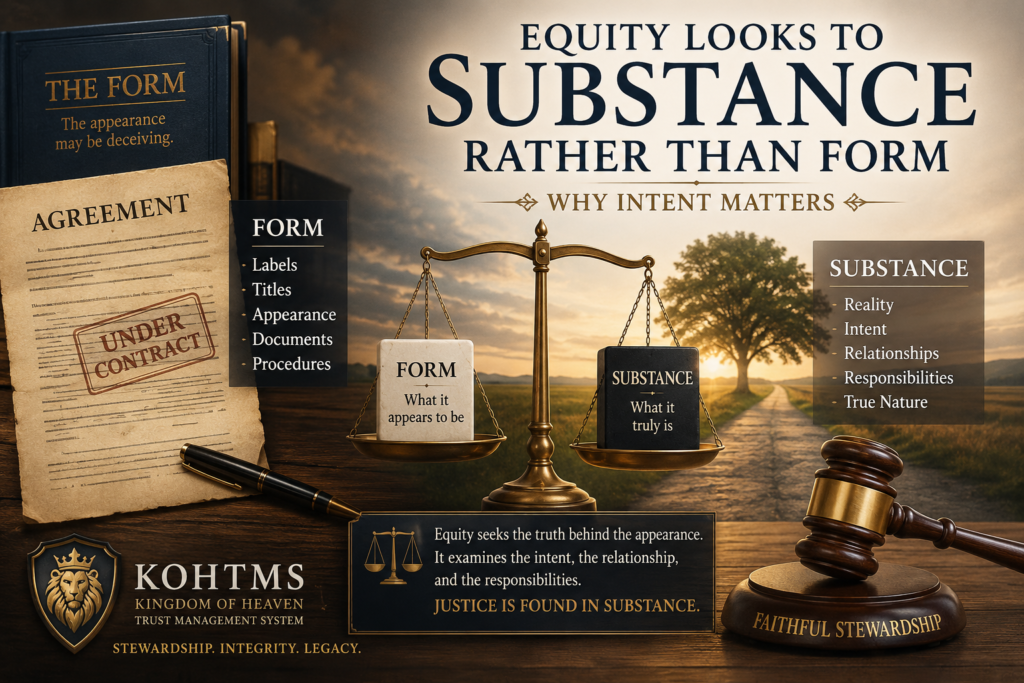
One of the oldest and most enduring principles of equity is expressed in a simple maxim:
Equity looks to substance rather than form.
Although brief, this principle has shaped equitable decision-making for centuries. It reminds us that justice is not always found by examining appearances alone. Instead, equity seeks to understand the true nature of a transaction, the intentions of the parties, and the realities that exist beneath the surface.
This principle distinguishes equitable thinking from a purely formalistic approach. While rules, procedures, and documents are important, equity recognizes that they do not always tell the whole story.
Forms matter.
Written agreements provide clarity.
Records preserve evidence.
Titles establish legal relationships.
Procedures promote consistency.
None of these are unimportant.
In fact, good stewardship often requires careful documentation and proper administration.
However, form was never intended to replace substance.
Documents should reflect reality, not conceal it.
Procedures should serve justice, not defeat it.
Substance refers to the underlying reality of a situation.
It asks questions such as:
What actually occurred?
What was the true intent of the parties?
What relationship existed?
What responsibilities were undertaken?
What benefit was received?
What obligation remains?
Substance seeks truth rather than appearance.
It examines the relationship rather than merely the label.
The same transaction may be described in different ways.
A document may carry one title while functioning in an entirely different manner.
A relationship may appear simple on paper but involve significant fiduciary responsibilities in practice.
Equity therefore asks whether the form accurately reflects the substance.
If the two differ, equity gives greater weight to substance.
This principle helps prevent injustice that might otherwise occur through technical wording alone.
Closely connected to substance is intent.
Why was the agreement made?
What objective were the parties attempting to accomplish?
What responsibilities did they voluntarily assume?
Intent often provides valuable insight into the true character of a relationship.
This does not mean that written documents become irrelevant.
Rather, documents are understood within the broader context of the parties’ actions and intentions.
The principle of substance over form also applies to stewardship.
A person may hold legal title to property.
Another may administer it.
Another may enjoy its benefits.
Understanding these relationships requires looking beyond titles and examining the actual responsibilities being carried out.
Faithful stewardship is demonstrated through actions, not merely through labels.
Rigid adherence to form alone can sometimes produce unintended consequences.
Equity developed in part to address situations where a strict application of rules failed to produce a fair result.
Looking to substance allows decision-makers to evaluate the complete relationship rather than isolated technicalities.
This approach encourages honesty and discourages attempts to rely upon appearances that do not reflect reality.
Throughout Scripture, the emphasis repeatedly falls upon the condition of the heart as well as outward actions.
Integrity, faithfulness, and sincerity receive consistent attention.
External appearances alone are never presented as sufficient.
The pattern reflects a concern for substance rather than mere form.
Within the Kingdom of Heaven Trust Management System, stewardship begins with reality rather than appearance.
Trust relationships are understood through responsibility.
Fiduciary duties are measured by faithful administration.
Documents serve stewardship.
They do not replace it.
The objective is that the form accurately reflects the substance of the relationship and the responsibilities that have been accepted.
Modern life often places great emphasis on labels, titles, and appearances.
While these have their place, faithful stewardship requires looking deeper.
Understanding the true nature of relationships, responsibilities, and intentions helps create stronger trust administration, healthier communities, and more faithful governance.
Substance provides the foundation.
Form provides the structure.
Both are valuable when they work together.
The equitable principle that equity looks to substance rather than form remains as relevant today as ever.
It reminds us that justice is not found merely in appearances.
It is found by understanding the true nature of relationships, responsibilities, and intentions.
The faithful steward values both proper form and genuine substance.
Documents matter.
Procedures matter.
Titles matter.
Yet they should always reflect reality rather than replace it.
Because lasting stewardship is built not merely upon what things are called, but upon what they truly are and how faithfully they are administered.
Featured Course: Flipping the Tables: From Law to Equity
This article introduces one of the foundational maxims of equity. The course explores this principle in depth, along with the historical development of equity, fiduciary relationships, equitable remedies, and the practical application of equitable principles within stewardship and trust administration.
Related Articles:
What Is Equity?
Law and Equity: Understanding the Difference
Servant Leadership: The Kingdom Model of Authority
The Fiduciary Standard: Why Trustees Are Held to a Higher Duty