
Category: Kingdom Jurisprudence
Reading Time: 16–20 Minutes
Learning Path: Kingdom Jurisprudence Foundations
Featured Course: Kingdom Jurisprudence I – Authority, Covenant & Stewardship (Coming Soon)
Key Topics
Every administration begins somewhere.
Before records are examined…
Before testimony is heard…
Before evidence is presented…
Before judgment is rendered…
Someone first asserts that something ought to be recognized, protected, restored, corrected, enforced, or restrained.
That assertion is a claim.
Without a claim there is no controversy.
Without a controversy there is no need for administration.
Understanding the nature of a claim is therefore one of the first responsibilities of every faithful steward.
Kingdom Jurisprudence does not begin with punishment.
It begins with understanding.
It asks:
What has been claimed?
Who is making the claim?
Against whom is the claim made?
What authority governs the matter?
Only after these questions are understood can faithful administration begin.
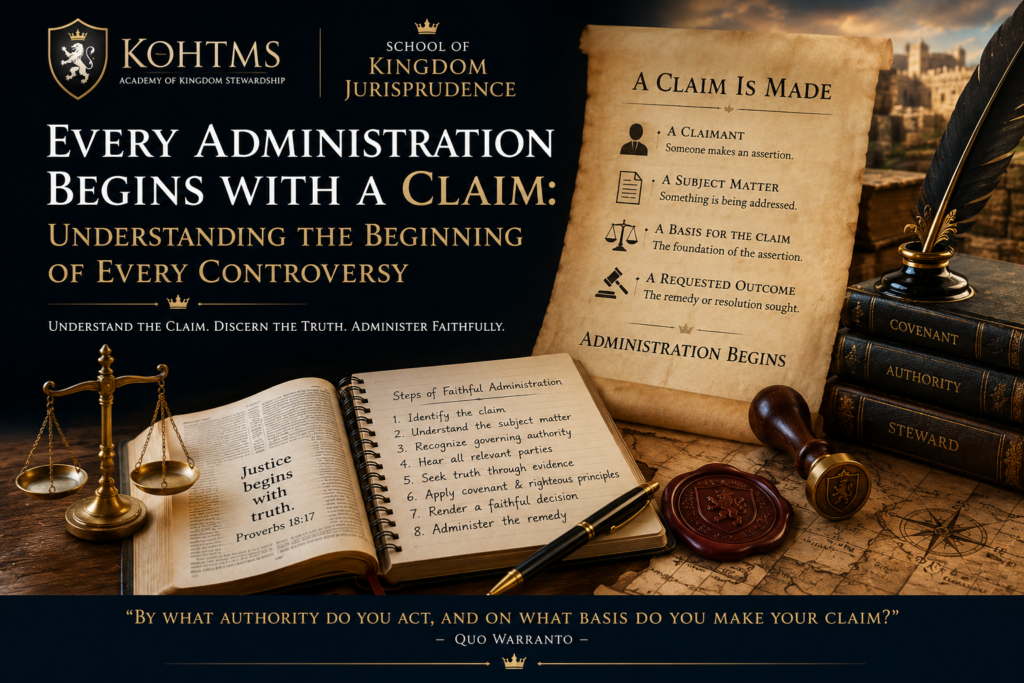
A claim is an assertion that something is true, owed, possessed, violated, entrusted, injured, or otherwise requires recognition or action.
Every claim contains several essential elements.
There is:
Without these elements, administration becomes uncertain because the steward cannot determine what is actually being presented.
Faithful administration begins by identifying the claim with clarity.
Not every claim creates conflict.
Many claims are acknowledged immediately.
A trustee claims responsibility to administer a trust.
A beneficiary claims an equitable interest.
A steward claims responsibility over property entrusted to his care.
These claims may exist without disagreement.
A controversy arises only when a claim is questioned, denied, opposed, or when competing claims cannot both be accepted without further examination.
The controversy does not create the claim.
The claim precedes the controversy.
Administration exists because questions exist.
Questions concerning:
Authority.
Responsibility.
Ownership.
Stewardship.
Obligations.
Performance.
Remedy.
The steward’s role is not merely to react.
The steward must first understand the nature of the questions presented before attempting to answer them.
Faithful administration begins with careful examination rather than immediate conclusion.
No claim exists in isolation.
Every claim implicitly asks another question.
Who possesses the authority to address this matter?
This returns us to the foundational principles established in the previous articles.
Authority.
Delegated Authority.
Representative Capacity.
The Trust Res.
Ownership versus Stewardship.
Quo Warranto.
Every one of these principles becomes relevant the moment a claim is presented.
The steward therefore learns never to separate a claim from the authority under which it is examined.
No administration can proceed without understanding the subject matter.
What relationship is involved?
What responsibility is questioned?
What property is being discussed?
What covenant governs the matter?
What trust res is entrusted?
Confusion concerning the subject matter produces confusion throughout the entire administration.
Faithful stewards therefore identify the matter before attempting to resolve it.
The existence of a claim does not establish its correctness.
Nor does disagreement automatically invalidate it.
Faithful stewardship requires patience.
Wisdom.
Discernment.
The steward listens.
Examines.
Understands.
Only afterward does faithful administration continue.
Justice is not served by assumptions.
Justice begins with understanding.
Throughout Scripture, God consistently establishes order before judgment.
Questions are asked.
Witnesses are heard.
Facts are established.
Responsibilities are identified.
Only afterward are conclusions reached.
The faithful steward follows this pattern.
Administration without order becomes confusion.
Administration with order promotes justice.
Every steward will eventually encounter claims.
Within families.
Communities.
Trusts.
Businesses.
Congregations.
Relationships.
The question is never whether claims will arise.
The question is whether the steward possesses the wisdom to administer them faithfully.
Understanding the nature of claims prepares the steward to respond with clarity rather than confusion.
Many systems begin by asking:
Who wins?
Kingdom Jurisprudence asks a different question.
What is actually being claimed?
Only after understanding the claim can faithful stewardship continue.
This simple distinction changes the entire approach to administration.
The faithful steward seeks understanding before judgment.
Truth before conclusion.
Faithfulness before power.
Every administration begins with a claim.
Claims invite questions.
Questions require understanding.
Understanding requires faithful stewardship.
The steward who learns to identify claims carefully will be better prepared to administer responsibilities wisely, preserve relationships faithfully, and pursue justice with integrity.
Administration does not begin with judgment.
It begins with understanding.
Consider the areas of stewardship presently entrusted to your care.
Ask yourself:
This week, choose a recent disagreement, misunderstanding, or administrative issue you have encountered.
Without deciding who is right or wrong, write down:
The purpose of this exercise is not to decide the matter but to develop the habit of identifying claims clearly before attempting to administer them.
Faithful stewardship begins with understanding.
Kingdom Jurisprudence I: Authority, Covenant & Stewardship (Coming Soon)
The Foundations of Kingdom Jurisprudence (Coming Soon)
Justice Begins With Truth: Why Evidence Matters