
Ask a hundred people what freedom means and you will likely receive a hundred different answers.
Some define freedom as the ability to do whatever they want.
Others define it as independence.
Some associate freedom with financial security.
Others associate it with political rights.
Still others define freedom as the absence of obligations, restrictions, or responsibilities.
While each of these perspectives contains some truth, they often overlook a principle that has shaped successful individuals, families, and communities throughout history.
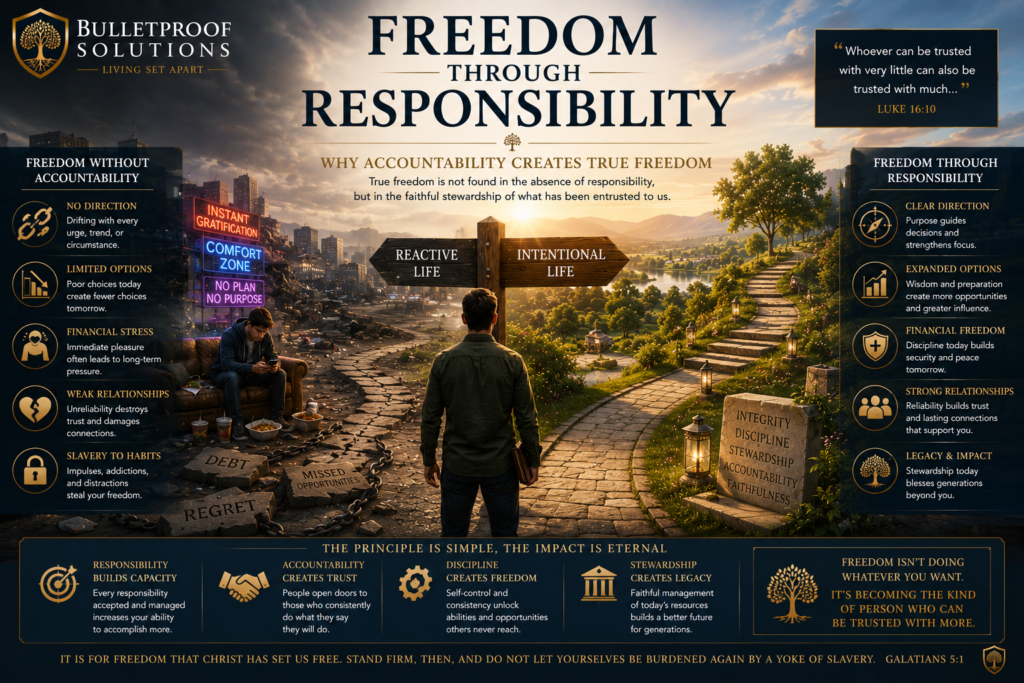
True freedom is not produced by escaping responsibility.
True freedom is produced by embracing it.
At first glance, this idea may seem backwards.
After all, responsibility appears to create obligations.
Freedom appears to remove them.
Yet a closer examination reveals that the greatest forms of freedom are often the direct result of accountability, discipline, and stewardship.
The relationship between freedom and responsibility is far deeper than most people realize.
Modern culture often presents freedom as the absence of constraints.
Do what you want.
Go where you want.
Believe what you want.
Live however you want.
The focus is frequently placed upon personal autonomy.
The ability to choose without interference.
Choice is certainly an important component of freedom.
However, choice alone is insufficient.
A person may possess unlimited choices yet lack the ability to exercise those choices effectively.
Without competence, choices become limited.
Without resources, choices become limited.
Without discipline, choices become limited.
Without responsibility, choices become limited.
This reveals an important truth:
Freedom is not merely the existence of options.
Freedom is the ability to steward those options wisely.
Every responsibility accepted and managed successfully increases capacity.
A child learns responsibility by caring for simple tasks.
Over time they gain greater opportunities.
Greater opportunities bring greater responsibilities.
Greater responsibilities create greater capability.
The pattern repeats throughout life.
A trusted employee receives more responsibility.
A capable leader receives more responsibility.
A faithful steward receives more responsibility.
As responsibility increases, influence often increases as well.
This is not accidental.
Responsibility develops competence.
Competence creates opportunity.
Opportunity expands freedom.
The process begins with stewardship.
Many people seek freedom without accountability.
Unfortunately, this often produces the opposite result.
Consider finances.
A person who spends without discipline may initially feel free.
No budgets.
No planning.
No restrictions.
Yet over time debt accumulates.
Financial pressure increases.
Options decrease.
What appeared to be freedom eventually becomes limitation.
Now consider health.
A person may choose convenience over discipline.
Again, the decision initially appears liberating.
However, over time the consequences accumulate.
Energy decreases.
Capabilities decline.
Choices become restricted.
The same pattern appears in relationships, education, business, and community life.
Avoiding responsibility may provide temporary comfort.
Embracing responsibility creates long-term freedom.
One of the greatest benefits of accountability is trust.
Trust is one of the most valuable forms of capital a person can possess.
People trust those who consistently fulfill responsibilities.
They trust those who honor commitments.
They trust those who demonstrate integrity.
Trust creates opportunities.
It creates relationships.
It creates partnerships.
It creates influence.
Without accountability, trust deteriorates.
Without trust, opportunities become limited.
Freedom therefore is not merely an individual pursuit.
It is relational.
Trust expands possibilities.
Accountability strengthens trust.
The highest form of governance is self-government.
Self-government does not mean isolation.
It means the ability to direct one’s own conduct according to principles rather than impulses.
A person incapable of governing themselves will eventually be governed by circumstances.
Or emotions.
Or habits.
Or external pressures.
Stewardship requires self-government.
The steward plans.
The steward prepares.
The steward evaluates.
The steward accepts responsibility for outcomes.
This form of accountability creates stability.
Stability creates freedom.
The individual who governs themselves effectively requires less external control.
Discipline is frequently misunderstood.
Many people view discipline as restriction.
In reality, discipline often creates possibilities that would otherwise remain inaccessible.
A musician practices scales.
A craftsman develops skills.
An athlete trains consistently.
An entrepreneur develops systems.
Each accepts discipline.
The reward is greater capability.
Greater capability expands opportunities.
Expanded opportunities increase freedom.
Discipline therefore is not the enemy of freedom.
Discipline is one of its primary sources.
The most capable individuals are often the most disciplined.
Relationships provide another powerful example.
Many people desire trust.
Fewer people desire accountability.
Yet trust cannot exist without accountability.
Healthy relationships depend upon reliability.
Reliability depends upon responsibility.
Responsibility depends upon integrity.
When individuals consistently honor commitments, relationships become stronger.
Stronger relationships create stability.
Stable relationships create freedom.
People flourish in environments where trust exists.
Trust flourishes where accountability exists.
The connection is unavoidable.
A person who prepares possesses options.
A person who neglects preparation often loses them.
Preparation is one of the most practical expressions of responsibility.
Financial preparation creates resilience.
Educational preparation creates competence.
Relational preparation creates trust.
Community preparation creates stability.
Preparation does not eliminate uncertainty.
It increases the ability to navigate uncertainty successfully.
That ability is a form of freedom.
The more prepared a person becomes, the more capable they become.
The more capable they become, the greater their available options.
Stewardship offers a practical path toward freedom.
The steward understands that resources must be managed wisely.
Time must be managed.
Money must be managed.
Knowledge must be managed.
Relationships must be managed.
Responsibilities must be managed.
As stewardship improves, dependence often decreases.
Capability increases.
Confidence increases.
Options increase.
These are all forms of freedom.
The steward does not pursue freedom directly.
They pursue responsibility.
Freedom emerges as a result.
Perhaps the greatest impact of responsibility is generational.
Responsible people create stability.
Stable families create opportunities.
Strong communities create resilience.
Future generations inherit the benefits of present stewardship.
This is one reason responsibility matters so deeply.
Its effects extend beyond the individual.
The choices made today influence the opportunities available tomorrow.
Freedom is rarely inherited accidentally.
It is often the product of faithful stewardship across generations.
Modern culture frequently presents freedom and responsibility as opposites.
In reality, they are partners.
Freedom without responsibility often leads to limitation.
Responsibility embraced faithfully often produces greater freedom.
Accountability creates trust.
Trust creates opportunity.
Discipline creates competence.
Competence creates capability.
Capability expands freedom.
The path to freedom is not found in avoiding responsibility.
It is found in becoming the kind of person who can faithfully manage it.
Living set apart requires this shift in perspective.
Instead of asking:
“How can I have fewer responsibilities?”
The steward begins asking:
“How can I become more faithful with what has already been entrusted to me?”
The answer to that question often unlocks a level of freedom that many people spend their entire lives seeking.
Responsibility, stewardship, trust, and freedom are deeply connected principles.
Explore the educational resources, discussions, weekly calls, and training available through BulletProof Solutions and continue developing the skills necessary to live intentionally, steward faithfully, and build lasting freedom.