
Few words create more confusion than jurisdiction.
Most people hear the term and immediately think of courts, governments, boundaries, and legal systems.
While jurisdiction certainly appears within those settings, the principle itself is much older.
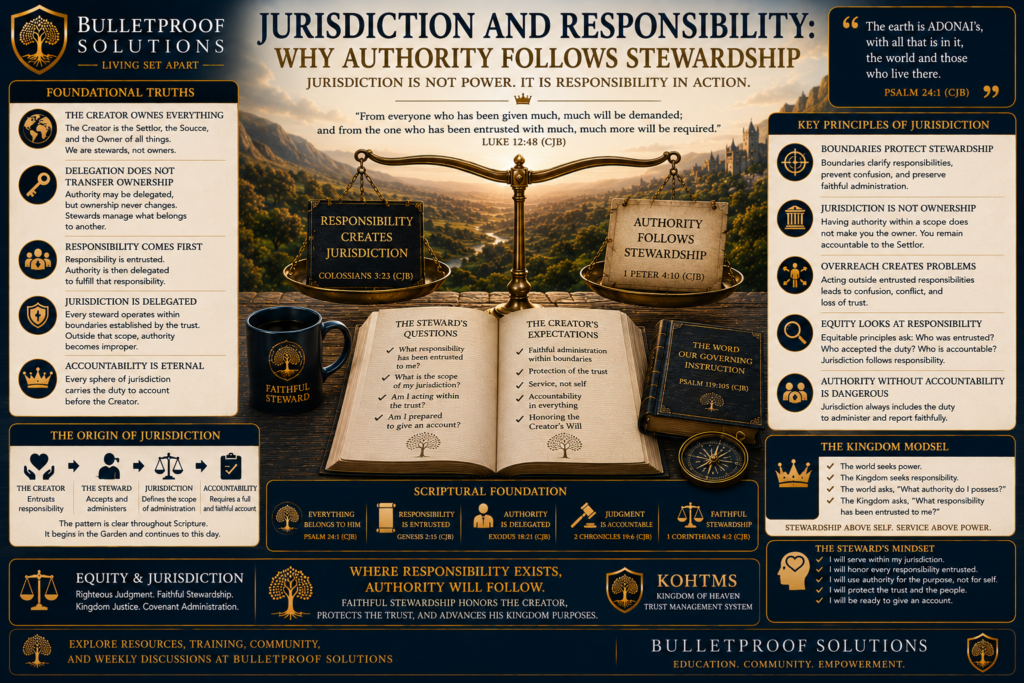
Jurisdiction is fundamentally about responsibility.
Who has been entrusted?
Who is accountable?
Who possesses the duty to administer?
These questions reveal the true foundation of jurisdiction.
Within the Kingdom of Heaven Trust Management System, jurisdiction is not viewed primarily as power.
It is viewed as stewardship.
The steward is entrusted with responsibilities.
Those responsibilities create a sphere of administration.
That sphere becomes the steward’s jurisdiction.
Understanding this principle changes how authority, governance, and accountability are viewed.
At its simplest level, jurisdiction describes the scope within which authority may be exercised.
Every steward operates within boundaries.
Every trustee operates within boundaries.
Every administrator operates within boundaries.
Every leader operates within boundaries.
These boundaries are not arbitrary.
They arise from the responsibilities that have been entrusted.
Jurisdiction therefore defines where administration properly belongs.
Outside that scope, authority becomes improper.
Inside that scope, authority may be exercised faithfully.
Modern thinking often assumes authority creates responsibility.
Kingdom administration teaches the opposite.
Responsibility comes first.
Authority follows responsibility.
The Creator entrusts a responsibility.
Authority is then delegated to fulfill that responsibility.
Consider a parent.
The parent receives responsibility for the care and development of a child.
Authority follows that responsibility.
The authority exists because the responsibility exists.
Without the responsibility, the authority has no legitimate purpose.
The same principle applies throughout Kingdom administration.
The Creator alone possesses unlimited jurisdiction.
Everything belongs to Him.
Everything originates from Him.
Everything ultimately returns to Him.
Every other jurisdiction is delegated.
Every steward’s jurisdiction is entrusted.
Every trustee’s jurisdiction is entrusted.
Every administrator’s jurisdiction is entrusted.
This reality creates humility.
No steward possesses original jurisdiction.
Every steward administers delegated responsibilities within delegated boundaries.
The principle appears from the beginning.
Adam was entrusted with responsibilities.
He was instructed to tend and guard the garden.
His responsibilities created a sphere of administration.
That sphere became his jurisdiction.
Notice what happened.
Responsibility came first.
Authority followed.
The pattern established in Genesis continues throughout Scripture.
The Creator entrusts.
The steward administers.
Jurisdiction emerges from stewardship.
Faithful administration requires boundaries.
Without boundaries, accountability becomes impossible.
Responsibilities become unclear.
Authority becomes confused.
Conflict increases.
Boundaries protect stewardship.
They clarify responsibilities.
They establish expectations.
They preserve accountability.
The steward therefore respects jurisdiction because jurisdiction protects faithful administration.
One of the most common mistakes in administration occurs when jurisdiction is confused with ownership.
A steward may possess jurisdiction.
A trustee may possess jurisdiction.
A judge may possess jurisdiction.
A leader may possess jurisdiction.
None of these positions create ownership.
The steward administers.
The owner remains the owner.
The trustee administers.
The trust remains the trust.
Jurisdiction grants authority to administer.
It does not transfer ownership.
This distinction preserves humility and accountability.
Whenever authority extends beyond entrusted responsibilities, problems emerge.
The steward begins acting outside the trust.
The administrator begins acting outside the assignment.
The leader begins acting outside the purpose.
Overreach often begins with good intentions.
It frequently ends with confusion and conflict.
Kingdom administration therefore emphasizes faithful stewardship within established boundaries.
The objective is not expansion.
The objective is faithfulness.
Equity has always been closely connected to responsibility.
Equity asks questions such as:
Who was entrusted?
Who accepted responsibility?
Who owed a duty?
Who was accountable?
These questions naturally involve jurisdiction.
The person responsible for administration possesses the corresponding jurisdiction.
The person lacking responsibility lacks the corresponding jurisdiction.
This relationship explains why equitable principles frequently focus upon trusteeship, fiduciary duty, and stewardship.
Every sphere of jurisdiction carries accountability.
The parent accounts for parenting.
The trustee accounts for administration.
The steward accounts for stewardship.
The leader accounts for leadership.
Jurisdiction therefore is not merely authority.
Jurisdiction is authority connected to accountability.
Authority without accountability becomes dangerous.
Jurisdiction properly understood always includes both.
The Kingdom model differs dramatically from worldly models.
The world often associates jurisdiction with power.
The Kingdom associates jurisdiction with responsibility.
The world asks:
“What authority do I possess?”
The Kingdom asks:
“What responsibility has been entrusted to me?”
This difference changes everything.
Power-centered administration seeks control.
Responsibility-centered administration seeks faithful stewardship.
The Kingdom consistently favors stewardship.
The faithful steward rarely seeks greater jurisdiction.
The faithful steward seeks greater faithfulness.
The steward understands that every additional responsibility increases accountability.
Every expanded jurisdiction increases the duty to administer faithfully.
This perspective creates humility.
It encourages service.
It strengthens stewardship.
The steward recognizes that jurisdiction is not a privilege to exploit.
It is a responsibility to honor.
Within the Kingdom of Heaven Trust Management System, jurisdiction is inseparable from stewardship.
The Creator establishes the Covenant.
The Covenant establishes responsibilities.
Responsibilities establish administration.
Administration establishes jurisdiction.
The steward therefore does not begin with power.
The steward begins with responsibility.
This sequence preserves proper Kingdom order.
It keeps authority aligned with purpose.
It keeps administration aligned with stewardship.
It keeps jurisdiction aligned with accountability.
Jurisdiction is often misunderstood as power.
Kingdom administration reveals a deeper reality.
Jurisdiction is responsibility in action.
The Creator entrusts responsibilities.
Authority follows those responsibilities.
Jurisdiction defines the sphere within which faithful administration occurs.
The faithful steward understands that jurisdiction is never ownership.
It is stewardship.
It is accountability.
It is service.
It is faithful execution of the Creator’s expressed Will.
For this reason, the wise steward does not seek authority for its own sake.
The wise steward seeks faithfulness.
Because where responsibility exists, authority will follow.
And where authority follows stewardship, Kingdom administration can flourish according to the purposes of the Creator.
Explore stewardship, trusteeship, jurisdiction, equity, covenant administration, and Kingdom governance through the educational resources, training programs, weekly discussions, and community available through BulletProof Solutions.