
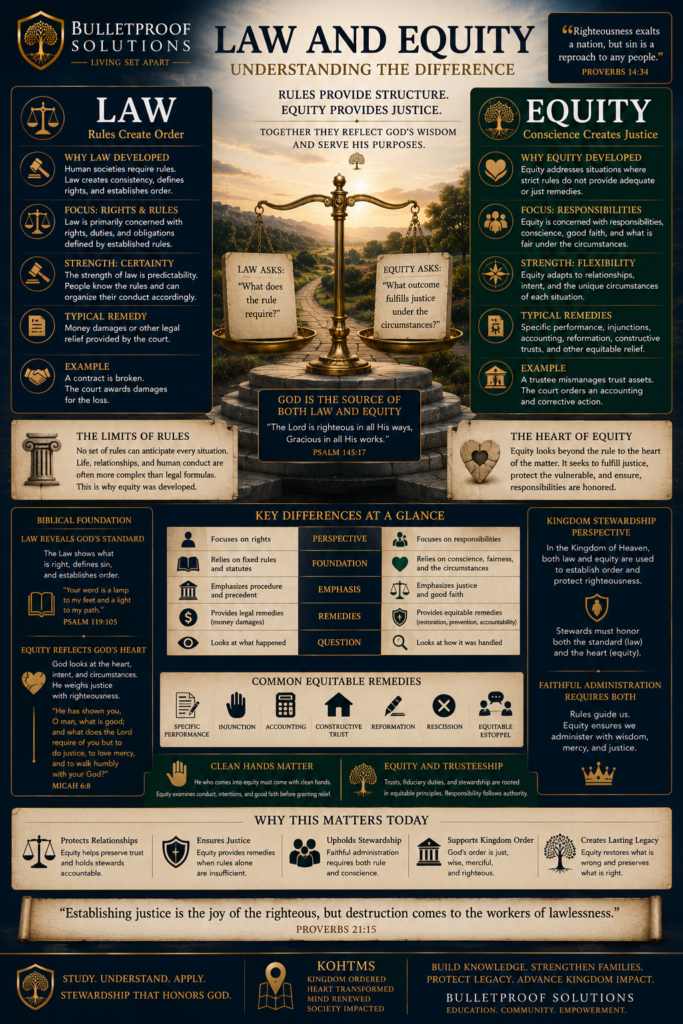
Few concepts have influenced the development of Western legal systems more than the distinction between law and equity.
The terms are frequently used.
Attorneys reference them.
Judges reference them.
Court opinions reference them.
Yet most people have never been taught what the distinction actually means.
As a result, many assume that law and equity are simply different words describing the same thing.
Historically, they were not.
While modern courts often combine legal and equitable powers within the same institution, the principles developed from different purposes and sought different kinds of remedies.
Understanding this distinction helps explain many aspects of administration, fiduciary responsibility, trusts, remedies, and governance.
More importantly, it helps explain the difference between strict rules and the pursuit of justice when strict rules alone fail to provide adequate solutions.
Human societies require rules.
Without rules, predictability becomes difficult.
Commerce becomes difficult.
Relationships become unstable.
Communities become vulnerable to conflict.
Legal systems developed to create consistency.
Rules establish expectations.
Expectations create predictability.
Predictability allows society to function more effectively.
The strength of law is certainty.
People generally know what the rules are.
They can organize their conduct accordingly.
This predictability remains one of the greatest strengths of legal systems.
Despite their value, rules possess limitations.
No set of rules can anticipate every circumstance.
Life is often more complicated than statutes.
Relationships are often more complicated than contracts.
Human conduct is often more complicated than legal formulas.
Situations arise where applying a rule mechanically may produce outcomes that appear unjust, unreasonable, or incomplete.
Historically, these situations created pressure for another system of relief.
That system became known as equity.
Equity emerged to address situations where strict application of legal rules failed to provide adequate remedies.
Rather than focusing exclusively upon rules, equity focused upon fairness, conscience, responsibility, and justice.
The objective was not to replace law.
The objective was to supplement it.
Law asked:
What does the rule require?
Equity asked:
What outcome fulfills justice under the circumstances?
Both questions matter.
The difference lies in perspective.
Law focuses primarily upon rights.
Equity frequently focuses upon responsibilities.
Law often emphasizes procedure.
Equity often emphasizes conscience.
Historically, individuals who could not obtain adequate relief through common law courts often petitioned the sovereign for assistance.
Over time, these petitions were administered through separate courts of equity.
These courts developed principles designed to address circumstances that legal remedies could not adequately resolve.
Many concepts familiar today emerged from equitable traditions.
Trusts.
Fiduciary duties.
Specific performance.
Injunctions.
Constructive trusts.
Accounting.
Equitable estoppel.
These remedies often focused upon responsibilities and relationships rather than merely legal rights.
One of the most important distinctions between law and equity involves perspective.
Law frequently focuses upon rights.
Who possesses rights?
What rights exist?
Have those rights been violated?
Equity frequently examines responsibilities.
Who accepted responsibilities?
Were those responsibilities fulfilled?
Did someone act faithfully?
Did someone act fairly?
This distinction helps explain why fiduciary relationships often involve equitable principles.
Fiduciary relationships are fundamentally relationships of responsibility.
Equity therefore naturally became involved in their administration.
Trusteeship developed largely through equitable principles.
The trustee accepted responsibilities.
The beneficiary relied upon faithful administration.
The relationship depended upon trust.
Equity became concerned with ensuring that responsibilities remained connected to authority.
This focus produced many fiduciary concepts still recognized today.
Loyalty.
Good faith.
Accountability.
Care.
Faithful administration.
These principles continue influencing trust relationships, organizational governance, and responsible stewardship.
One of the clearest differences between law and equity appears in the remedies each traditionally provided.
Legal remedies frequently involved monetary compensation.
Someone suffered harm.
Money was awarded.
The matter concluded.
Equitable remedies often addressed situations where money alone was insufficient.
Examples included:
Specific performance
Injunctions
Accounting
Rescission
Reformation
Constructive trusts
These remedies sought solutions tailored to the circumstances.
The focus was not merely compensation.
The focus was restoration, prevention, administration, or accountability.
One of the most recognized equitable principles is often summarized as:
“He who comes into equity must come with clean hands.”
The principle reflects a simple idea.
A person seeking equitable relief should not be acting inequitably themselves.
Equity examines conduct.
Intentions.
Responsibilities.
Behavior.
The principle reinforces the connection between accountability and equitable relief.
Equity is not solely concerned with what happened.
It is also concerned with how parties have conducted themselves.
The relationship between equity and stewardship is significant.
Stewardship focuses upon responsibility.
Equity frequently examines responsibility.
Stewardship emphasizes accountability.
Equity frequently enforces accountability.
Stewardship asks:
“What was entrusted?”
Equity often asks:
“How was it administered?”
This overlap explains why trust administration and fiduciary relationships became closely associated with equitable principles.
Modern legal systems continue relying upon both legal and equitable principles.
Although separate courts may no longer exist in many jurisdictions, the underlying concepts remain influential.
Trust administration.
Corporate governance.
Probate administration.
Partnership disputes.
Fiduciary litigation.
Injunctions.
Specific performance.
Accounting actions.
All continue reflecting equitable traditions.
Understanding these concepts helps people appreciate how responsibilities, relationships, and remedies interact within modern systems.
Law and equity should not be viewed as enemies.
Historically they served different purposes.
Law provides predictability.
Equity provides flexibility.
Law provides structure.
Equity provides conscience.
Law provides consistency.
Equity provides fairness.
Healthy administration often requires both.
Rules create order.
Equitable principles help ensure that order serves justice rather than defeating it.
The distinction between law and equity remains one of the most important developments in legal history.
Law developed to provide consistency, predictability, and order.
Equity developed to address situations where strict application of rules failed to produce adequate outcomes.
Together they shaped many of the principles that continue influencing trusts, fiduciary relationships, governance, administration, and remedies today.
Understanding the difference helps reveal an important truth:
Rules matter.
Responsibilities matter as well.
Rights matter.
Stewardship matters as well.
Justice often requires both.
And where responsibility, trust, and faithful administration are involved, the influence of equitable principles continues to be felt.
Equity, fiduciary responsibility, stewardship, trusteeship, and administration are deeply connected subjects.
Explore the educational resources, discussions, training programs, and community available through BulletProof Solutions and continue building a deeper understanding of law, equity, and faithful administration.