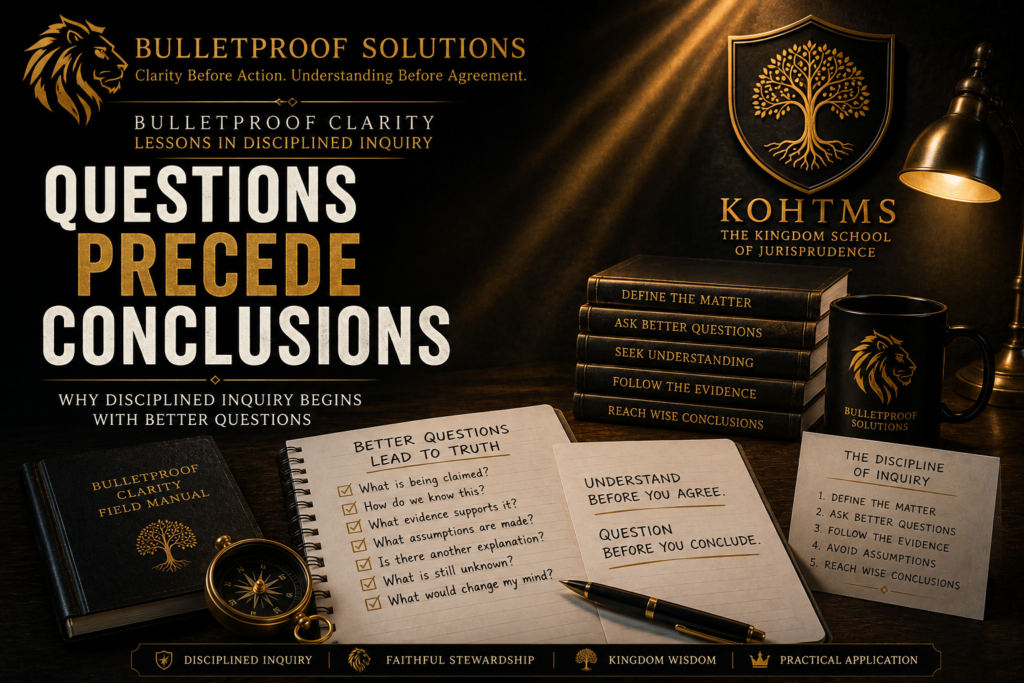
“A question honestly pursued is often more valuable than an answer hastily accepted.”
Why do disciplined thinkers ask questions before reaching conclusions, and how do carefully constructed questions lead to greater understanding?
Every meaningful inquiry begins with uncertainty.
When we encounter a problem, hear a claim, witness an event, or attempt to make an important decision, we stand at the threshold between what we know and what we have yet to understand. The bridge across that gap is not assumption. It is inquiry.
Yet many people reverse the process.
They begin with an answer.
Then they search for questions that defend it.
Disciplined inquiry follows the opposite path.
It begins with questions—not because questions are an end in themselves, but because they illuminate facts, expose assumptions, clarify definitions, reveal relationships, and identify what remains unknown.
Questions are not obstacles to understanding.
They are the pathway to it.
The quality of any conclusion depends upon the quality of the questions that preceded it.
Poor questions produce shallow understanding.
Loaded questions produce biased conclusions.
Unasked questions leave important facts undiscovered.
Every investigator, administrator, steward, business owner, educator, parent, judge, researcher, and student depends upon questions to understand reality before acting.
Questions do not demonstrate ignorance.
They demonstrate intellectual discipline.
A person who refuses to ask questions often becomes captive to assumptions they never realized they possessed.
The disciplined examiner is not embarrassed by uncertainty.
He recognizes that uncertainty is the proper starting point of honest inquiry.
People often assume:
Asking questions slows progress.
Intelligent people should already know the answers.
Questions reveal weakness.
The first answer is usually correct.
Agreement is more important than understanding.
If someone sounds confident, further questions are unnecessary.
Every question deserves an immediate answer.
Once a conclusion has been reached, questioning should stop.
These assumptions discourage careful examination and reward premature certainty.
Before accepting any claim, ask:
What exactly is being claimed?
How do we know this?
What evidence supports it?
What assumptions are being made?
Are important terms clearly defined?
Is there another reasonable explanation?
Who bears the burden of establishing this claim?
What information is still missing?
What would change my present understanding?
Am I asking questions to understand, or only to defend what I already believe?
These questions move inquiry from reaction to examination.
Every answer marks the end of one question.
Every good question opens the door to another layer of understanding.
Questions identify what has not yet been established.
They reveal where evidence is lacking.
They expose hidden assumptions.
They prevent us from mistaking familiarity for knowledge.
Many disagreements disappear once important words are defined.
When someone says:
“I was treated unfairly.”
The disciplined examiner does not immediately agree or disagree.
Instead, he asks:
“What do you mean by unfair?”
The definition often determines the direction of the entire inquiry.
Suppose someone says:
“They intentionally ignored me.”
A disciplined inquiry might ask:
What actually occurred?
What evidence establishes intent?
Could another explanation exist?
The event may be factual.
The interpretation may still require examination.
Human beings naturally seek information that confirms existing beliefs.
Disciplined questions interrupt that tendency.
Instead of asking:
“How can I prove I am right?”
Ask:
“What evidence would demonstrate that my present understanding is incomplete?”
That question protects intellectual integrity.
Approach every matter with the willingness to learn rather than the desire to win.
Curiosity creates room for discovery.
Defensiveness closes it.
Questions should seek understanding rather than compel agreement.
Instead of asking:
“Why did they act irresponsibly?”
Ask:
“What decision was made, and what information influenced it?”
Neutral questions produce more reliable answers.
Each answer should naturally produce another question.
The inquiry develops progressively.
Rather than forcing the evidence to support a conclusion, allow the evidence to guide the next question.
Closed questions confirm specific facts.
Example:
“Was the notice delivered on May 10?”
Open questions develop understanding.
Example:
“How was the notice delivered, and what evidence supports that conclusion?”
Both have value.
Knowing when to use each is part of disciplined inquiry.
Sometimes the greatest breakthrough comes from changing the question entirely.
Instead of asking:
“Who is at fault?”
Perhaps ask:
“What sequence of events produced this outcome?”
Instead of asking:
“How do we defend our position?”
Perhaps ask:
“What matter has actually been established?”
Changing the question often changes the quality of the answer.
Questions should not stop merely because an answer has been given.
They continue until the matter becomes sufficiently clear to support responsible action.
Understanding—not speed—is the goal.
Replace accusations with questions that seek understanding before assigning blame.
Ask questions that identify causes before implementing solutions.
Questions identify jurisdiction, authority, duties, relationships, evidence, and burdens before arguments are presented.
Ask:
Who was speaking?
To whom?
Under what circumstances?
What question was being answered?
What covenantal relationship existed?
Good questions protect the text from being separated from its context.
Before administering any responsibility, ask:
What has been entrusted?
By whom?
For what purpose?
According to what authority?
Every faithful steward begins with questions before taking action.
What assumptions do I usually make before asking questions?
Do my questions seek understanding or confirmation?
Have I confused confidence with evidence?
Which question would most improve my understanding of a current matter?
What important question have I avoided asking?
Questions do not delay understanding. They create it. Every careful conclusion is built upon a foundation of disciplined inquiry, and every disciplined inquiry begins with better questions.
The first discipline was defining the matter.
The second discipline is learning to ask better questions.
The next discipline addresses another common obstacle to clear thinking:
Clarity before action. Understanding before agreement. Questions before conclusions.