
Category
Kingdom Jurisprudence
Reading Time
Approximately 24–28 minutes
Supports Learning Path
Kingdom Jurisprudence → Equity & Jurisdiction → Trust Estate Foundations
Featured Course
Defending and Bringing Claims on Behalf of Your Trust Estate
Related Courses
Key Topics
By what authority is this power being exercised, and has that authority been lawfully established?
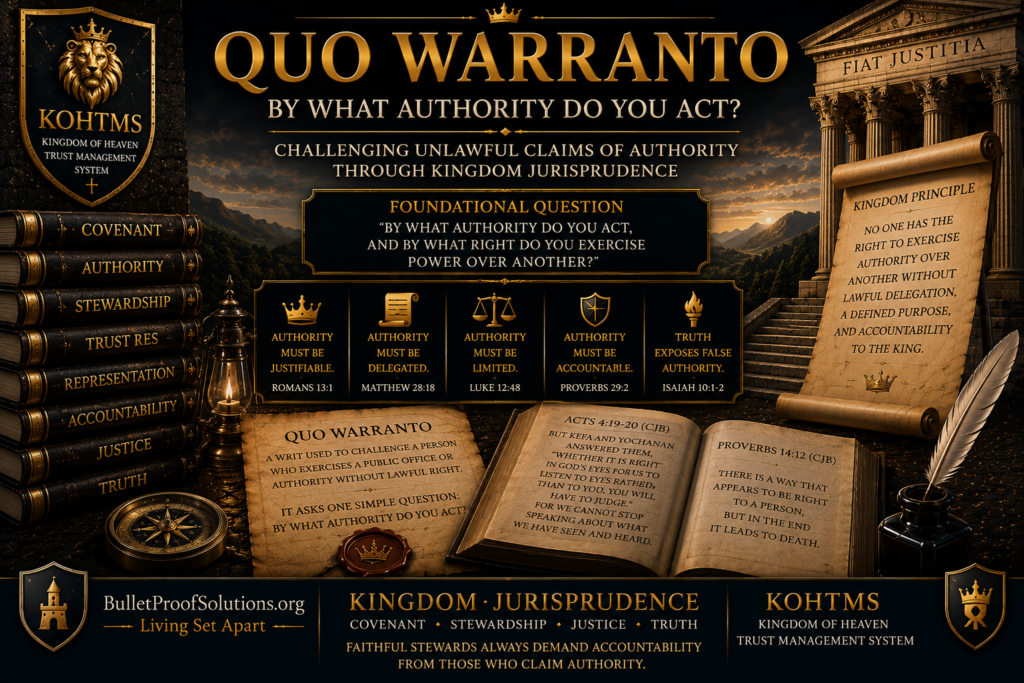
A historic legal writ whose name means “By what authority?” It was traditionally used to require a person exercising a public office or franchise to demonstrate the lawful basis upon which that authority was claimed.
The delegated right and corresponding responsibility to administer according to the governing covenant or governing instrument.
The lawful scope within which authority is exercised over a particular subject matter, relationship, person, or controversy according to the governing system.
One who faithfully administers responsibilities entrusted by another.
The continuing obligation to demonstrate faithful administration before the one from whom authority has been received.
Every exercise of authority raises a question.
Sometimes it is spoken.
Sometimes it remains unasked.
Yet it always exists.
“By what authority do you act?”
Kingdom Jurisprudence teaches that authority is never presumed simply because it is asserted.
Every steward understands that authority has a source.
It has a purpose.
It has limits.
It carries accountability.
For this reason, one of the oldest questions in jurisprudence continues to possess extraordinary importance.
Not,
“What power do you possess?”
But,
“From whom have you received the authority you now exercise?”
The historic writ of quo warranto reminds us that authority has never been intended to exist without accountability.
Every lawful exercise of authority should be capable of identifying its source, its purpose, its limits, and the accountability accompanying it.
Historically, the writ of quo warranto required one exercising certain public authority to demonstrate the legal basis for doing so.
The question itself was remarkably simple.
“By what authority do you claim this office?”
The purpose was not merely confrontation.
It was accountability.
Authority exercised without lawful foundation invited examination.
The writ reflected an enduring principle:
Authority should be demonstrable rather than assumed.
Long before the writ existed, Scripture repeatedly records questions concerning authority.
Prophets were asked by whose word they spoke.
Kings were confronted concerning their stewardship.
Priests were accountable for the administration entrusted to them.
Messiah Himself was asked concerning His authority.
The recurring question was never merely about power.
It concerned source.
Authority was expected to be connected to the One from whom it originated.
Faithful stewards do not exercise authority carelessly.
Before acting they ask:
Who entrusted this responsibility?
What governing instrument defines it?
What purpose does it serve?
Where are its boundaries?
To whom will I give account?
These questions protect the steward from confusing personal preference with delegated authority.
Whenever authority is disconnected from accountability, administration begins to deteriorate.
Offices become self-serving.
Responsibilities become neglected.
Stewardship becomes domination.
Kingdom Jurisprudence therefore continually reconnects authority to accountability.
The steward never exercises authority merely because he possesses power.
He administers faithfully because he has received a sacred trust.
It is easy to question another’s authority.
It is often more difficult to examine our own.
Faithful stewardship begins at home.
Before asking another,
“By what authority do you act?”
the steward first asks himself:
Have I correctly understood the authority entrusted to me?
Have I remained within its proper limits?
Am I faithfully administering according to the governing covenant?
This self-examination guards against hypocrisy.
Every administration concerns something.
A trust concerns its trust res.
A family concerns its household.
A business concerns its operations.
A controversy concerns its disputed subject matter.
The faithful steward learns to identify both the subject matter and the authority claimed over that subject matter before proceeding with administration.
Understanding these foundational elements brings clarity to every controversy.
Truth has nothing to fear from honest inquiry.
If authority is genuine, careful examination strengthens confidence.
If authority has been misunderstood, careful examination provides an opportunity for correction.
The faithful steward therefore does not fear foundational questions.
He welcomes them.
Truth is strengthened through careful examination.
Throughout Scripture the pattern remains remarkably consistent.
The King entrusts authority.
The steward receives.
The steward faithfully administers.
The steward gives account.
Faithful stewardship therefore continually remembers that every exercise of authority ultimately points back to the King.
Many controversies become confused because the foundational questions are never asked.
What is the subject matter?
Who has been entrusted with its administration?
What governing instrument establishes that stewardship?
What authority is being exercised?
What are its limits?
Kingdom Jurisprudence teaches the steward to begin with first principles before moving to conclusions.
Doing so often brings clarity where confusion previously existed.
The enduring question of quo warranto is ultimately a question of faithful stewardship.
It reminds every steward that authority should never become detached from its source.
The faithful steward neither assumes authority lightly nor exercises it carelessly.
He continually seeks to understand:
Its source.
Its purpose.
Its limits.
Its accountability.
By doing so he reflects the wisdom, justice, and order of the Kingdom he serves.
Review every area in which you presently exercise authority.
For each one ask:
Review your trust records.
Can you readily identify:
Whenever a steward participates in legal or administrative proceedings involving a trust or other fiduciary responsibility, disciplined preparation is essential.
Consider questions such as:
Likewise, when evaluating claims made by others, careful attention to the asserted basis of authority, the governing documents, and the relevant legal framework can help clarify the issues in dispute.
Prepare an Authority Analysis Worksheet for a stewardship you presently administer.
Document:
Repeat this exercise annually to ensure your administration remains orderly and faithful.
Defending and Bringing Claims on Behalf of Your Trust Estate
Learn how faithful trustees preserve, protect, and administer trust estates through disciplined stewardship, careful documentation, and sound fiduciary practices.
Understanding Authority, Jurisdiction, and Faithful Administration
Next Article
Every Administration Begins With a Claim: Understanding Controversy, Claims, and the Burden of Establishing Them
I will never exercise authority carelessly nor accept responsibility lightly.
I will seek to understand the source, purpose, limits, and accountability of every stewardship entrusted to me.
I will administer faithfully according to the governing covenant and preserve the trust placed in my care.
I will welcome honest examination, remain teachable, and seek truth before judgment.
May my administration reflect the justice, wisdom, and faithfulness of the King whom I serve.
“Well done, good and faithful servant.”