Every generation inherits something.
Resources.
Knowledge.
Opportunities.
Responsibilities.
Challenges.
The question is not whether an inheritance will be received.
The question is whether the next generation will be prepared to steward what they receive.
Many people focus on leaving assets.
Far fewer focus on preparing future stewards.
Yet stewardship may be the most valuable inheritance that can be passed forward.
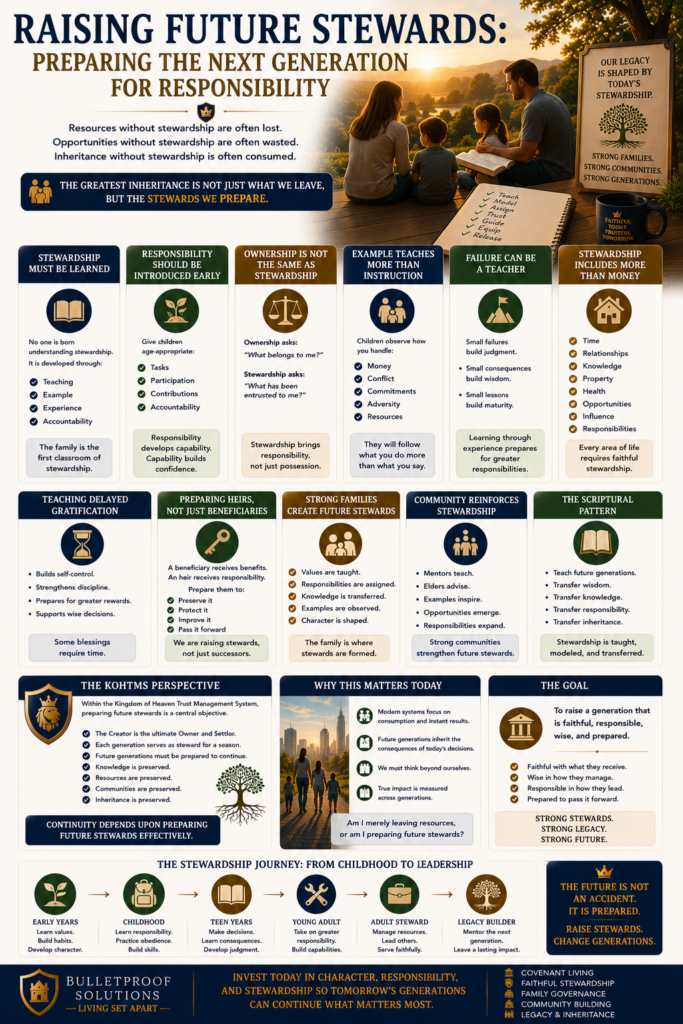
Resources without stewardship are often lost.
Opportunities without stewardship are often wasted.
Inheritance without stewardship is often consumed.
The faithful steward understands that preparing future stewards is one of the most important responsibilities of every family and community.
No one is born understanding stewardship.
Children are not born knowing how to manage resources.
How to make wise decisions.
How to resolve conflict.
How to preserve inheritance.
How to exercise responsibility.
These skills are developed through teaching, example, experience, and accountability.
The family serves as the first classroom of stewardship.
Parents become the first instructors.
Daily life becomes the curriculum.
One of the greatest gifts that can be given to a child is responsibility.
Not overwhelming responsibility.
Appropriate responsibility.
Age-appropriate tasks.
Meaningful participation.
Real contributions.
Real accountability.
Children learn stewardship by doing.
The faithful steward understands that responsibility develops capability.
Capability develops confidence.
Confidence prepares future leaders and stewards.
Many children are taught ownership.
Far fewer are taught stewardship.
Ownership asks:
What belongs to me?
Stewardship asks:
What has been entrusted to me?
Ownership focuses on possession.
Stewardship focuses on responsibility.
The distinction matters.
The faithful steward seeks to teach that resources carry obligations as well as benefits.
This lesson often shapes future decision-making.
Children observe far more than they hear.
They watch how parents handle money.
How they resolve conflict.
How they treat others.
How they honor commitments.
How they respond to adversity.
How they administer resources.
The example provided within the home often becomes more influential than formal lessons.
The faithful steward recognizes that teaching stewardship begins with living stewardship.
Many parents attempt to protect children from every mistake.
While protection has its place, stewardship often develops through experience.
Small failures.
Small consequences.
Small lessons.
These experiences help build judgment.
Wisdom grows when people learn to evaluate outcomes and adjust behavior.
The faithful steward understands that controlled opportunities to learn can become valuable preparation for larger responsibilities later.
Many people associate stewardship primarily with finances.
Stewardship involves much more.
Time.
Relationships.
Knowledge.
Property.
Health.
Opportunities.
Influence.
Responsibilities.
The faithful steward seeks to help future generations understand that stewardship applies to every area of life.
Resources come in many forms.
Each requires administration.
One of the most important stewardship skills is learning to think beyond immediate desires.
The ability to delay gratification influences nearly every area of life.
Saving.
Planning.
Investing.
Learning.
Building.
Preserving.
Inheritance.
The faithful steward helps future generations understand that some rewards require patience.
Some opportunities require preparation.
Some blessings require time.
A beneficiary receives benefits.
An heir receives responsibility.
The distinction is significant.
The faithful steward seeks to prepare heirs rather than merely beneficiaries.
Future stewards must understand not only what they may receive.
They must understand how to preserve it.
Protect it.
Improve it.
Pass it forward.
This preparation helps create continuity across generations.
Families play a central role in stewardship development.
Values are taught.
Responsibilities are assigned.
Knowledge is transferred.
Examples are observed.
Character is shaped.
The family becomes the environment where future stewards are formed.
Strong families often produce individuals better prepared to manage resources, relationships, opportunities, and responsibilities.
Communities also contribute to stewardship development.
Mentors teach.
Elders advise.
Examples inspire.
Opportunities emerge.
Responsibilities expand.
The faithful steward understands that healthy communities help reinforce the lessons first introduced within the family.
Stewardship grows stronger when families and communities work together.
Throughout Scripture, parents are instructed to teach future generations.
Wisdom is transferred.
Knowledge is transferred.
Responsibility is transferred.
Inheritance is transferred.
The emphasis extends beyond information.
The goal is preparation.
Future generations are expected to continue the work of faithful stewardship.
The pattern remains consistent.
Stewardship is taught.
Stewardship is modeled.
Stewardship is transferred.
Within the Kingdom of Heaven Trust Management System, preparing future stewards remains a central objective.
The Creator remains the ultimate Owner and Settlor.
Each generation serves as steward for a season.
Future generations must be prepared to continue the stewardship.
Knowledge is preserved.
Resources are preserved.
Communities are preserved.
Inheritance is preserved.
This continuity depends upon preparing future stewards effectively.
Many modern systems focus heavily on consumption and immediate results.
Stewardship requires a longer perspective.
Future generations will inherit the consequences of today’s decisions.
The faithful steward therefore asks an important question:
Am I merely leaving resources?
Or am I preparing future stewards?
The answer often determines whether inheritance survives.
Raising future stewards is one of the most important responsibilities entrusted to families and communities.
Resources can be transferred quickly.
Stewardship takes years to develop.
The faithful steward therefore invests intentionally in preparation.
Teaching.
Example.
Responsibility.
Accountability.
Wisdom.
Because the greatest inheritance is often not what we leave behind.
It is the people we prepare to continue the stewardship after we are gone.
When future generations are prepared, inheritance survives, communities strengthen, and faithful stewardship continues from one generation to the next.
Explore covenant living, family governance, stewardship, inheritance preservation, Kingdom administration, community building, and practical educational resources through the courses, discussions, tools, and community available through BulletProof Solutions.