Throughout history, strong communities shared a common characteristic.
People helped one another.
Families supported one another.
Neighbors supported one another.
Skills were shared.
Resources were shared.
Knowledge was shared.
When difficulties arose, people often turned first to relationships rather than institutions.
This principle is often described as mutual aid.
Mutual aid is not charity in the traditional sense.
It is not dependency.
It is not centralized control.
It is not coercion.
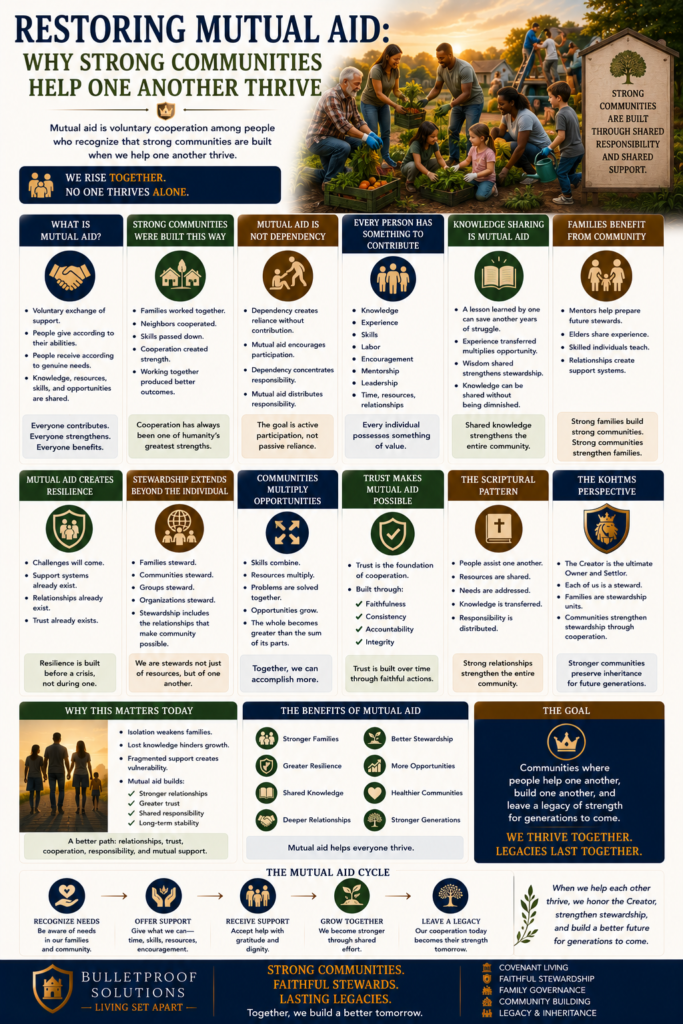
Mutual aid is voluntary cooperation among people who recognize that strong communities are built through shared responsibility and shared support.
The faithful steward understands that healthy communities become stronger when people help one another thrive.
Mutual aid is the voluntary exchange of support between individuals, families, and communities.
People contribute according to their abilities.
People receive assistance according to genuine needs.
Knowledge is shared.
Resources are shared.
Skills are shared.
Opportunities are shared.
The relationship is reciprocal.
Everyone contributes something.
Everyone benefits from the strength of the community.
Mutual aid strengthens resilience because support exists before crises occur.
For most of human history, mutual aid was normal.
Families worked together.
Neighbors cooperated.
Communities shared labor.
Skills passed from one generation to another.
People understood that cooperation created strength.
No single person possessed every skill.
No single family possessed every resource.
Working together often produced better outcomes than isolated effort.
The faithful steward recognizes that cooperation has always been one of humanity’s greatest strengths.
One of the most important distinctions involves the difference between mutual aid and dependency.
Dependency creates reliance without contribution.
Mutual aid encourages participation.
Dependency often concentrates responsibility in one place.
Mutual aid distributes responsibility.
Dependency can weaken stewardship.
Mutual aid often strengthens stewardship.
The objective is not creating passive recipients.
The objective is creating active participants within a healthy community.
Many people assume contribution requires wealth.
Contribution takes many forms.
Knowledge.
Experience.
Skills.
Labor.
Encouragement.
Mentorship.
Leadership.
Time.
Resources.
Relationships.
The faithful steward understands that every individual possesses something of value.
Strong communities learn how to recognize and utilize these contributions effectively.
One of the most powerful forms of mutual aid is the sharing of knowledge.
A lesson learned by one person may save another years of difficulty.
Experience transferred becomes opportunity multiplied.
Wisdom shared becomes stewardship strengthened.
Knowledge is unique because it can be shared without being diminished.
The faithful steward values the transfer of knowledge because it strengthens the entire community.
Families remain the primary stewardship institution.
Communities strengthen families.
Mentors help prepare future stewards.
Elders share experience.
Skilled individuals teach valuable abilities.
Relationships create support systems.
The strongest families often exist within strong communities.
The strongest communities often consist of strong families.
The relationship is mutually reinforcing.
Every family eventually faces challenges.
Health issues.
Financial difficulties.
Unexpected losses.
Life transitions.
No family is immune to hardship.
Communities built upon mutual aid often respond more effectively to challenges.
Support systems already exist.
Relationships already exist.
Trust already exists.
The faithful steward understands that resilience is easier to build before a crisis than during one.
Many people view stewardship only through an individual lens.
Personal finances.
Personal responsibilities.
Personal resources.
The stewardship model extends further.
Families steward.
Communities steward.
Groups steward.
Organizations steward.
The faithful steward recognizes that stewardship includes caring for the broader relationships that make community possible.
One person may possess a skill.
Another may possess a resource.
Another may possess knowledge.
Another may possess experience.
When people cooperate, opportunities multiply.
Problems become easier to solve.
Resources become more effective.
Knowledge spreads more rapidly.
The community becomes stronger than the sum of its individual parts.
This multiplication effect represents one of the greatest benefits of mutual aid.
Mutual aid depends upon trust.
Without trust, cooperation becomes difficult.
Without trust, relationships weaken.
Without trust, communities fragment.
Trust develops through faithfulness.
Consistency.
Accountability.
Integrity.
The faithful steward understands that trust is not created instantly.
It is built over time.
Strong communities therefore invest heavily in relationships because relationships create trust.
Throughout Scripture, communities repeatedly cooperate for mutual benefit.
People assist one another.
Resources are shared.
Needs are addressed.
Knowledge is transferred.
Responsibility is distributed.
The emphasis remains upon stewardship, faithfulness, and voluntary support.
The pattern reflects mutual aid in practice.
Strong relationships strengthen the entire community.
Within the Kingdom of Heaven Trust Management System, mutual aid represents an important expression of community stewardship.
The Creator remains the ultimate Owner and Settlor.
Individuals serve as stewards.
Families serve as stewardship units.
Communities strengthen stewardship through cooperation.
Knowledge is shared.
Resources are shared.
Responsibilities are shared.
Future generations benefit from stronger support networks and healthier communities.
Many modern societies experience increasing isolation.
Families become separated.
Neighbors remain strangers.
Knowledge becomes fragmented.
Support systems weaken.
The result is often unnecessary vulnerability.
The stewardship model offers another path.
A path built upon relationships.
Trust.
Cooperation.
Responsibility.
Mutual support.
This path strengthens both individuals and communities.
Mutual aid is not merely a historical practice.
It is a stewardship principle.
Strong communities help one another thrive.
Knowledge is shared.
Resources are shared.
Responsibilities are shared.
Opportunities are shared.
The faithful steward understands that no individual succeeds entirely alone.
Families benefit from communities.
Communities benefit from families.
Both become stronger through cooperation.
When mutual aid becomes part of community culture, resilience increases, opportunities multiply, relationships deepen, and future generations inherit stronger foundations upon which to build.
Because healthy communities are not built through isolation.
They are built through faithful people working together for the benefit of one another and the generations that follow.
Explore covenant living, family governance, stewardship, inheritance preservation, Kingdom administration, community building, and practical educational resources through the courses, discussions, tools, and community available through BulletProof Solutions.