
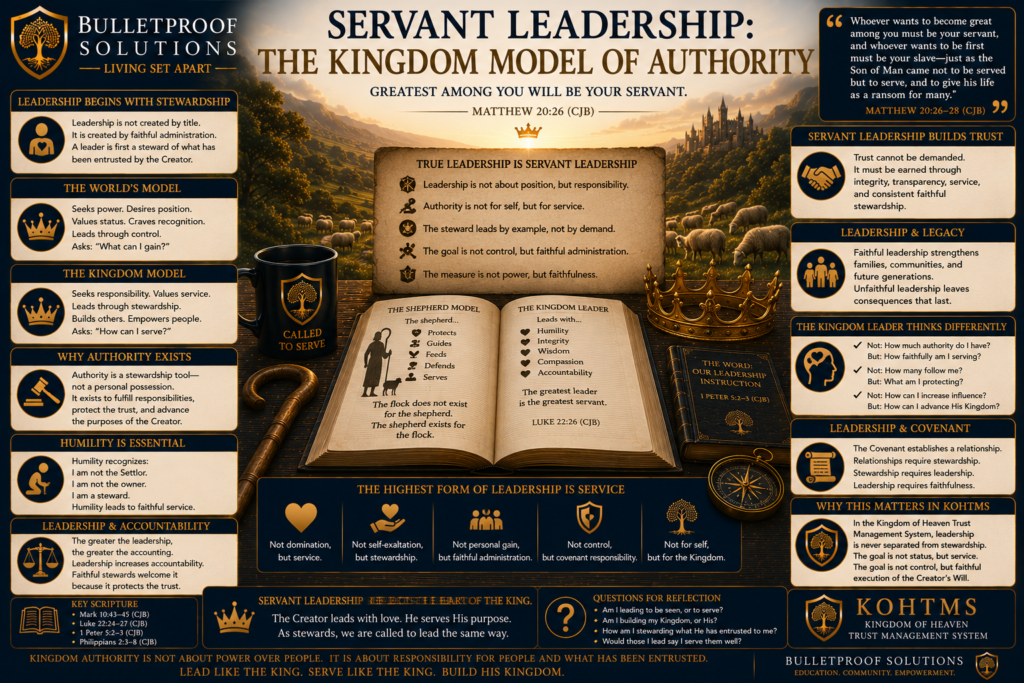
One of the greatest differences between the Kingdom of Heaven and the kingdoms of men is how authority is understood.
The world often views leadership as position.
The Kingdom views leadership as stewardship.
The world often views leadership as power.
The Kingdom views leadership as responsibility.
The world frequently associates leadership with control.
The Kingdom associates leadership with service.
This distinction lies at the heart of Kingdom administration.
It also lies at the heart of the Kingdom of Heaven Trust Management System.
Many people desire authority.
Far fewer desire the responsibilities that accompany it.
Yet throughout Scripture, the Creator consistently teaches that authority exists for service rather than self-exaltation.
The faithful steward therefore approaches leadership very differently than the world around them.
Leadership does not begin when a title is received.
Leadership begins when responsibility is accepted.
A parent becomes a leader through responsibility.
A teacher becomes a leader through responsibility.
A trustee becomes a leader through responsibility.
An elder becomes a leader through responsibility.
The common element is stewardship.
Leadership is not created by position.
Leadership is created by faithful administration.
This principle appears repeatedly throughout Scripture.
The Creator develops faithful stewards before entrusting greater responsibilities.
Throughout history, many systems have viewed leadership primarily through the lens of power.
Who commands?
Who controls?
Who possesses authority?
Who occupies the highest office?
These questions often dominate human thinking.
Leadership becomes associated with status.
Influence.
Prestige.
Recognition.
Control.
As a result, many seek leadership for what they can gain from it.
Scripture consistently warns against this mindset.
Because leadership pursued for self-interest eventually becomes corruption.
Yeshua presented a radically different model.
When His disciples argued about greatness, He redirected the conversation entirely.
The issue was not who possessed the highest position.
The issue was who served most faithfully.
Within the Kingdom:
The greatest servant becomes the greatest leader.
The greatest steward becomes the greatest administrator.
The greatest responsibility carries the greatest accountability.
Leadership therefore moves in the opposite direction of worldly ambition.
The Kingdom elevates service.
Not self-exaltation.
Authority is often misunderstood.
Many assume authority exists to benefit the person exercising it.
Kingdom administration teaches the opposite.
Authority exists to fulfill responsibilities.
Authority exists to protect the trust.
Authority exists to preserve the inheritance.
Authority exists to advance the purposes of the Creator.
Authority therefore remains a stewardship tool.
Not a personal possession.
Not a status symbol.
Not an entitlement.
The steward uses authority to serve the trust rather than the trust serving the steward.
Scripture repeatedly uses the shepherd as a model for leadership.
The shepherd protects.
Guides.
Feeds.
Defends.
Serves.
The shepherd’s authority exists for the benefit of the flock.
The flock does not exist to benefit the shepherd.
This distinction reveals one of the most important principles of Kingdom leadership.
Leadership exists to serve those entrusted to the steward’s care.
The objective is faithful administration.
Not personal advancement.
Humility is one of the defining characteristics of faithful leadership.
Humility recognizes:
I am not the Settlor.
I am not the owner.
I am not the source.
I am a steward.
This perspective transforms leadership.
The steward remains focused upon service.
Focused upon responsibility.
Focused upon accountability.
Pride seeks position.
Humility seeks faithfulness.
Pride seeks recognition.
Humility seeks stewardship.
This is why humility remains essential to Kingdom administration.
The greater the leadership, the greater the accounting.
This principle appears consistently throughout Scripture.
Those entrusted with greater responsibilities face greater accountability.
Not less.
Leadership never removes accountability.
Leadership increases it.
The faithful steward therefore welcomes accountability.
Because accountability protects the trust.
Protects the steward.
Protects future generations.
Protects the integrity of the administration itself.
Trust cannot be demanded.
Trust must be earned.
Faithful leaders earn trust through consistent stewardship.
Integrity.
Transparency.
Service.
Accountability.
People follow faithful stewards because they recognize faithfulness.
Not because force compels them.
Trust becomes one of the greatest assets any leader possesses.
And servant leadership strengthens trust more effectively than domination ever can.
The quality of leadership influences generations.
Faithful leadership strengthens families.
Communities.
Fellowships.
Trusts.
Institutions.
Future generations inherit the benefits.
Unfaithful leadership produces the opposite.
Resources are wasted.
Trust deteriorates.
Communities weaken.
Future generations bear the consequences.
The steward therefore understands that leadership carries responsibilities extending far beyond the present moment.
The Kingdom leader asks different questions.
Not:
How much authority do I possess?
But:
How faithfully am I serving?
Not:
How many people follow me?
But:
How well am I protecting what has been entrusted to me?
Not:
How can I increase my influence?
But:
How can I advance the purposes of the Creator?
These questions reveal the heart of Kingdom leadership.
The Everlasting Covenant establishes a relationship.
Relationships require stewardship.
Stewardship requires leadership.
Leadership requires faithfulness.
This sequence explains why servant leadership plays such a central role within Kingdom administration.
The faithful steward serves the Covenant.
Serves the trust.
Serves the inheritance.
Serves the purposes of the Creator.
Leadership therefore becomes an expression of stewardship rather than domination.
Within the Kingdom of Heaven Trust Management System, leadership is never separated from stewardship.
The Creator remains the Settlor.
The Covenant remains the governing framework.
The steward remains accountable.
Leadership becomes the faithful administration of responsibilities entrusted by the Creator.
The objective is not status.
The objective is service.
The objective is not recognition.
The objective is stewardship.
The objective is not control.
The objective is faithful execution of the Creator’s expressed Will.
The Kingdom of Heaven presents a model of leadership unlike the systems commonly found in the world.
The world often elevates power.
The Kingdom elevates stewardship.
The world seeks position.
The Kingdom seeks faithfulness.
The world pursues control.
The Kingdom pursues service.
This distinction changes everything.
Because leadership is no longer measured by authority alone.
Leadership is measured by faithful administration.
The faithful steward therefore understands that the highest form of leadership is not domination.
It is service.
Not self-exaltation.
But stewardship.
Not personal gain.
But faithful execution of the Creator’s Will.
For this reason, servant leadership remains the foundation of Kingdom administration.
And faithful stewardship remains the mark of every true Kingdom leader.
Explore stewardship, covenant administration, Kingdom governance, trusteeship, accountability, and faithful leadership through the educational resources, training programs, discussions, and community available through BulletProof Solutions.