
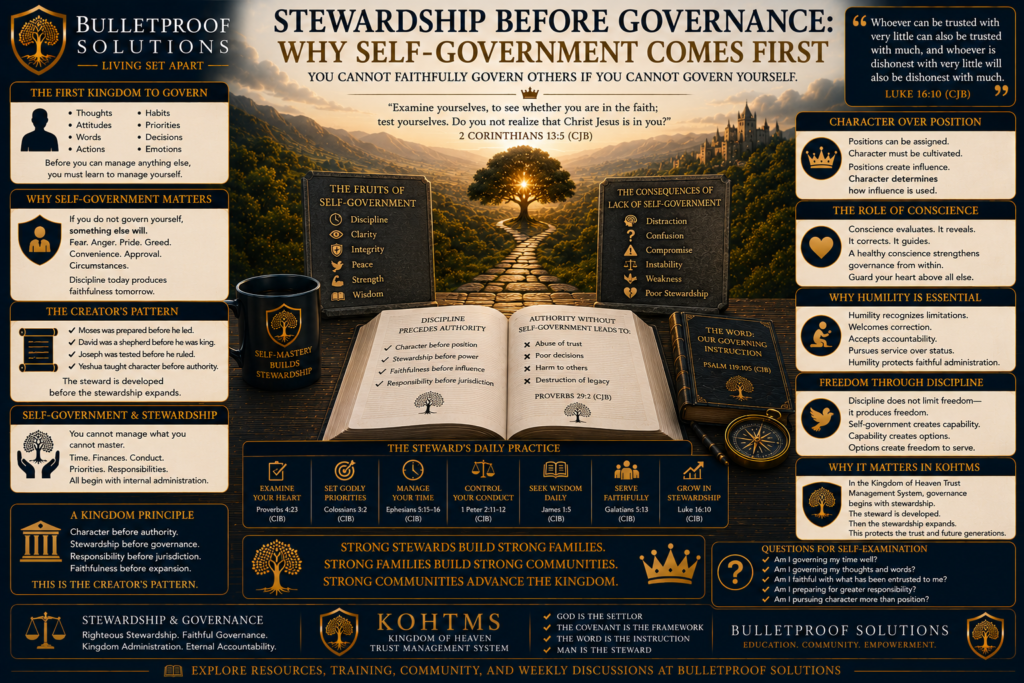
One of the greatest misconceptions about governance is the belief that governance begins with authority over others.
Many people associate governance with governments.
Leaders.
Administrators.
Judges.
Councils.
Institutions.
Kingdom administration begins somewhere entirely different.
It begins with self-government.
Before a steward can faithfully administer a trust, the steward must first learn to govern themselves.
Before a leader can guide others, the leader must first learn to guide themselves.
Before authority can be exercised responsibly, character must be developed internally.
This principle appears throughout Scripture.
The Creator consistently focuses upon the steward before the stewardship.
The heart before the office.
The character before the authority.
The administration before the jurisdiction.
This pattern reveals a foundational truth:
Governance begins within.
Every person possesses a realm over which they exercise influence.
Their thoughts.
Their attitudes.
Their words.
Their actions.
Their habits.
Their priorities.
Their decisions.
This internal realm is the first kingdom entrusted to every steward.
Before managing resources.
Before managing relationships.
Before managing communities.
The steward must learn to manage themselves.
Failure at this level eventually produces failure at higher levels of administration.
Success at this level creates the foundation for everything that follows.
The steward who cannot govern themselves becomes vulnerable to every external influence.
Fear governs them.
Anger governs them.
Pride governs them.
Greed governs them.
Convenience governs them.
Approval governs them.
Circumstances govern them.
Such a person may possess authority.
Yet they do not truly govern.
They are governed.
Kingdom administration requires something different.
The faithful steward learns to exercise discipline over thoughts, emotions, desires, and conduct.
This internal order becomes the foundation of external stewardship.
Throughout Scripture the Creator repeatedly develops the steward before expanding the stewardship.
Moses spent years being prepared before leading Israel.
David learned stewardship as a shepherd before becoming king.
Joseph learned administration in adversity before administering a nation.
Yeshua taught His disciples character before entrusting them with greater responsibilities.
The pattern remains consistent.
The steward is developed before the stewardship expands.
The character is strengthened before authority increases.
The foundation is established before the structure is built.
Many people pursue positions.
Kingdom administration focuses upon character.
Positions may be granted quickly.
Character develops slowly.
Positions can be assigned.
Character must be cultivated.
Positions may create influence.
Character determines how that influence will be used.
This distinction explains why Scripture repeatedly emphasizes qualities such as:
Faithfulness.
Integrity.
Humility.
Wisdom.
Patience.
Self-control.
These qualities strengthen the steward.
The stronger the steward, the stronger the administration.
Stewardship and self-government are inseparable.
The steward who cannot manage time struggles to manage resources.
The steward who cannot manage priorities struggles to manage responsibilities.
The steward who cannot manage conduct struggles to manage authority.
Everything begins with internal administration.
This principle applies throughout life.
Financial stewardship begins with disciplined decisions.
Relationship stewardship begins with disciplined conduct.
Community stewardship begins with disciplined service.
The quality of stewardship reflects the quality of self-government.
Conscience plays an essential role in self-government.
Conscience evaluates conduct.
It examines motives.
It reveals inconsistencies.
It encourages correction.
A healthy conscience strengthens governance from within.
Without conscience, discipline deteriorates.
Without discipline, stewardship weakens.
Without stewardship, governance becomes unstable.
The steward therefore protects conscience carefully because conscience helps maintain internal order.
Many people seek authority.
Few seek the discipline required to exercise it faithfully.
This imbalance creates many problems.
Authority magnifies character.
If the steward possesses integrity, authority expands opportunities for service.
If the steward lacks integrity, authority expands opportunities for harm.
For this reason the Creator consistently develops character before authority.
The steward who governs themselves becomes prepared to administer greater responsibilities.
The steward who neglects self-government remains vulnerable regardless of position.
Humility is one of the most important characteristics of self-government.
Humility recognizes limitations.
Humility welcomes correction.
Humility accepts accountability.
Humility remembers that stewardship is a trust rather than an entitlement.
Pride often resists growth.
Humility embraces growth.
Pride seeks status.
Humility seeks faithfulness.
Pride pursues recognition.
Humility pursues service.
Kingdom governance consistently favors humility because humility protects faithful administration.
The family often becomes the first environment in which governance is learned.
Children learn responsibility.
Accountability.
Service.
Cooperation.
Respect.
Discipline.
These lessons establish patterns that influence future stewardship.
Strong families often produce stronger stewards.
Stronger stewards often produce stronger communities.
The Creator’s design frequently develops governance through relationships long before it appears in formal institutions.
Many people assume discipline limits freedom.
In reality, discipline often creates freedom.
The steward who governs time gains opportunities.
The steward who governs finances gains stability.
The steward who governs conduct gains trust.
The steward who governs priorities gains clarity.
Self-government creates capability.
Capability creates options.
Options create freedom.
This is one reason stewardship and freedom are so closely connected.
Faithful self-government expands the steward’s ability to serve effectively.
Within the Kingdom of Heaven Trust Management System, governance begins with stewardship.
The Creator is the Settlor.
The Covenant establishes the relationship.
The steward accepts responsibility.
The steward develops self-government.
Only then can larger responsibilities be administered faithfully.
This sequence protects the trust.
It protects the steward.
It protects future generations.
Most importantly, it aligns administration with the Creator’s purposes.
The Kingdom model differs dramatically from worldly models.
The world often begins with power.
The Kingdom begins with character.
The world begins with position.
The Kingdom begins with stewardship.
The world asks:
Who is in charge?
The Kingdom asks:
Who is faithful?
This distinction changes everything.
Because faithful administration depends more upon the quality of the steward than the size of the office.
Every form of governance begins with self-government.
Before a steward administers a trust.
Before a leader guides a community.
Before a parent raises a family.
Before a trustee manages resources.
The steward must first learn to govern themselves.
This principle appears throughout Scripture because it reflects the Creator’s pattern for faithful administration.
Character before authority.
Stewardship before governance.
Responsibility before jurisdiction.
Faithfulness before expansion.
The wise steward therefore focuses first upon internal administration.
Because the strongest communities, trusts, families, and Kingdom institutions are ultimately built upon faithful stewards who have first learned the discipline of governing themselves.
And where self-government flourishes, righteous stewardship can flourish as well.
Explore stewardship, Kingdom governance, covenant administration, self-government, trusteeship, and faithful stewardship through the educational resources, training programs, discussions, and community available through BulletProof Solutions.