
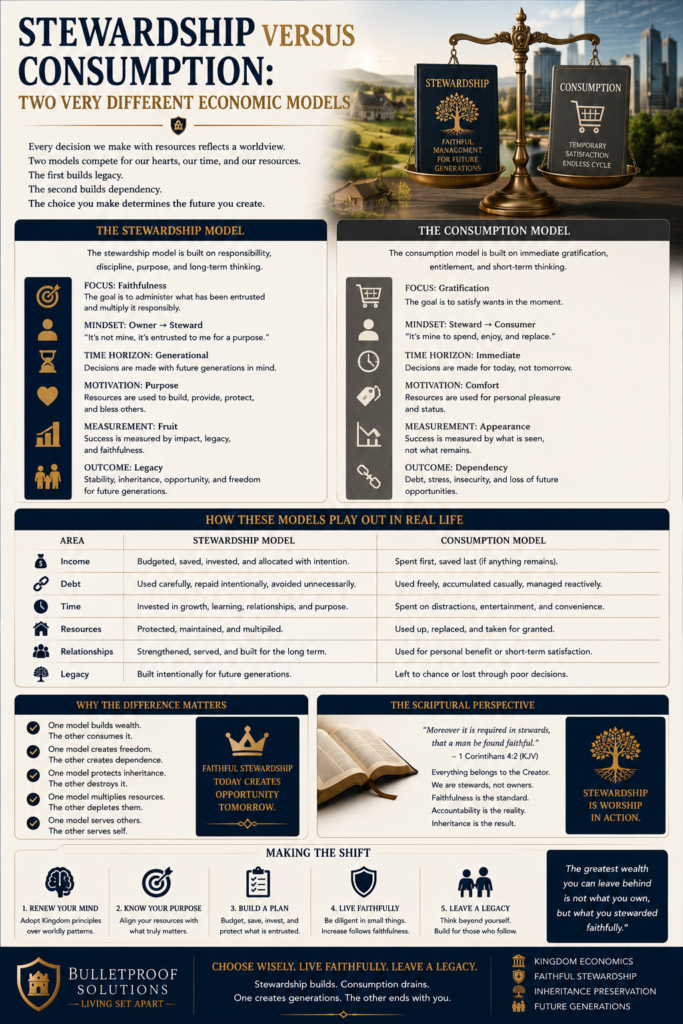
Every economic decision reflects a worldview.
Whether we realize it or not, the way we earn, spend, save, invest, preserve, and transfer resources reveals what we believe about ownership, responsibility, and the future.
Most people assume economics is primarily about money.
In reality, economics is about decisions.
Resources are limited.
Time is limited.
Energy is limited.
Opportunities are limited.
How those resources are managed determines outcomes.
At the heart of many economic choices are two competing models.
The stewardship model.
And the consumption model.
These two systems produce dramatically different results because they begin with dramatically different assumptions.
Understanding the difference may be one of the most important financial lessons a person can learn.
Every resource eventually goes somewhere.
Money is spent.
Time is invested.
Knowledge is transferred.
Property is maintained or neglected.
Relationships are strengthened or weakened.
The question is not whether resources will be used.
The question is how they will be used.
The stewardship model seeks purposeful administration.
The consumption model seeks immediate satisfaction.
This distinction affects every area of life.
The stewardship model starts with a simple assumption.
Resources have been entrusted.
The steward asks:
What am I responsible for?
How should this be administered?
How can it be protected?
How can it be improved?
How can it benefit others?
How can it be preserved for future generations?
Responsibility becomes the foundation of decision-making.
Resources are viewed as assignments rather than possessions.
This mindset naturally produces careful administration.
The consumption model begins differently.
The primary question becomes:
What do I want right now?
How can this benefit me immediately?
How can this increase my comfort?
How can this satisfy my desires?
Future consequences often receive less attention.
Long-term planning frequently yields to short-term gratification.
The focus shifts from preservation to consumption.
From responsibility to entitlement.
From stewardship to personal satisfaction.
One of the most important distinctions between these models involves their long-term effects.
Stewardship generally builds.
Consumption generally depletes.
The steward preserves assets.
The consumer uses assets.
The steward improves resources.
The consumer consumes resources.
The steward thinks about continuity.
The consumer thinks about immediacy.
Neither model eliminates all enjoyment.
The difference lies in priorities.
One prioritizes preservation.
The other prioritizes consumption.
These economic models become visible in ordinary life.
A steward budgets intentionally.
A consumer spends reactively.
A steward evaluates purchases according to purpose.
A consumer evaluates purchases according to desire.
A steward maintains assets.
A consumer often replaces assets.
A steward values durability.
A consumer frequently values convenience.
Small decisions repeated consistently create dramatically different outcomes over time.
One of the defining characteristics of stewardship is long-term thinking.
The steward asks:
What will remain?
What will endure?
What inheritance is being created?
What opportunities are being preserved?
How will future generations be affected?
Generational thinking changes financial behavior.
Savings increase.
Planning improves.
Preservation becomes important.
Inheritance becomes meaningful.
The steward recognizes that today’s decisions often affect people who have not yet been born.
Consumption is not inherently wrong.
People must consume resources to live.
Food must be eaten.
Homes must be occupied.
Tools must be used.
The problem occurs when consumption becomes the primary objective.
When immediate satisfaction dominates decision-making, long-term consequences often suffer.
Future opportunities may be sacrificed.
Future inheritance may be diminished.
Future flexibility may disappear.
The steward seeks balance.
The consumer often seeks gratification.
Debt frequently exposes the contrast between these models.
The steward views debt cautiously.
The consumer often views debt as a means of obtaining immediate gratification.
The steward asks:
How will this obligation affect future stewardship?
The consumer asks:
Can I obtain what I want today?
Debt itself is not always the problem.
The mindset behind the debt often reveals which economic model is operating.
One of the greatest strengths of the stewardship model is its emphasis on preservation.
The steward understands that inheritance does not happen automatically.
Resources must be protected.
Knowledge must be transferred.
Assets must be administered.
Families must be strengthened.
Opportunities must be preserved.
Without stewardship, inheritance frequently disappears within a generation or two.
With stewardship, inheritance can continue benefiting families for generations.
Many people pursue freedom through acquisition.
The stewardship model often creates freedom through administration.
Good stewardship reduces waste.
Reduces unnecessary obligations.
Reduces dependency.
Reduces vulnerability.
Strong stewardship creates options.
Options create freedom.
The faithful steward therefore views wise administration as a pathway to greater independence and stability.
Economic choices rarely affect only individuals.
Families are affected.
Communities are affected.
Future generations are affected.
The stewardship model strengthens families by preserving resources and creating stability.
The consumption model often places greater pressure on future generations by consuming resources that might otherwise have been preserved.
The effects extend far beyond individual decisions.
Throughout Scripture, faithful stewardship receives consistent praise.
The faithful steward manages wisely.
Protects diligently.
Plans carefully.
Preserves faithfully.
The focus remains upon administration.
Responsibility.
Accountability.
Inheritance.
The blessing follows faithful stewardship.
Not reckless consumption.
The pattern remains remarkably consistent.
Within the Kingdom of Heaven Trust Management System, stewardship forms the foundation of economics.
The Creator remains the ultimate Owner and Settlor.
Human beings function as trustees and stewards.
Resources are administered.
Inheritance is preserved.
Future generations are considered.
The objective is not merely increasing consumption.
The objective is faithful administration of everything entrusted to one’s care.
This perspective naturally creates a different approach to economics.
Modern economies often encourage consumption.
Advertising promotes consumption.
Debt frequently supports consumption.
Social pressure often rewards consumption.
The stewardship model offers a different path.
A path focused on purpose.
Preservation.
Responsibility.
Inheritance.
Long-term thinking.
This path may not always be popular.
It is often far more sustainable.
Stewardship and consumption represent two very different economic models.
One begins with responsibility.
The other begins with gratification.
One builds.
The other depletes.
One thinks generationally.
The other thinks immediately.
One protects inheritance.
The other often consumes it.
The faithful steward understands that resources are more than possessions.
They are responsibilities.
Assignments.
Opportunities.
Trusts.
The goal is not merely to acquire.
The goal is to administer faithfully.
Protect wisely.
Preserve diligently.
And pass forward what has been entrusted.
Because the greatest economic legacy is not what we consume.
It is what we faithfully steward for those who come after us.
Explore Kingdom economics, inheritance preservation, stewardship, trust administration, generational planning, community development, and practical educational resources through the courses, discussions, tools, and community available through BulletProof Solutions.