
Few ideas have shaped human civilization more than the concept of ownership.
People work to acquire property.
Businesses seek to acquire assets.
Governments regulate ownership.
Entire legal systems have developed around defining, protecting, transferring, and regulating ownership interests.
Yet beneath the concept of ownership lies another principle that is often overlooked.
Stewardship.
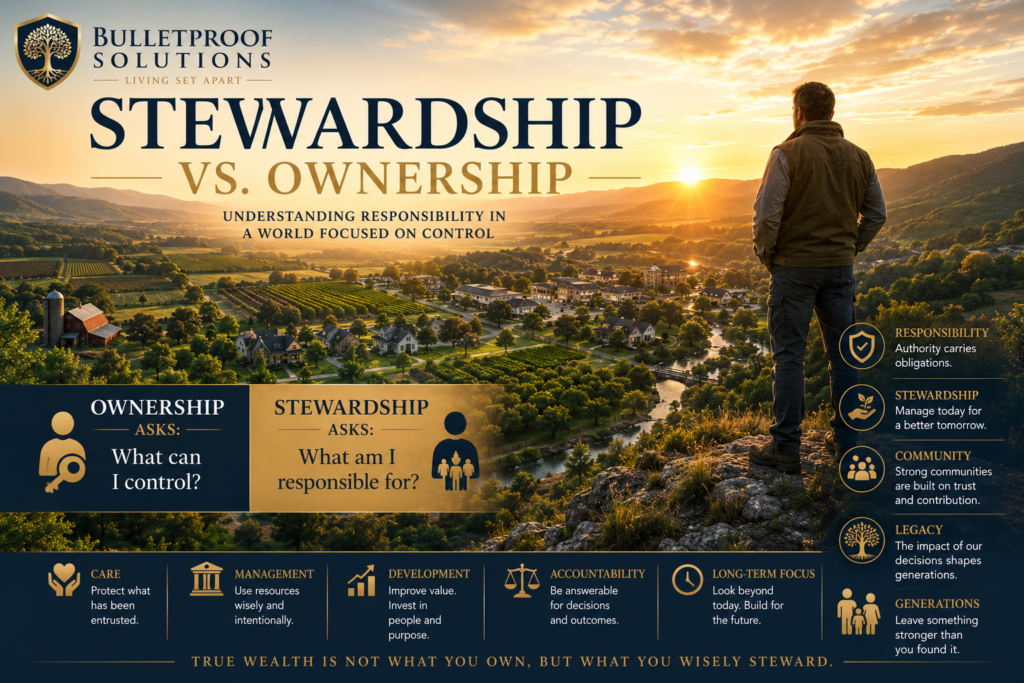
While ownership focuses primarily on what a person controls, stewardship focuses on how a person manages what has been entrusted to them.
The distinction may appear subtle at first.
In reality, it changes everything.
It changes how we view property.
It changes how we view relationships.
It changes how we view leadership.
It changes how we view community.
Most importantly, it changes how we view responsibility.
Understanding the difference between ownership and stewardship may be one of the most important lessons a person can learn.
Ownership is generally understood as the right to possess, control, use, transfer, or dispose of something.
When people purchase a home, they often describe themselves as owners.
When someone buys a vehicle, they become the owner.
When a business acquires equipment, it becomes the owner of those assets.
Ownership carries significant benefits.
It creates certainty.
It provides control.
It encourages investment.
It allows individuals to make decisions regarding resources under their authority.
For these reasons, ownership has become one of the cornerstones of modern economic systems.
However, ownership by itself does not answer an important question.
Just because someone can do something, should they?
Ownership defines authority.
Stewardship defines responsibility.
A steward is a person entrusted with responsibility.
Historically, stewards managed households, estates, resources, and affairs on behalf of others.
Their role was not merely to possess.
Their role was to preserve, improve, protect, and administer.
A steward recognizes that authority carries obligations.
Control carries accountability.
Benefits carry duties.
This mindset transforms how a person views resources.
Instead of asking:
“What belongs to me?”
The steward asks:
“What am I responsible for?”
This shift may seem small.
Its implications are enormous.
Imagine two farmers.
Both receive identical pieces of land.
The first farmer views the land strictly through the lens of ownership.
The second farmer views the land through the lens of stewardship.
The first asks:
“What can I take from this land today?”
The second asks:
“How do I leave this land healthier for tomorrow?”
The difference in mindset affects every decision.
One focuses primarily on extraction.
The other focuses on sustainability.
Over time, stewardship tends to produce stronger long-term outcomes because it requires consideration of future consequences.
Stewards understand that short-term decisions often create long-term effects.
They recognize that resources should not merely be consumed.
They should be managed.
The principle extends far beyond property.
Relationships require stewardship.
Trust requires stewardship.
Families require stewardship.
Friendships require stewardship.
Communities require stewardship.
A relationship cannot thrive when one party focuses solely upon what they can receive.
Healthy relationships develop when people accept responsibility for what they contribute.
The strongest marriages are built upon stewardship.
The strongest friendships are built upon stewardship.
The strongest communities are built upon stewardship.
Every healthy relationship contains an element of care, responsibility, and accountability.
These are the hallmarks of stewardship.
Leadership is one of the clearest examples of stewardship in action.
Many people view leadership through the lens of authority.
History suggests a different perspective.
The most effective leaders rarely focus on power.
They focus on responsibility.
Great leaders understand that their role is not to dominate.
Their role is to serve the mission, the organization, the community, or the people entrusted to their care.
Leadership therefore is not primarily about privileges.
It is about obligations.
The greater the authority, the greater the responsibility.
This principle appears consistently throughout successful organizations.
Leaders who embrace stewardship build trust.
Leaders who pursue personal advantage often destroy it.
People willingly follow those they trust.
Trust grows where stewardship is visible.
Governance exists wherever decisions affect groups of people.
Families require governance.
Businesses require governance.
Communities require governance.
Organizations require governance.
The question is not whether governance exists.
The question is whether governance operates according to stewardship or control.
Governance rooted in stewardship seeks the long-term health of the people and resources under its care.
Governance rooted solely in control often prioritizes compliance over responsibility.
The difference becomes apparent over time.
Stewardship encourages participation.
Control often encourages dependence.
Stewardship develops capable contributors.
Control frequently develops passive followers.
The healthiest systems are those that balance authority with accountability and responsibility.
Knowledge itself is a resource.
Like any resource, it can be used wisely or carelessly.
People often pursue knowledge for personal advantage.
A steward recognizes another purpose.
Knowledge creates responsibility.
The more a person understands, the greater their ability to contribute.
This principle applies to teachers, mentors, leaders, administrators, and professionals.
Knowledge is not merely something to accumulate.
It is something to steward.
The purpose of knowledge is not simply information.
The purpose of knowledge is application.
Wisdom emerges when knowledge is used responsibly.
Perhaps the greatest difference between ownership and stewardship is the concept of legacy.
Owners often focus on the present.
Stewards think about future generations.
They ask questions such as:
What will remain after I am gone?
What impact will my decisions have on others?
How can today’s efforts benefit tomorrow’s opportunities?
Legacy thinking encourages long-term planning.
It encourages sustainability.
It encourages responsibility.
It encourages investment in outcomes that may not produce immediate rewards.
Stewards understand that the future is shaped by present decisions.
Modern society often rewards short-term thinking.
Quarterly results.
Immediate gratification.
Instant feedback.
Short-term gains.
Stewardship offers a different perspective.
It encourages patience.
It encourages responsibility.
It encourages sustainability.
It encourages investment in people, relationships, resources, and communities.
These principles remain relevant regardless of profession, background, or circumstances.
Whether someone manages a family, a business, a ministry, a trust estate, or simply their own life, stewardship provides a framework for responsible decision-making.
Ownership answers the question:
“What can I control?”
Stewardship answers the question:
“What am I responsible for?”
Both concepts matter.
But stewardship introduces something ownership alone cannot provide.
Purpose.
Responsibility.
Accountability.
Legacy.
The steward recognizes that authority and responsibility must remain connected.
They understand that resources should be preserved, improved, and managed wisely.
They seek long-term outcomes rather than merely short-term gains.
Most importantly, they recognize that true success is not measured solely by what is accumulated.
It is measured by what is responsibly managed and passed forward.
In a world increasingly focused on control, stewardship offers a different path.
A path grounded in responsibility.
A path grounded in service.
A path grounded in legacy.
And ultimately, a path that builds stronger families, stronger communities, and a stronger future.
Stewardship is one of the foundational principles behind trust relationships, administration, governance, leadership, and community building.
Explore the educational resources, discussions, and training available through the Exploring Foundations Membership at BulletProof Solutions and continue your journey toward intentional stewardship and responsible living.